



You pass the real estate exam by finishing your state-approved pre-licensing education first, learning the national and state material as two separate jobs, practicing under timed conditions and walking into the test center with a plan for the clock. Most states require a score of 70% to 75% on each portion. Official figures from Florida and New York show that roughly half of first-time candidates pass, so preparation matters, and it is entirely doable.
This guide covers the scores states require, what the questions look like, where candidates lose points, a week-by-week study approach and what to do if you need a second attempt.
Key Takeaways
- Passing scores are set by each state, and most fall between 70% and 75% on each exam portion. Always confirm the number in your own state’s candidate handbook.
- Official first-time pass rates sit near 50%: Florida reported 48% for sales associates in its November 2025 summary, and New York reported 52% for 2024.
- State-specific law and math are where well-prepared candidates most often lose points, so give both dedicated study blocks.
- There is no penalty for guessing on typical multiple-choice licensing exams, so answer every question.
- If you fail, most states let you retake only the portion you missed, within a set window.
Table of Contents
- What Score Do You Need to Pass?
- What the Exam Covers and How Questions Look
- How Many People Pass on the First Try?
- Where Candidates Lose Points
- A Study Plan That Works
- Test-Day Tactics
- Perspective: Why the Course Behind the Exam Matters
- Prepare in Florida With Self-Paced Courses
- If You Do Not Pass the First Time
- State-Specific Preparation Guides
- FAQ
- Sources
What Score Do You Need to Pass?
The short answer: usually 70% to 75% on each portion, but the exact number, the number of questions and the time limit depend on your state. Most licensing exams have two parts, a national portion on general real estate principles and a state portion on local law. You must pass both.
A few official examples show how much this varies:
| State | Exam portion | Requirement |
|---|---|---|
| California | Salesperson | At least 70% correct, per the Department of Real Estate |
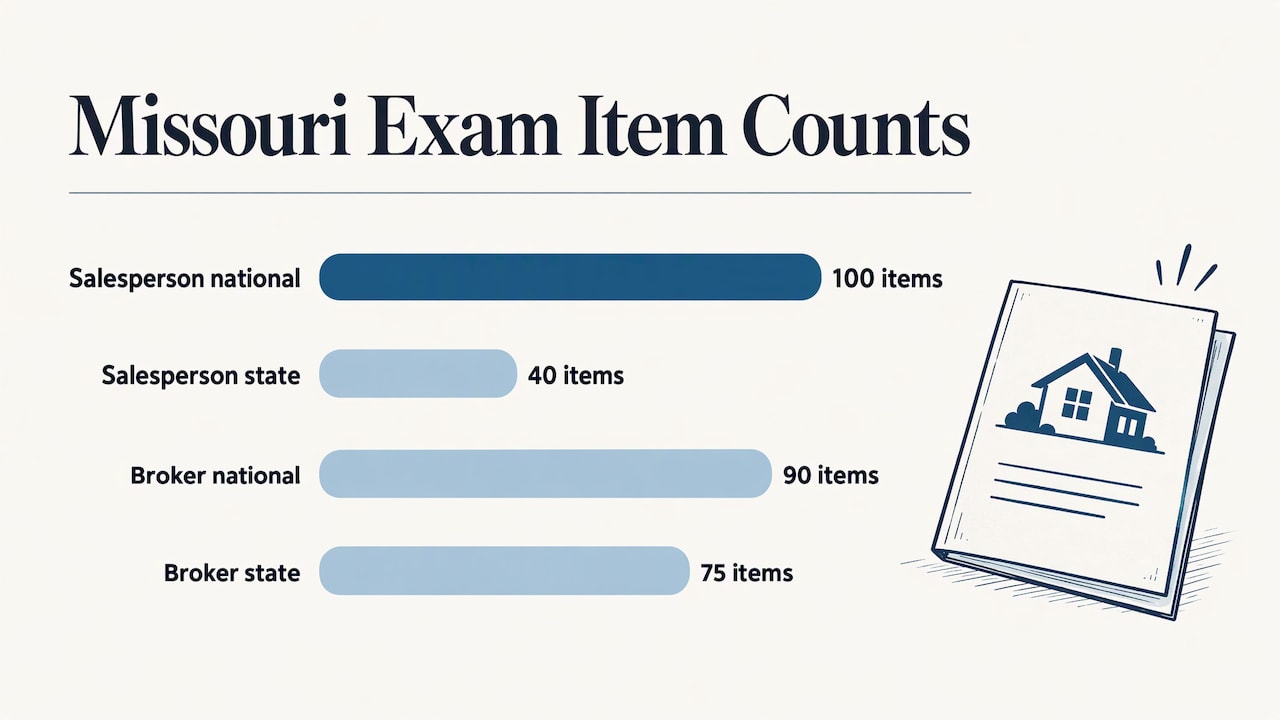
| Missouri | Salesperson national | 100 items, 70% to pass, 150 minutes |
| Missouri | Salesperson state | 40 items, 75% to pass, 120 minutes |
| Missouri | Broker national | 90 items, 75% to pass, 150 minutes |
| Missouri | Broker state | 75 items, 75% to pass, 120 minutes |
| Pennsylvania | Salesperson and broker, national and state | Minimum 75% |
| Texas | Salesperson | 56 correct on the national portion, 28 correct on the state portion |
| Texas | Broker | 60 correct on the national portion, 38 correct on the state portion |
The Missouri figures come from the Missouri Real Estate Commission handbook. The Pennsylvania minimum comes from the Pennsylvania candidate handbook, which also explains that the exam uses multiple forms equated for difficulty and converts raw scores to a scaled score from 0 to 100. The Texas figures come from the Texas candidate handbook.
Notice that Texas states the requirement as a count of correct answers rather than a percentage. Do not assume your state works like another one. Download your state’s candidate handbook and write the exact numbers at the top of your study plan.
What the Exam Covers and How Questions Look
Expect broad coverage. The California Department of Real Estate lists salesperson exam topics that include property ownership and land use controls and regulations, laws of agency and fiduciary duties, property valuation and financial analysis, financing, transfer of property, practice of real estate and disclosures, and contracts. The department also notes that any single test samples the field and does not promise to touch every listed area, as described on its salesperson exam content page. In practice that means you cannot study only the topics you expect.
Most questions are multiple choice with one best answer. Some broker exams add scenario-based items. The Missouri handbook explains that national broker scenario questions can offer more than four options, with only one best answer, and that options may be weighted at zero, one or two points depending on completeness and accuracy.
The national portion tests principles that apply everywhere: agency, contracts, finance, valuation and fair housing. The state portion tests the license law, rules and practices of the state where you want to work. They feel like two different exams, and you should study them that way.
How Many People Pass on the First Try?
About half. The best evidence is official data from the states themselves:
- Florida: the Department of Business and Professional Regulation’s exam performance summary for November 2025 reports a 48% first-time pass rate for sales associates (974 of 2,027) and 45% for brokers.
- Repeat takers: in the same Florida summary, sales associate repeaters passed at 34% (645 of 1,918), and the overall rate was 41%. Repeating the exam without changing how you prepare does not improve your odds.
- New York: the Department of State’s Real Estate Board meeting summary reports that 19,558 people took the salesperson exam in 2024, with a 52% pass rate. For brokers, 1,346 people took it, also with a 52% pass rate.
Two cautions when you read pass-rate numbers. First, rates for first-time takers, repeat takers and combined groups are different statistics, so compare like with like. Second, you cannot rank states from the hardest to the easiest with confidence, because license type, exam portion, reporting period and who is counted all differ. A pass rate says how a group performed, not how hard your exam will be for you. The useful reading is simple: a first attempt is a real test, and the candidates who treat it as one tend to do better.
Where Candidates Lose Points
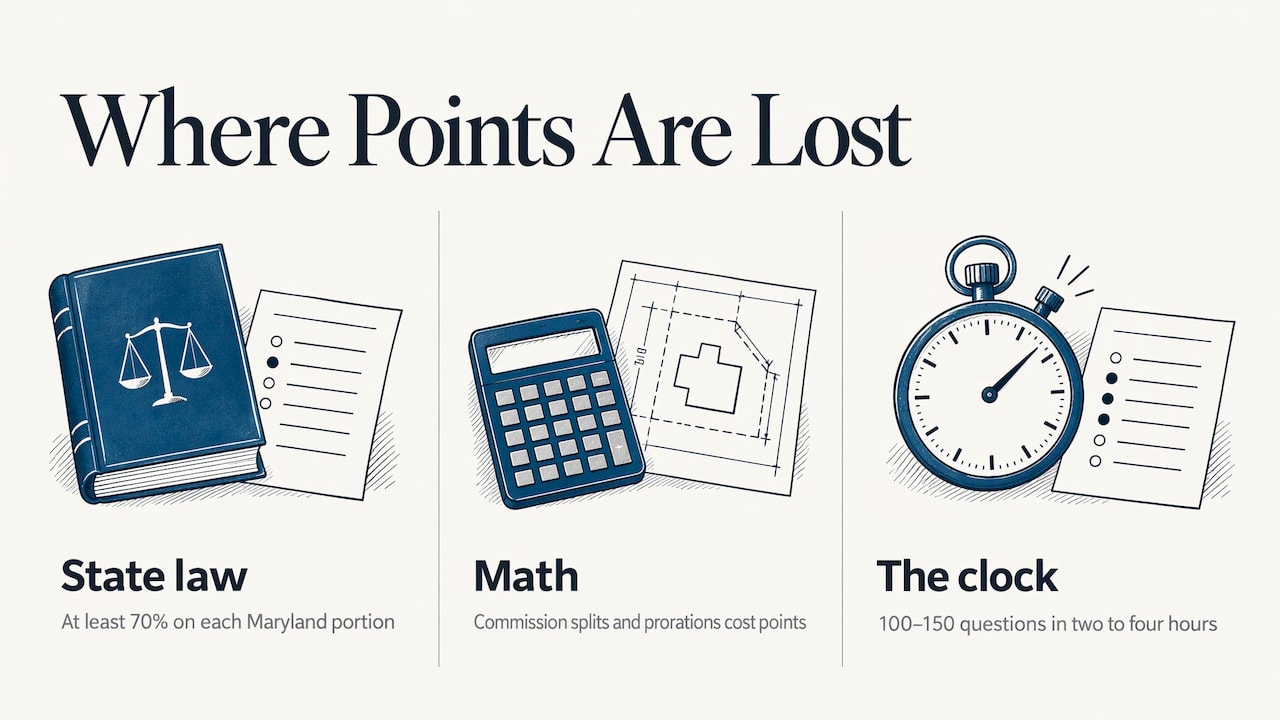
Three areas come up again and again.
State-specific law. A real estate brokerage’s analysis of the licensing process says state law is where well-prepared candidates lose the most points, because it is detailed, differs from general principles and leaves little room for error on a short portion. Its Maryland example pairs 80 national questions in 90 minutes with 30 state questions in 30 minutes, and requires at least 70% on each.
Math. Commission splits, prorations, loan-to-value ratios, area calculations and closing-cost adjustments cost points when you rush. The Miami Herald reports that math and state-specific laws trip up many test-takers.
The clock. The same article notes that exams typically present 100 to 150 questions in two to four hours, and that time pressure makes it harder to stay calm and focused. Candidates who know the material still lose points by spending four minutes on one calculation.
Notice that none of these is a talent problem. Each is a preparation problem, and each has a fix.
A Study Plan That Works
The Missouri handbook gives sound basic advice: plan your study schedule well in advance, use techniques such as reading or audiovisual aids, study in a quiet place and concentrate on carefully chosen textbooks. Here is how to turn that into a schedule.
- Start with your pre-licensing course. Your state-approved course is the foundation for the exam. Finish it with intent, not just to log the hours. Take notes on vocabulary, deadlines and numbers.
- Split your time by portion. Give the national and state portions separate study blocks. If your state exam is shorter, do not assume it is easier. The state portion is where precision matters.
- Make a math sheet. Write each formula once, work three examples per formula, then redo them without looking. Repeat weekly.
- Practice in timed sets. Do 25 questions in the time your exam would allow, then review every miss. Write why the right answer is right, not just what it is.
- Take full-length practice exams. Do at least two under real conditions: one timed sitting, no phone, no notes. This is where you learn your pacing.
- Track errors by topic. After each set, tally misses under headings such as agency, contracts, finance and state law. Spend your next study block on the weakest heading.
- Taper before test day. In the last two days, review your math sheet and error log, not new material. Sleep matters more than another chapter.
The Missouri handbook also advises answering every timed multiple-choice question and guessing when you are unsure, because there is no penalty for guessing. Check that your exam follows the same rule, then use it: eliminate two options, pick the best remaining one and move on.
Test-Day Tactics
- Read the last sentence first. Know what the question asks before you absorb the scenario.
- Watch absolute words. Options with “always” or “never” are rarely the best answer in a field full of exceptions.
- Flag and move. If a calculation is taking more than a couple of minutes, mark it, answer the rest and come back.
- Do the math twice. On a scratch sheet, redo each calculation by a different route when time allows.
- Choose the best answer. Several options may be partly true. The exam asks for the one that fits the facts given.
- Bring what your handbook requires. Your candidate handbook lists acceptable identification and what you may carry into the room. Read it a week early, not the morning of the exam.
Perspective: Why the Course Behind the Exam Matters
We see the exam as a milestone, not a finish line. The score on test day reflects the weeks of preparation before it, and that preparation starts with the course you choose.
That is why we built our state-approved courses to be self-paced and available in English, Spanish and Portuguese. Agents who serve diverse communities often learn best in the language they think in. Read-along narration lets you follow the text while you listen, which helps on long study days and for anyone who retains more by ear.
The exam is also only the first requirement. After you pass, you will need post-licensing and continuing education, and we report completions electronically so the paperwork does not become a second job. Every course carries a 30-day money-back guarantee, because we want you to commit to your education without hesitation.
Passing is the start of your career. Choose education that supports the whole path, from the first lesson to your first client.
the author
Prepare in Florida With Self-Paced Courses
If you are pursuing a Florida license, our state-approved pre-licensing courses are designed to give you the structured foundation the exam expects. The Florida Sales Associate 63-hour pre-licensing course is $99, and the Florida Broker 72-hour pre-licensing course is $159. Both are self-paced, include read-along narration and come with our 30-day money-back guarantee.
See all options on our Florida courses page, including post-licensing and continuing education for after you are licensed. If you are comparing the total cost of getting licensed, our guide to real estate license cost breaks down what you will pay in the U.S.
If You Do Not Pass the First Time
A failed attempt is a data point. Most states let you retake only the portion you missed, and many set a window.
- Texas: the candidate handbook says candidates who fail must retake only the failed portion, within one year of the date the application was filed with TREC.
- Oklahoma: the state real estate handbook allows unlimited attempts within one year of the approved application, and a candidate who passes one part needs to retake only the part failed.
Because repeat takers in Florida passed at a lower rate than first-time takers, change your approach before you rebook. Pennsylvania’s handbook says only failing candidates receive numeric scores, which makes that report useful. Look at the performance breakdown, find the weakest content area and rebuild your plan around it. Then do timed practice sets on that area until your accuracy holds.
Also confirm fees and waiting periods with your state commission or its testing vendor before scheduling, since both can change.
State-Specific Preparation Guides
The exam you take is the exam your state writes, so use state-level detail. If you are heading toward a license in a neighboring state, our guides to the Virginia real estate exam and the Georgia state real estate exam explain format, fees and preparation. For Florida, start with our pre-licensing courses.
FAQ
What percentage do you need to pass the real estate exam?
Most states require 70% to 75% on each portion. California requires at least 70% for salespersons, Pennsylvania sets a 75% minimum, and Missouri uses 70% or 75% depending on the portion. Texas states the requirement as a number of correct answers. Check your state’s candidate handbook for the exact standard.
What is the hardest part of the real estate exam?
State-specific law and math are the most common trouble spots. State law is detailed and leaves little room for error, while math questions such as commission splits take time under pressure. Give both their own study blocks and practice them under a timer.
What percentage of people pass on the first try?
Official numbers sit near half. Florida’s November 2025 summary shows 48% of first-time sales associate candidates and 45% of broker candidates passing. New York reported a 52% pass rate for both salesperson and broker exams in 2024. Rates differ by state and reporting period, so compare carefully.
Can you retake the exam if you fail?
Yes, in most states. Texas and Oklahoma let you retake only the portion you failed, within one year of your application. Your state’s rules on fees, waiting periods and attempt limits may differ, so confirm them with your commission before booking.
Sources
- Salesperson Examination Content, California Department of Real Estate
- Missouri Real Estate Commission handbook
- Pennsylvania Real Estate Candidate Handbook
- Texas Real Estate Candidate Handbook
- Florida DBPR Exam Performance Summary, November 2025
- New York Department of State Real Estate Board meeting summary
- Oklahoma Real Estate Handbook
- How Hard Is the Real Estate Exam, Miami Herald
- How Hard Is It to Get Your Real Estate License Today, Speicher Group
Recommended
- Virginia Real Estate Exam: Format, Fees and How to Pass
- Georgia State Real Estate Exam: Format, Fees, and How to Prepare
- Real Estate Finance Course: How to Choose the Right One
- Real Estate License Cost: What You’ll Pay in the U.S.
This article is provided for general information and is not a professional advice.