


A self-paced real estate course lets you study on your own schedule, with no fixed class times, and still earn credit your state accepts. The right one depends on where you are in your career: pre-licensing to get licensed, post-licensing after your first license, continuing education (CE) to renew, or professional development to win more clients. Our Florida courses are state-approved, run in English, Spanish and Portuguese, include read-along narration, report completions electronically, and carry a 30-day money-back guarantee. The rest of this guide shows how self-paced learning is regulated, how to match a course to your stage, and what to check before you pay.
Key Takeaways
- Self-paced (asynchronous) courses are a recognized delivery format, but regulators set rules for timing, quizzes, identity checks and certificates, so approval matters more than format.
- Match the course to your stage: pre-licensing to get licensed, post-licensing after you hold a license, CE to renew, professional development to grow your business.
- Hours, exams and renewal rules differ by state, so confirm what your own commission requires before you enroll.
- Check the provider’s approval, how completions are reported, language and accessibility options, and the refund terms.
- Our Florida courses start at $23.95 for the 14-hour CE course and come with a 30-day money-back guarantee.
Table of Contents
- What “self-paced” actually means in real estate education
- How regulators keep self-paced courses honest
- Which type of course fits your stage
- What to check before you enroll
- How to finish a self-paced course
- Our perspective on self-paced learning
- Start with the course that matches your stage
- FAQ
- Sources
What “self-paced” actually means in real estate education
Self-paced means you decide when to study. You log in, work through modules, and stop and restart as your calendar allows. Regulators call this asynchronous or distance learning, as opposed to a live classroom or a live webinar where an instructor teaches at a set time.
Arizona’s real estate department gives a clear definition in its distance learning policy statement, revised March 6, 2025. It describes online education that may be synchronous or asynchronous, including self-paced or prerecorded lessons a student reaches over the internet at their own pace. It also defines a credit hour as 50 minutes of instruction, with modules running between 12.5 and 50 minutes.
North Carolina’s commission takes the same view. Its course approval guidelines classify asynchronous distance instruction as a self-paced delivery format and set minimum instruction times for each course category.
Two things follow. First, self-paced does not mean unregulated: the course still has to meet the state’s content and timing standards. Second, “at your own pace” does not mean “without a clock”. Most states count instruction time, and the platform has to track it.
How regulators keep self-paced courses honest
If you have only taken casual online classes, the structure of an approved real estate course can surprise you. Rules vary by state, but the same themes recur.
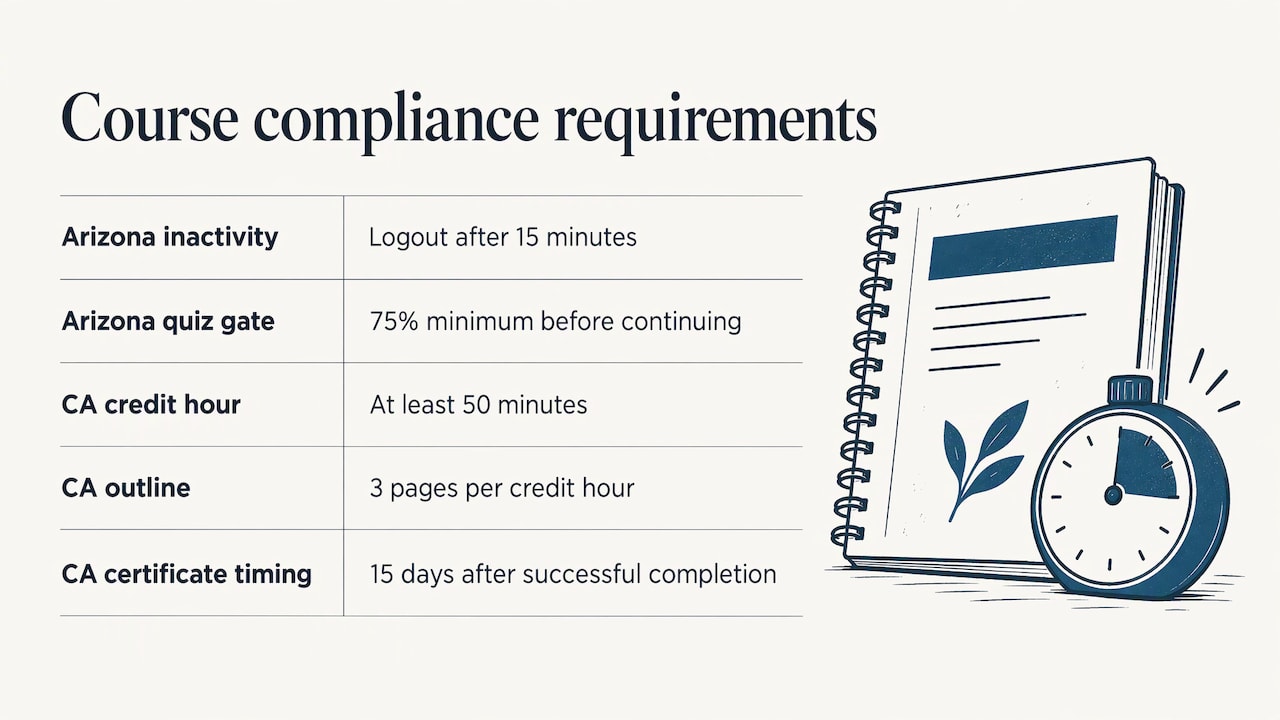
Time tracking and identity. Arizona requires platforms to authenticate students beyond a simple username and password, log students out after 15 minutes of inactivity, track the time spent on each unit, and stop the course clock when you are not interacting with the lesson, according to the same policy statement.
Quizzes that gate progress. The same Arizona policy requires a minimum 75% quiz score before a student may continue, and pre-licensing distance courses end with a comprehensive exam on a lockdown browser. It also says modules should be timed so students cannot move on before the minimum time has passed.
Content and certificates. California’s Course Provider Handbook (Rev 1/26) requires CE courses to deliver at least one clock hour of instruction per credit hour, with each hour no less than 50 minutes. It also requires a written narrative outline of at least 3 pages per credit hour and a completion certificate within 15 days of successful completion that carries the DRE course approval number.
Content that stays current. Virginia’s Real Estate Board can find a course deficient for outdated material, inaccurate or misleading information, or insufficient content. A current, approved course protects your credit hours and your license.
What this means for you: study at your pace, but expect quizzes, timers and a final exam. Plan your hours around those checkpoints, not around speed-reading.
Which type of course fits your stage
The best self-paced course is the one that matches the requirement you are trying to meet. Here is how the four categories line up.
| Your situation | Course type | What it does | Our Florida option and price |
|---|---|---|---|
| Not yet licensed | Pre-licensing | Meets the education requirement to sit for the state exam | Sales Associate 63 Hour, $99; Broker 72 Hour, $159 |
| Recently licensed | Post-licensing | Meets the first-renewal education requirement | Sales Associate 45 Hour, $79; Broker 60 Hour, $149 |
| Licensed, renewing | Continuing education | Keeps your license active | Florida 14h Continuing Education, $23.95 |
| Licensed, growing | Professional development | Builds business skills, not a license requirement | Most courses $29; International Real Estate Course, $49 |
Prices are as published on our site in 2026 and are one-time payments.
New agents: pre-licensing
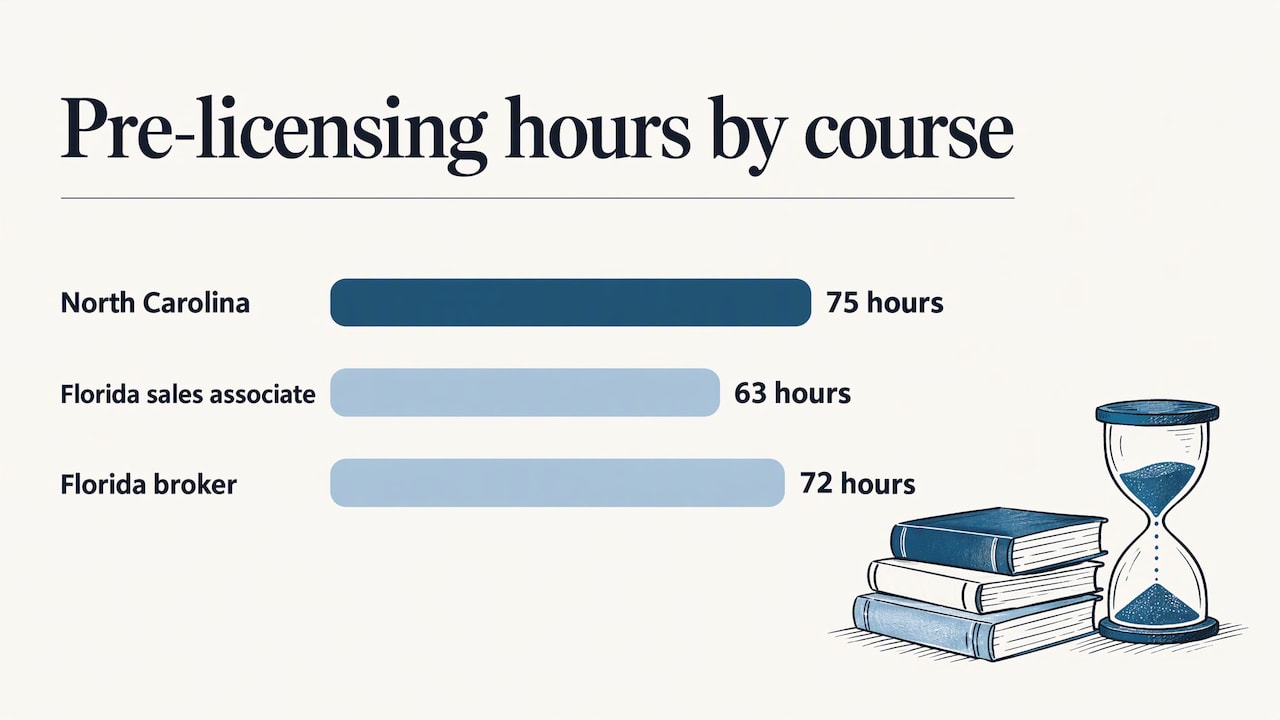
Pre-licensing is the education you complete before you can take the state exam. The required hours differ widely: North Carolina’s guidelines set prelicensing at 75 hours, while Florida’s sales associate course on our site is 63 hours and the broker course is 72 hours.
Self-paced study suits this stage because most people entering real estate are changing careers and working around another job. You can do an hour before work and three on a Sunday. Our Florida pre-licensing courses are built for exactly that, and you can enroll in the Florida Sales Associate 63 Hour course for $99. If you plan to go straight to the broker level, our guide to the 72-hour broker pre-license course explains what it covers. When you are ready to plan for the exam itself, read our Florida real estate state exam guide. Outside Florida, see our pre-licensing courses overview.
Newly licensed agents: post-licensing
In many states, your first license comes with an additional education requirement to complete before your first renewal. North Carolina, for example, sets postlicensing at 30 hours per course. In Florida, we offer a 45-hour course for sales associates ($79) and a 60-hour course for brokers ($149).
The deadline is the part new agents miss. Check your own state record for the date, then plan backward. Our guide on post-licensing hours, deadlines and how to choose covers the planning, and the Florida post-licensing courses page lists the options. For other states, see our post-licensing courses online.
Licensed agents: continuing education
CE keeps an active license in good standing, and the numbers vary a lot by state. North Carolina’s statute requires 8 hours of continuing education per year in subjects the Commission deems appropriate. Delaware requires 21 CE hours in seven 3-hour modules each renewal period, and the first module covers agency and fair housing.
Topics can also be prescribed. Ohio, for instance, approves CE credit only for listed subject areas such as ethics, legislative issues, property management, land use and zoning, and technology and internet marketing. Always confirm that a course counts toward your category of credit, not just toward total hours.
In Florida, our 14-hour CE course costs $23.95. See the Florida 14-hour real estate CE course for details, or read how CE credits for realtors work.
Agents building a business: professional development
These courses are not a licensing requirement, so no regulator sets their hours. You choose them for the skills. Our catalog includes courses on building a personal brand, lead conversion, the modern listing presentation, AI, photography and video basics, technology and productivity, social media and content marketing, open houses, and international real estate. Most are $29, and the International Real Estate Course is $49. Browse them on our professional development page.
If you want a starting point, our personal branding course and AI for real estate professionals course fit agents who want visible, practical changes to how they win clients. Pair them with the right tools for real estate agents and you will have a workflow, not just ideas.
What to check before you enroll
Use this list to compare any self-paced course.
- State approval for your license type. The course must be approved by your state’s commission for the credit you need. Florida’s distance education checklist states that only licensed real estate schools may offer Florida Law Update courses, and that specialty courses are approved for a maximum of 8 hours. In Florida, confirm the school’s license before buying.
- The right credit category. Total hours are not enough if your state prescribes topics or a mandatory module.
- How completion is reported. Some states expect the provider to report your completion; all expect a certificate. We report completions electronically to state authorities, so you do not have to chase paperwork after you finish.
- Language and accessibility. If you serve clients in more than one language, you may prefer to study in the one you think in. Our courses are available in English, Spanish and Portuguese, with read-along narration so you can listen while you follow the text. Our Florida real estate course in Spanish guide and our Portuguese pre-licensing page cover those paths.
- Cost and access terms. Look for the total price, whether it is one payment, and the refund policy. Our prices are one-time payments made at enrollment, and every course carries a 30-day money-back guarantee.
- Current rules. Requirements change. A New Jersey bill (S4219), described in a May 18, 2026 committee statement, would raise biennial CE from up to 16 to 18 hours and require online self-paced courses to include an exam with a minimum 75% score. It is a proposal, so check your own state’s current rules before each renewal cycle.
How to finish a self-paced course
Flexible schedules reward a plan. A few habits help.
- Set a weekly hours target. Divide the course hours by the weeks until your deadline. A 63-hour course over nine weeks is seven hours a week.
- Study in blocks that match the modules. Modules run roughly 12.5 to 50 minutes under Arizona’s policy, so a 45-minute session usually lets you finish a unit rather than abandon one midway.
- Do not rush the timers. Where a platform holds you until minimum time has passed, speed does not help. Spend the time on the quiz material.
- Schedule the exam. For pre-licensing, book your state exam date while the material is fresh.
- Check your record. After you finish, confirm the state shows your completion. Check your state record before any deadline.
Our perspective on self-paced learning
We built our courses around the way working agents actually learn. Most of the people we serve are balancing a job, a family or an active pipeline, so a fixed class time is often the thing that keeps them from finishing.
Self-paced study works when the course is approved, the material is current, and nothing about the process creates extra work for you. That is why we focus on three things: courses in English, Spanish and Portuguese, because agents serve diverse clients and learn best in their strongest language; read-along narration, so the content is accessible; and electronic reporting of completions to state authorities, so finishing the course is the last step you need to take.
The courses matter for compliance, but they also matter for your business. The skills in lead conversion, listing presentations and personal branding are what help agents attract and keep clients. A 30-day money-back guarantee on every course means you can start with confidence.
the author
Start with the course that matches your stage
If you are in Florida, you can enroll today in the course that matches your stage: the Sales Associate 63 Hour Pre Licensing course is $99, the Broker 72 Hour is $159, the Sales Associate 45 Hour Post Licensing is $79, the Broker 60 Hour Post Licensing is $149, and the 14-hour CE course is $23.95. See all of them on our Florida courses page, and every course is covered by our 30-day money-back guarantee.
For business skills, our professional development courses are $29 each, and you can see the full list on the professional development page. Outside Florida, start from our real estate courses online page.
FAQ
Are self-paced real estate courses accepted for state credit?
Yes, when the course is approved by your state for the credit you need. Regulators such as those in Arizona and North Carolina explicitly recognize asynchronous, self-paced delivery. Always confirm the course’s approval for your license type and credit category.
How long does a self-paced real estate course take?
It depends on the required hours, which vary by state and course type. Examples include 75 hours for prelicensing in North Carolina and 21 CE hours per renewal period in Delaware. Our Florida courses range from 14 hours of CE to 72 hours of broker pre-licensing, and you set your own pace within your deadline.
Is a self-paced course easier than a classroom course?
It is more flexible, not less rigorous. Approved courses still track your time, use quizzes, and in many states end with a proctored or lockdown exam. You gain control over when you study, not a shortcut around the material.
Do self-paced courses report my completion to the state?
That depends on the provider and the state. Our courses report completions electronically to state authorities. You should still check your state record afterward to confirm it shows your credit.
What if the course is not right for me?
Every course we sell comes with a 30-day money-back guarantee, so you can enroll and begin your studies without taking on the full risk.
Sources
- Arizona Distance Learning policy statement 2025.01
- North Carolina Real Estate Education Course Approval Guidelines
- California DRE Course Provider Handbook (Rev 1/26)
- Virginia Real Estate Board CE/Post License course form
- North Carolina General Statutes Chapter 93A, Article 3
- Delaware CE Module Course Contents
- Ohio Division of Real Estate asynchronous CE application instructions
- Florida FREC Real Estate Distance Education Checklist
- New Jersey S4219 committee statement, May 18, 2026
Recommended
- Real Estate Law Course: What It Covers and How to Choose
- Real Estate Finance Course: How to Choose the Right One
- Real Estate License Schools in Florida: How to Choose One
- Real Estate Post-Licensing Courses: Hours, Deadlines, How to Choose
This article is provided for general information and is not a professional advice.