



Getting a real estate license in the United States typically costs somewhere between $1,560 and $4,115 once you add up school, exams, state fees and startup expenses, not counting brokerage fees, according to a 2022 Inman estimate. The number moves because every state sets its own rules. The part you control most is the pre-licensing course, and that is where careful shopping pays off.
This guide breaks the total into its pieces, shows what several states charge, and covers the costs that arrive after you pass the exam.
- Budget for five buckets: pre-licensing education, exam fees, state application and license fees, fingerprints and background check, and first-year business costs.
- State fees are set by each state. California’s salesperson exam and license payments total $450, while Kansas charges a salesperson $210 to the Commission, and the education you pay for separately.
- Exam retakes, late renewals and inactive-license renewals are the most avoidable surprises.
- Your state commission’s website is the only reliable source for current fees. Verify there before you pay anyone.
- Our Florida pre-licensing courses start at $79 for the 45-hour Sales Associate course and come with a 30-day money-back guarantee.
Table of Contents
- The short answer: what is the total?
- Why the cost varies by state
- The five cost buckets, one by one
- What states actually charge: a side-by-side
- Worked example: a realistic first-year budget
- Costs after you pass
- Where the money is easy to waste
- How to confirm your state’s current fees
- Our perspective: treat the course as the part you control
- Our courses and what they cost
- Business skills: a small cost that can pay back
- FAQ
- Sources
The short answer: what is the total?
No single national price exists. Inman puts real estate school at $200 to $1,000 and estimates the full path at $1,560 to $4,115 before brokerage fees. That range is wide on purpose: it includes education, exams, licensing fees and early business costs.
A more useful way to think about it is in two layers.
- Required to get licensed: education, exam, application, license issuance, fingerprints.
- Required to work: a sponsoring brokerage, association and MLS dues, insurance, marketing, and the education that keeps the license active.
The first layer is often a few hundred dollars. The second is where the larger numbers come from.
Why the cost varies by state
A Connecticut Office of Legislative Research 50-state comparison shows that initial and renewal fees vary widely among jurisdictions. Most require pre-licensing education, an exam, and continuing education for renewal, but the hours, fee structures, background checks, reciprocity terms and license periods are not uniform. That report is from 2014, so use it to understand the pattern, not to read off today’s fees.
Three things drive most of the difference:
- Required education hours. More hours usually means a higher course price.
- State fee schedules. Some states bundle fees, others split them into application, background, license and recovery-fund charges.
- Exam vendor and fingerprint provider. These are usually private companies, so their prices are separate from the state’s.
The five cost buckets, one by one
1. Pre-licensing education
This is the largest line item you choose yourself. Schools charge anywhere from about $200 to $1,000, per the Inman figures above. Price alone is a poor guide. Check that the course is approved by your state, how long you have to finish it, whether access is self-paced, and whether the school reports your completion to the state for you.
2. Exam fees
Inman estimates $150 to $400 to apply for and take both the state and national portions of the exam. HousingWire reports salesperson exam fees of roughly $40 to $200, averaging around $60, with exam-prep courses commonly running $100 to $1,000. Exam prep is optional. Your pre-licensing course may already cover what you need.
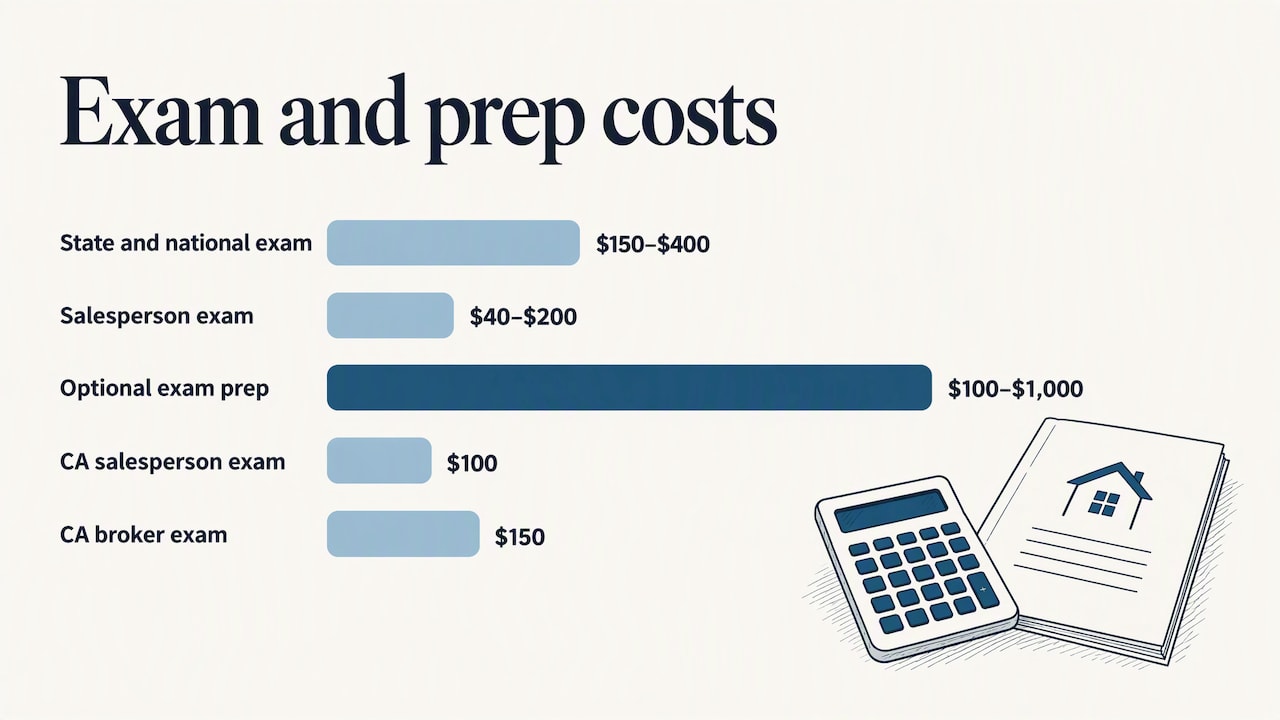
If you fail, you generally pay again. California lists salesperson examination and re-examination at $100 and broker at $150, plus rescheduling fees of $40 for salespersons and $45 for brokers.
3. State application and license fees
These go to your state regulator. The structure differs in every state, as the examples below show.
4. Fingerprints and background check
These are usually collected by a vendor, not the state. In North Carolina, a criminal-record report likely costs less than $50 if you have lived only in that state for the past seven years. Charges rise for each additional state or country, each name or alias, and a required federal report. If you have moved often, expect more.
5. Business startup costs
Brokerage fees, association dues, MLS access, lockboxes, business cards and insurance are not licensing fees, but you will pay them early. The Kansas Real Estate Commission is explicit that brokerage costs and board or association dues are outside what it collects. Ask your prospective brokerage what it charges before you choose one.
What states actually charge: a side-by-side
The table shows only what each regulator itself lists. It excludes education, and in some cases fingerprints, so do not add the rows across states.
| State | What the regulator lists for a salesperson | Source |
|---|---|---|
| California | $100 exam plus $350 license ($450 combined); $49 fingerprint processing fee separate | California DRE |
| Kansas | $210 to the Commission: $15 application, $70 background fee, $125 license | Kansas Real Estate Commission |
| Nevada | $140 license fee; 2% convenience fee on credit-card payments | Nevada Real Estate Division |
| Oklahoma | $35 application, $60 background-check processing, $75 exam (with booking discount); $215 issuance fee for a sales associate | Oklahoma Real Estate Commission |
| Pennsylvania | $97 initial fee ($72 licensure plus $25 application); 75 hours of basic education required | Pennsylvania Department of State |
| Texas | $150 original application plus $10 Real Estate Recovery Trust Account fee | Texas Administrative Code |
A few details worth noticing:
- Oklahoma’s fees stack. Application, background check, exam and post-exam issuance are separate charges, and issuance differs by license level: $100 for a provisional sales associate, $215 for a sales associate, $260 for a broker associate and $295 for a broker.
- Broker licenses cost more. California’s broker exam and license payment is $600 ($150 plus $450), and Kansas charges a broker $295 against $210 for a salesperson.
- Fee schedules change. Treat every figure here as a snapshot and confirm on the regulator’s page.
Worked example: a realistic first-year budget
Here is how the pieces combine, using the published figures above for a hypothetical Kansas applicant. Education is a placeholder you replace with the actual price of your course.
| Item | Amount |
|---|---|
| State fees to the Commission | $210 |
| Pre-licensing course | Your course price |
| Exam fees | Set by the exam vendor in your state |
| Fingerprints | Varies by provider |
| Brokerage, dues, MLS | Varies by brokerage |
That table is deliberately incomplete, because the honest answer is that your state’s regulator and your chosen vendors fill in the blanks. What you can do is add them up before you enroll. Write down every line, get a quote or published price for each, and add a cushion of one exam retake.
Costs after you pass
Post-licensing education
Some states require new licensees to complete additional education early on. North Carolina provisional brokers must complete postlicensing education to keep an active license. Check whether your state has an equivalent and when it is due.
Renewal
Most jurisdictions issue licenses for two years, although renewal periods differ. Examples:
- California: on-time renewal is $350 for a salesperson and $450 for a broker. Late renewal within two years is $525 and $675.
- Pennsylvania: $96 biennial renewal with 14 hours of continuing education per renewal period.
- Texas: timely renewal is $72 for a broker and $66 for a sales agent. Late renewal costs 1.5 times that within 90 days and twice that after 90 days but before six months.
Renew on time. The late fees alone can exceed the cost of the continuing education you were putting off.
Continuing education
Requirements differ widely. Wyoming, for example, requires salespersons and associate brokers to complete 45 hours in each three-year cycle, while responsible brokers need 53 hours including eight broker-management hours. Wyoming also notes that inactive licenses must still be renewed, at a listed $370 renewal cost, though inactive licensees do not need continuing education. Going inactive does not mean going free.
Where the money is easy to waste
- Retaking the exam. Each retake means paying the exam fee again. Spend a week on practice questions before you book.
- Rescheduling. California charges $40 for a salesperson to reschedule. Book a date you can keep.
- Duplicate prep. Buying a pricey exam-prep package on top of a course that already includes practice exams.
- Card surcharges. Nevada adds a 2% convenience fee for credit-card payments on its form.
- Paying a third party for a state fee. Fees listed by your regulator should be paid to your regulator.
- Letting a course certificate expire. Some states limit how long a completed course counts. Apply while it is valid.
How to confirm your state’s current fees
- Find your regulator. Search for your state’s real estate commission or division. Use the .gov site.
- Open its licensing or fee page. Look for a fee schedule, an FAQ or an application form. Many list fees directly, as Nevada’s Form 501 does.
- Separate state fees from vendor fees. The state lists its own charges. Exam and fingerprint vendors set theirs.
- Confirm the education requirement. Hours, approved providers and any time limit on the course.
- Ask your target brokerage what it charges in desk fees, splits or training costs.
- Add a retake cushion and a renewal reserve before you start.
Our perspective: treat the course as the part you control
We see a pattern in how new agents budget. They research state fees carefully, because those are fixed and published, then spend the least attention on the one cost that is genuinely a choice: the course. The state fee is the same whichever school you pick. The course is not.
For us, a good value course does a few things. It is state-approved. It lets you work at your own pace, so a job or family does not push you past a deadline. It offers narration to read along with the text, and it is available in English, Spanish and Portuguese, because agents serve diverse clients and many learn best in their first language. It reports your completion electronically to the state, so you are not chasing paperwork. And it comes with a money-back guarantee, because we think the risk should sit with us, not with you.
We also encourage agents to see the license as a milestone, not a finish line. The courses you take afterward, from continuing education to business skills, are where income grows. Required education keeps you compliant. Practical education helps you attract and keep clients.
— User
Our courses and what they cost
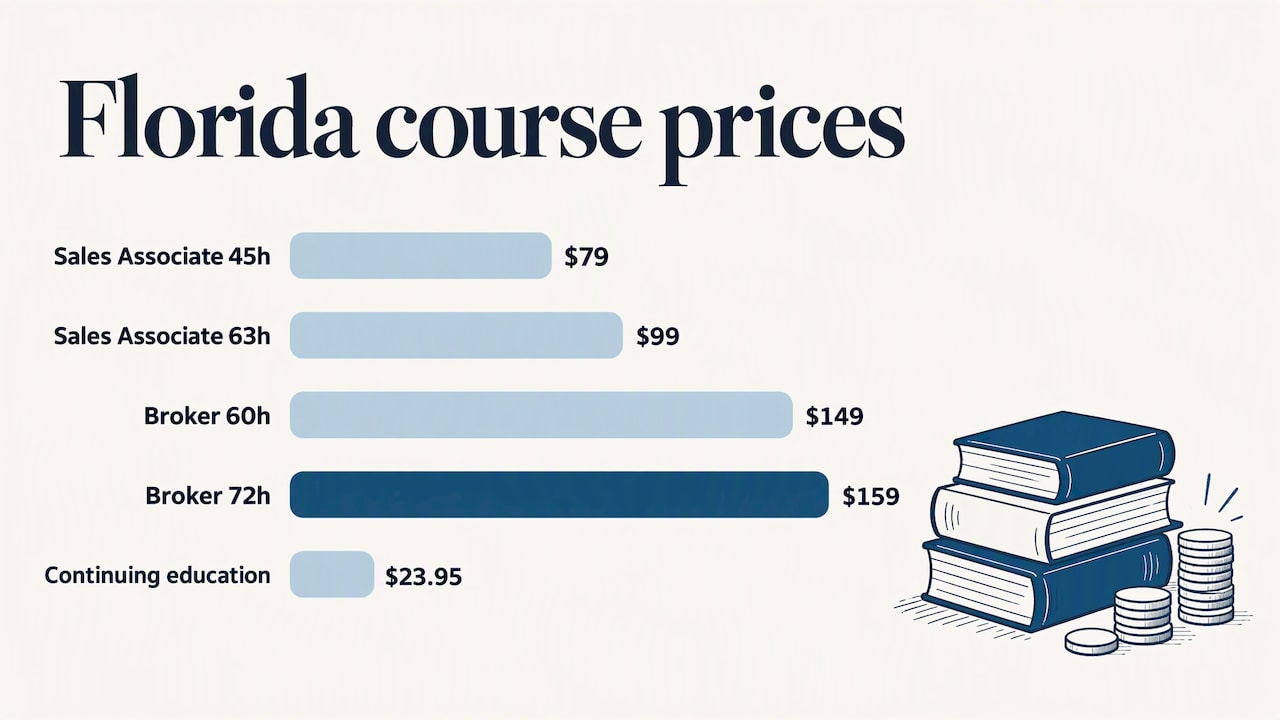
If you are licensing in Florida, our published prices are below. Each is a one-time payment.
| Course | Price |
|---|---|
| Sales Associate 45 Hour | $79 |
| Sales Associate 63 Hour | $99 |
| Broker 60 Hour | $149 |
| Broker 72 Hour | $159 |
| 14-Hour Real Estate Continuing Education | $23.95 |
You can see how the pre-licensing path works on our Florida pre-licensing courses page, read about the 63-hour sales associate course or the 72-hour broker course, and browse everything on our Florida courses page. Once you are licensed, the 14-hour continuing education course is $23.95. All courses carry a 30-day money-back guarantee.
Not in Florida? Our real estate pre-licensing courses page covers other options, and your state regulator’s page will confirm what your state requires.
Business skills: a small cost that can pay back
After licensing, agents who invest in skills tend to win listings faster. Our professional development courses are $29 each, including personal branding, lead conversion, the modern listing presentation, AI for real estate professionals, social media and content marketing, and running better open houses. The International Real Estate Course is $49. Compared with annual dues and renewal fees, these are small line items. You can see them all on our professional development courses page.
FAQ
How much does it cost to get a real estate license?
A practical U.S. estimate is $1,560 to $4,115, excluding brokerage fees, according to Inman. Your state’s fee schedule and your choice of school move the number most. Your state regulator’s website gives the current official fees.
What is the cheapest part of getting licensed, and what is the biggest?
State fees are published and fixed, such as Kansas’s $210 for a salesperson. The education is typically the largest choice you control, with school costs ranging from $200 to $1,000. Brokerage and association dues often outweigh both over time.
Do I pay again if I fail the exam?
Yes. Retakes require paying the exam fee again, and some states add rescheduling fees. California, for instance, lists $100 for salesperson re-examination. Take practice exams before you book.
How much does it cost to keep a license active?
It depends on your state. California on-time renewal is $350 for a salesperson, while Pennsylvania’s biennial renewal is $96, and both require continuing education. Renew before the deadline, since late fees climb quickly.
Sources
- How much does it cost to get your real estate license? (Inman)
- Real Estate Salesperson and Broker Licensure Requirements (Connecticut OLR)
- Fees (California DRE)
- Frequently Asked Questions (Kansas Real Estate Commission)
- Application and Exam FAQs (Oklahoma Real Estate Commission)
- Form 501: Real Estate Licensing Requirements (Nevada)
- Licensing FAQs (North Carolina Real Estate Commission)
- 22 Tex. Admin. Code § 535.101 Fees
- Continuing Education (Wyoming Real Estate Commission)
- Real Estate Salesperson Licensure Snapshot (Pennsylvania Department of State)
- Real Estate Exam Prep guide (HousingWire)
Recommended
- Florida Real Estate Courses You Need to Know
- Florida Real Estate Pre-Licensing Courses
- Florida 14-Hour Real Estate CE Course
- Real Estate Personal Branding Course