



CE credits are the continuing education hours your state requires you to complete to renew an active real estate license. The number of hours, the mandatory subjects and the deadline are set by your state, so the first step is always to check your own commission’s rules. Beyond that, the credits split into required “core” topics and elective hours you choose, and this guide shows how to plan both.
Key Takeaways
- CE hours are set by state law and commissions, and the amounts, time frames and due dates vary considerably, according to the National Association of REALTORS®.
- Most states divide CE into mandatory core subjects and elective hours. Elective hours are where you can choose topics that build your business.
- CE is separate from pre-licensing and post-licensing education. Completing one never satisfies the deadline of the other.
- Missing a renewal deadline can bring late fees or worse, so build your CE plan early and keep your completion records.
- In Florida, active licensees need 14 CE hours every two years, and approved online courses count.
Table of Contents
- What CE Credits Actually Are
- How Many CE Hours Do You Need?
- Core Hours and Elective Hours
- How to Choose Elective CE That Builds Your Business
- Deadlines, Reporting and What Happens If You Miss One
- Our Perspective on CE Credits
- Meeting Your Florida CE Requirement With MyEdukator
- Common Mistakes With CE Credits
- A Simple CE Plan for Any State
- FAQ
- Sources
What CE Credits Actually Are
Continuing education credits are hours of approved coursework you complete after you are licensed, so your license stays active. Each state real estate commission decides what counts. Courses must be approved for your jurisdiction, and the approval belongs to the course, not to you. ARELLO explains that course content stays subject to approval by each jurisdiction, although its distance-education certification can simplify or speed up approval in recognized jurisdictions, and some require it.
The word “credit” usually maps to a classroom hour. Florida’s statute, for example, speaks in classroom hours and allows approved distance learning to substitute hour for hour. That is why an online, self-paced course can fully satisfy a CE requirement when your state approves it.
CE, pre-licensing and post-licensing are different programs
Agents often mix these up, and the mix-up can cost a license.
| Stage | When you take it | What it does |
|---|---|---|
| Pre-licensing | Before you hold a license | Qualifies you to sit for the state exam |
| Post-licensing | Right after your first license is issued | Completes your initial licensing requirement, with its own deadline |
| Continuing education (CE) | Every renewal cycle after that | Keeps your license active |
The North Carolina Real Estate Commission puts the separation plainly in its bulletin on post-licensing and CE: finishing post-licensing does not change your CE deadlines, and finishing CE does not meet post-licensing deadlines. Other states have their own rules, but the habit is a good one everywhere. Track each requirement on its own calendar.
How Many CE Hours Do You Need?
There is no national number. The National Association of REALTORS® notes that requirements are set by state law and administered by state commissions, and that pre-licensing and post-licensing rules vary as well. A few official examples show how wide the range is.
| State | Official requirement | Source |
|---|---|---|
| Florida | 14 classroom hours per biennium for an active license | Florida Statutes 475.182 |
| Pennsylvania | 14 Commission-approved hours per two-year license period | Pennsylvania Department of State |
| Connecticut | 12 hours per two-year cycle | Connecticut DCP |
| New Jersey | 12 hours per license term | NJDOBI |
| Tennessee | 16 hours | Tennessee Commerce |
| Hawaii | 20 hours for active renewal | Hawaii Real Estate Commission |
| Minnesota | Generally 30 hours for salespersons, before June 30 each year | Minnesota Commerce |
Notice that the cycle length also differs. Some states count a two-year license term, others use a fixed annual date. Minnesota’s guide adds a detail that catches people out: excess hours do not carry forward, so extra credits this cycle will not lighten the next one.
Inactive licenses are treated differently too. Hawaii’s commission bulletin says inactive licensees must renew but do not need CE until they reactivate. Check your own state before assuming the same applies to you.
Core Hours and Elective Hours
When readers search for “elective CE credits,” they are usually asking one thing: which hours can I choose, and which are decided for me? Most states divide the total into two buckets.
Core (mandatory) hours cover subjects the state considers essential. Typical themes are ethics, agency, fair housing and legal updates. Elective hours are the remainder, and you pick the subject from the approved list.
Here is how it looks in practice:
- New Jersey: at least six core hours, including two ethics hours, one Fair Housing/NJLAD hour and one agency hour. The other six hours may be core or elective.
- Connecticut: 12 hours per cycle, made up of one three-hour mandatory course and nine hours of real estate electives, as the state’s CE page describes.
- Tennessee: 16 hours, split into 10 elective hours and 6 mandatory CORE hours, per the state’s CE FAQ.
- Hawaii: 20 hours for an active license, made up of Core A (3 hours), Core B (3 hours) and 14 elective hours, according to the commission bulletin.
- Minnesota: a specific general module, at least one hour on agency representation and disclosure laws, and at least one hour on fair housing, antidiscrimination or underserved-population topics, within the salesperson CE structure.
The pattern is consistent: the state fixes the must-haves first, and you have freedom with the rest. Complete the core hours first. Then use the elective hours deliberately.
Fair housing training for REALTOR® members
If you are a REALTOR® member, there is one more layer on top of your license. NAR requires at least two instructional hours of Fair Housing/Anti-Bias Training on becoming a member and every three years after. The requirement began on January 1, 2025, and the first cycle’s deadline is December 31, 2027. State licensing-authority training counts only if it meets NAR’s learning objectives and criteria. That is a membership obligation, not a licensing one, so confirm that any course you choose satisfies it before you rely on it for both.
How to Choose Elective CE That Builds Your Business
Elective hours are the one part of renewal that you control. Treating them as a box to tick is a missed opportunity. The approved lists are broad. New Jersey’s elective topics, for example, include commercial real estate, property management, seasonal rentals, financing, land use, valuation, foreclosure and short-sale transactions, and residential transaction topics, according to the state’s instructions.
Use this short process:
- Confirm the approved subjects. Open your commission’s CE page and note what qualifies as an elective.
- Find the gap in your business. Ask where deals stall: lead follow-up, listing presentations, marketing, a client segment you cannot serve yet.
- Match the course to the gap. Choose an approved course in that area, not simply the shortest one.
- Check the provider’s approval for your state. Approval is per jurisdiction, so verify it before you pay.
- Schedule the hours. Spread them across the cycle instead of leaving them for the last week.
A caution on the final step: the weeks before a deadline are when providers’ systems are busiest and mistakes are costly. Plan the schedule early.
Deadlines, Reporting and What Happens If You Miss One
CE is only worth something if it is recorded. Reporting works differently from state to state, but there are two common patterns.
- Provider reports for you. Tennessee’s official FAQ says course sponsors must upload attendance rosters to CE Broker within 10 business days. In states like this, confirm your completion appears on your record before you try to renew.
- You attest at renewal. Connecticut licensees attest to completion when renewing and should keep their records for four years, according to the state’s page. Late completion brings fees, and failure can lead to civil fines, suspension or revocation.
Some states offer no cushion at all. Pennsylvania licenses expire May 31 of every even-numbered year, and the Commonwealth states there is no renewal grace period. Pennsylvania also requires first-renewal salespersons to complete a specific set of CE courses, and CE used to reactivate an expired license cannot be used again for renewal in the same period.
Your checklist before any deadline:
- Look up your own license record and your exact expiration date.
- Confirm how many hours remain, and in which categories.
- Verify each completed course has been reported, or save the certificate if you attest.
- Keep the records for as long as your state tells you to.
Our Perspective on CE Credits
We see CE as a milestone, not a finish line. The state sets a minimum so your license stays active. What you do with the hours you are free to choose is what separates an agent who renews from an agent who grows.
That is why we built our courses around how agents actually work. Every course is self-paced, available in English, Spanish and Portuguese, and includes read-along narration, so you can study in the language you serve clients in. Completions are reported electronically, which means less paperwork for you near a deadline, and every course carries a 30-day money-back guarantee.
Our advice: finish your mandatory hours early, then spend the elective hours on a skill that brings in clients, such as personal branding, lead conversion or listing presentations. The requirement is the same either way. The return is not.
the author
Meeting Your Florida CE Requirement With MyEdukator
If you hold a Florida license, the rule is straightforward. Under Florida Statutes section 475.182, an active broker, broker associate or sales associate needs at least 14 classroom hours of CE in each biennium, and approved distance learning can substitute classroom hour for classroom hour.
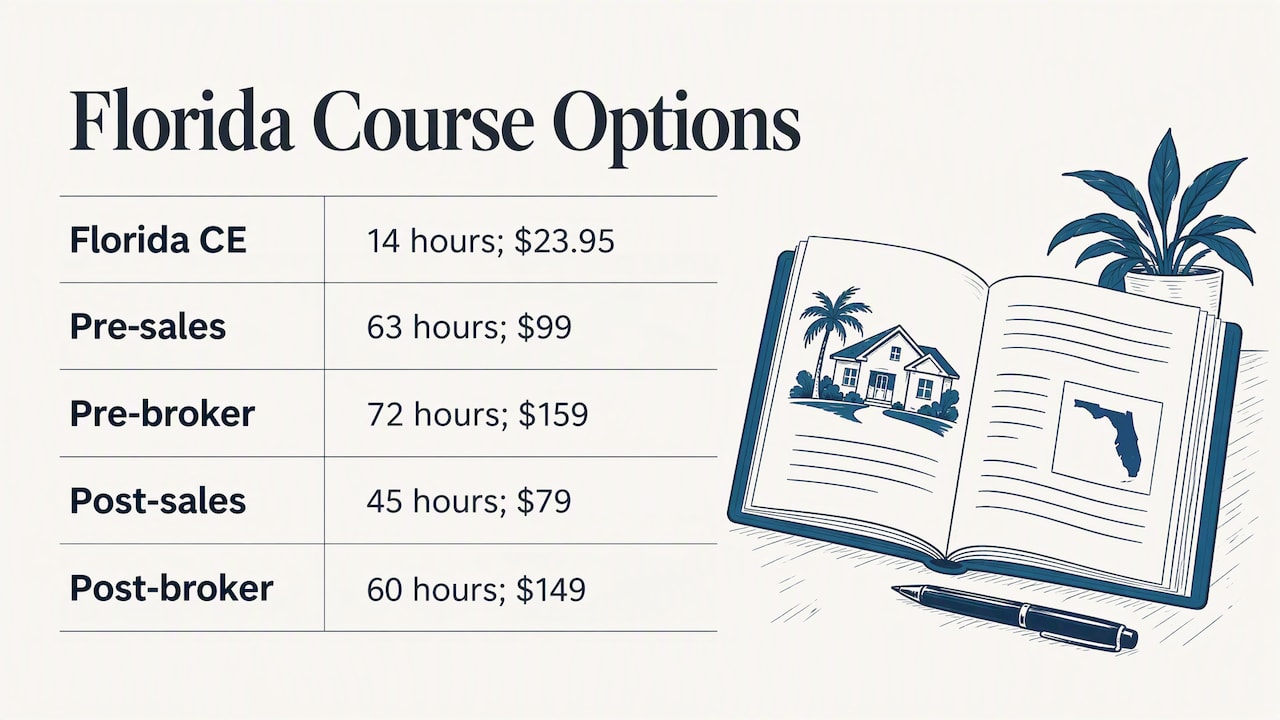
Our Florida 14-hour real estate CE course is $23.95. It is self-paced, delivered online, and completions are reported electronically. You can see everything we offer for Florida on our Florida courses page, and read more in our guide to the Florida 14-hour continuing education requirement.

If you are earlier in your career, the same platform covers the stages around CE. The Florida pre-licensing courses include the 63-hour sales associate course at $99 and the 72-hour broker course at $159. The post-licensing courses include the 45-hour sales associate course at $79 and the 60-hour broker course at $149. Florida requires a new sales associate to complete 45 post-licensing hours before the initial license expires, according to the state’s licensure requirements.
For business-building electives and skills courses, our professional development library offers topics such as personal branding, lead conversion, the modern listing presentation, AI for real estate professionals, social media and content marketing, and running better open houses, mostly at $29 each. Our International Real Estate Course is $49. Confirm in your own jurisdiction whether a given course counts toward your CE hours, since approval is set by each state.
Common Mistakes With CE Credits
Assuming one state’s rules apply to another. Hours, cycles and core topics differ. If you hold licenses in more than one state, track each separately.
Counting post-licensing as CE. As North Carolina’s commission makes clear, the programs are independent. Do not assume a completed post-licensing course covers CE.
Banking extra hours. Minnesota’s guide says excess hours do not carry forward. Doing more than you need in one cycle may not help the next.
Leaving the core hours for last. Core topics are mandatory and they are the ones that can be tied to specific categories. Do them first so a shortfall in a required category does not surprise you.
Not checking that the course is approved. An unapproved course gives you knowledge but no credit. Check approval for your state before enrolling.
Forgetting the reporting step. Where the provider reports your completion, confirm it posted. Where you attest, keep your certificates.
A Simple CE Plan for Any State
Here is a short plan you can apply wherever you are licensed.
- Find your commission’s CE page. Write down total hours, core hours, elective hours and the renewal date.
- Look up your record. Confirm what is already completed.
- Take the core courses first. They are the non-negotiable part.
- Choose electives for your business. Pick the topic that fills your biggest gap.
- Verify reporting. Check that completions appear, or save your certificates.
- Renew early. Do not rely on a grace period. Pennsylvania’s rules show that some states offer none.
FAQ
Are CE credits the same as post-licensing education?
No. Post-licensing is the education a new licensee completes after the first license is issued, and continuing education is what you complete to renew afterward. The North Carolina Real Estate Commission says completing one does not satisfy the deadlines for the other. Check your own state’s rules for details.
What are elective CE credits?
Elective credits are the CE hours you can choose freely from your state’s approved subjects, after the mandatory core hours are done. Connecticut, for example, requires nine hours of real estate electives within its 12-hour cycle. Your commission lists which topics qualify.
How many CE hours does a Florida real estate agent need?
Florida requires at least 14 classroom hours of continuing education in each biennium to renew an active broker, broker associate or sales associate license. Approved distance learning can substitute hour for hour. Our 14-hour course is built for that requirement.
Do online courses count for CE credit?
In many states, yes, provided the provider and course are approved by your commission. Florida’s statute allows approved distance learning on an hour-for-hour basis. Because approval is set by each jurisdiction, verify it for your state before you enroll.
Can I carry extra CE hours into the next renewal cycle?
It depends on the state. Minnesota’s licensing guide says excess hours do not carry forward. Look for a carryover rule on your commission’s page before you plan to complete extra hours.
Sources
- NAR: Continuing Education Requirements
- NAR: Fair Housing Training Requirement
- ARELLO: Distance Education Certification
- NCREC Bulletins: Postlicensing and CE
- Florida Statutes section 475.182
- Florida DBPR: Real Estate Associate Requirements for Licensure
- Pennsylvania Department of State: Renewal Information
- Connecticut DCP: Real Estate Salesperson Continuing Education
- New Jersey DOBI: Licensing Services CE
- Tennessee Commerce: Continuing Education FAQs
- Hawaii Real Estate Commission Bulletin
- Minnesota Commerce: Real Estate Licensing Guide
Recommended
- Florida 14-Hour Real Estate CE Course
- Continuing Education – MyEdukator Real Estate Courses
- AI for Real Estate Agents Course
- Lead Generation for Realtors: What Works and What to Pay For
This article is provided for general information and is not a professional advice.