



A real estate law course teaches you the legal rules behind property ownership, contracts, financing, leases and land use, so you can spot legal issues before they cost a client a deal. It does not train you to be a lawyer. For agents, the most useful version is the one built into your state’s licensing path: pre-licensing, post-licensing and continuing education all carry legal content, and they are the courses your state actually requires.
This guide explains what these courses cover, who they are for, how state rules shape them, and how to choose one. Florida is our worked example, because that is where our state-approved courses are offered.
Key Takeaways
- A real estate law course introduces legal concepts, not legal practice. Its goal is to help you recognize issues and know when to bring in an attorney.
- Required legal content sits inside your state-approved licensing courses. Rules on hours, formats and exams differ by state, so check your own regulator first.
- In Florida, sales associates complete 63 pre-licensing hours, brokers 72, and active licensees 14 hours of continuing education every biennium.
- Property rights, title, liens, easements, zoning and fair housing show up in nearly every state’s curriculum.
- Choose a course your state approves, in a format and language that fits how you study, and confirm how completions are reported.
Table of Contents
- What a real estate law course actually is
- Who needs one, and when
- What real estate law courses cover
- How a law course helps you as an agent
- Can a law course count toward licensing or renewal?
- Format: studying online without losing the legal substance
- How to choose a course
- Our perspective
- Florida courses and prices
- A simple plan for your next 30 days
- FAQ
- Sources
What a real estate law course actually is
The label covers several different things, and the search results for it show that. Some pages are continuing legal education for attorneys. Others are university classes, paralegal programs or short online certificates. The common thread is the subject: the legal framework around real estate interests, transactions, financing, landlord-tenant relationships and land-use controls.
An academic example makes the scope plain. The University of Michigan’s Real Estate Law course introduces students to legal concepts around real estate interests, transactions, financing, landlord-tenant interactions and land-use controls, and it states that the course does not train students to be lawyers. That is the right frame for an agent. You are learning to recognize a problem, understand what the rule is for, and know whom to call.
There are three broad types you will run into:
- Licensing courses. Pre-licensing, post-licensing and continuing education approved by your state’s real estate regulator. These are mandatory for most agents.
- University or certificate courses. Broader academic or professional programs. Useful for background, but they generally do not satisfy state licensing hours unless the school is approved for that purpose.
- Attorney continuing legal education. Written for lawyers and credited toward bar requirements, not real estate license requirements.
If you hold or want a real estate license, the first category is where your time and money should go first.
Who needs one, and when
Your career stage decides which course is relevant.
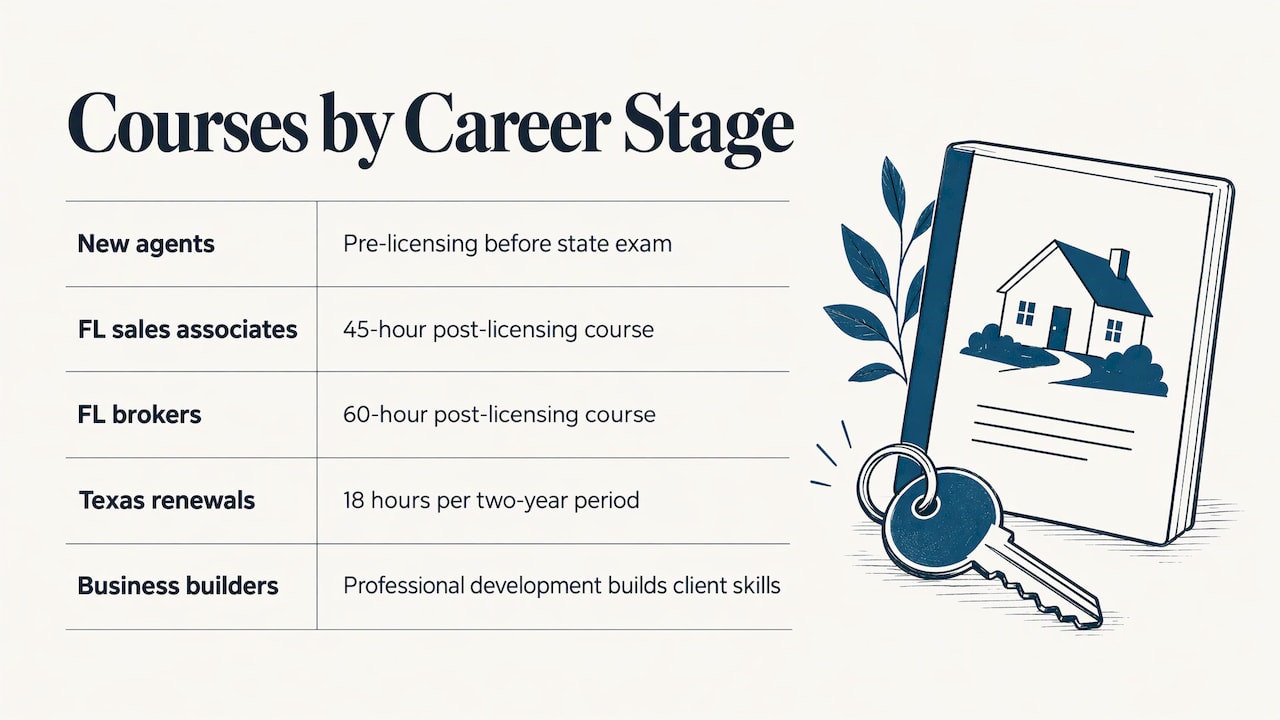
New agents seeking a license. Pre-licensing education is your entry point. Legal fundamentals are a large part of it, and you must complete it before you can sit for the state exam.
Newly licensed agents. Many states require post-licensing education after your first license is issued. In Florida, for example, sales associates take a 45-hour course and brokers a 60-hour course. Our guide to post-licensing courses, hours and deadlines walks through how to plan around them.
Active agents renewing a license. Continuing education keeps your license active and refreshes your legal knowledge as rules change. Texas, for instance, lists 18 hours of continuing education for each two-year license period, including 4 hours each of Legal Update I and II, 3 hours of contract-related coursework and 7 elective hours, with an additional 6-hour Broker Responsibility Course for certain brokers and supervisors, according to the Texas Real Estate Commission.
Agents building a business. Once your compliance hours are done, professional development courses sharpen the skills that bring in clients: listing presentations, lead conversion, marketing and technology. These are not legal courses, but they help you apply what you know.
What real estate law courses cover
Curricula differ, but the legal core is remarkably consistent across schools and states. Looking at several official and academic outlines shows the pattern.
The University of Washington’s real estate law syllabus covers land-use controls, environmental concerns, housing regulation, title insurance, due diligence, entity selection, insurance, zoning, fair housing, broker licensing, eminent domain and taxation. That is a graduate-level program, but many of the same topics appear in agent licensing courses at a more practical level.
State licensing curricula are narrower and more applied. Hawaii’s official salespersons’ pre-licensing curriculum covers the bundle of rights; surface, air, subsurface, mineral and water rights; fixtures; legal descriptions and boundaries; estates; easements and encroachments; liens; deeds and title; leases; taxes; zoning; and fair housing.
South Carolina’s fundamentals standards ask learners to understand ownership rights such as use, possession, control and disposition, along with government controls including eminent domain, escheat, police power, planning and zoning. Washington’s required fundamentals curriculum adds co-ownership, homestead laws, encumbrances, lien priority, and public and private land-use controls.
The topics you will meet most often
| Topic | Why it matters in practice |
|---|---|
| Bundle of rights and estates | Defines what a seller actually owns and can transfer |
| Easements, encroachments, liens | Can limit use of a property or cloud the title |
| Deeds, title and legal descriptions | Determine whether ownership transfers cleanly |
| Contracts and leases | The core documents of nearly every transaction you handle |
| Zoning and land-use controls | Decide what a buyer can legally do with the property |
| Fair housing | Governs how you market, show and serve every client |
| Taxes and government powers | Eminent domain, escheat and taxation affect value and ownership |
| Agency and licensing law | Define your duties to clients and the limits of your role |
You will notice that none of this asks you to draft a legal opinion. It asks you to understand why a rule exists and what it means for the transaction in front of you.
How a law course helps you as an agent
The practical objective is worth stating precisely. The Michigan Ross course description emphasizes recognizing legal issues, understanding the purpose and function of legal rules, and knowing how to engage lawyers and other transaction participants. For an agent, that translates into four everyday benefits.
- You catch problems early. A survey that does not match a legal description, a lien that appears at title search, or an easement the seller forgot to mention: each is easier to handle when you know what it is on first sight.
- You protect your clients and your license. Misstating a legal point, or giving advice that belongs to an attorney, creates risk for everyone. Knowing the boundary keeps you on the right side of it.
- You communicate with confidence. Clients trust an agent who can explain, in plain words, what a contract clause does and when to bring in counsel.
- You work well with other professionals. Title agents, lenders, inspectors and attorneys all speak a shared vocabulary. A solid legal foundation lets you coordinate them.
For readers who want to see what practical legal support looks like from the attorney side, this overview of practical legal knowledge for real estate transactions shows the kinds of matters, from sales and purchases to leasing and financing, where an agent will typically hand a question to a lawyer. The firm serves clients in Ontario, Canada, so treat its practice areas as an illustration of when to refer, not as guidance on US state law.
Can a law course count toward licensing or renewal?
Only if your state approves it for that purpose. That single sentence prevents most wasted money. A general law course from a university or a CLE provider may be excellent, yet your regulator will not credit it unless the provider and the course are approved.
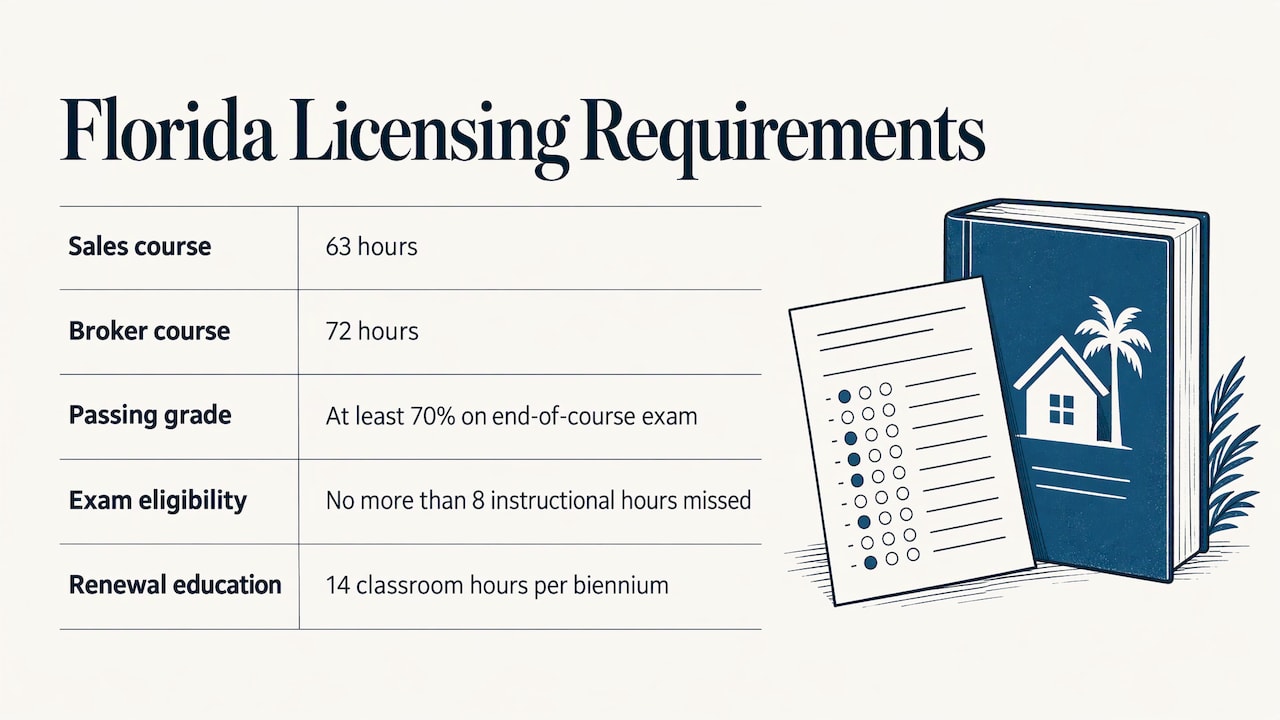
Florida shows how specific the rules are. The commission’s pre-licensing rule sets a sales associate course of 63 hours and a broker course of 72 hours, each hour being 50 minutes and including the examination. Approved providers include eligible colleges and registered real estate schools. The same rule says satisfactory completion requires a grade of at least 70% on the commission-prescribed end-of-course exam, and that you may take the exam only if you have not missed more than 8 instructional hours.
For renewal, Florida’s 2025 statute on continuing education requires active brokers, broker associates and sales associates to complete at least 14 classroom hours of approved continuing education each biennium. The commission may accept approved distance learning, and it may not require a centralized monitored written exam for correspondence or distance-learning completion.
Florida requirements are only one example. Hour counts, exam rules, approved formats and renewal cycles are set state by state, as the Florida and Texas figures above already show. Before you enroll anywhere, open your own regulator’s site, find the current requirement for your license type, and confirm the provider is approved. Rules change, so check the regulator’s page rather than relying on any article, including this one.
Format: studying online without losing the legal substance
Most state regulators now accept approved distance education for at least some licensing hours, under specified requirements. In Florida, that includes pre-licensing delivered online by an approved school, subject to the rule’s completion standards described above.
Self-paced online study suits working adults, but legal material rewards a deliberate approach. A few habits help:
- Plan the schedule backward from your deadline. Whether it is an exam date, a post-licensing deadline or a renewal date, count your hours and divide them across weeks.
- Study in short, regular sessions. Legal terms such as estates, encumbrances and lien priority stick better with repetition than with marathon sessions.
- Write your own examples. For every concept, think of a transaction where it would matter. An easement becomes real when you picture a neighbor’s driveway.
- Watch your attendance rules. In Florida pre-licensing, missing more than 8 instructional hours blocks the end-of-course exam.
- Keep proof of completion. Even when your school reports electronically, save your certificate and confirmation.
How to choose a course
Use these criteria in order.
1. State approval. If the course is meant to satisfy a requirement, the provider and course must be approved by your state regulator. Verify on the regulator’s site.
2. The right course for your stage. Pre-licensing, post-licensing, continuing education and professional development are not interchangeable. Match the course to what your license record needs.
3. Language and accessibility. If you serve clients in more than one language, or you learn best by listening while you read, look for a provider that supports it. Our courses are offered in English, Spanish and Portuguese, with read-along narration.
4. Completion reporting. Ask how and when completions reach your state. Our courses report completions electronically to state authorities, which spares you from chasing paperwork.
5. Risk and price. Compare total cost, and look for a refund policy. We offer a 30-day money-back guarantee on all our courses.
Our perspective
Agents tend to treat required education as a box to check. We see it differently. The legal content in a licensing course is the foundation for every contract you will write and every client conversation you will have, and the stakes are higher than a passing grade.
That is why we built our courses to be state-approved, self-paced and accessible. Learners can study in English, Spanish or Portuguese, which matters when the clients you serve speak those languages too. Read-along narration lets you follow the text as you listen, and electronic reporting of completions to state authorities keeps the compliance side simple.
We also believe education should not stop at the minimum. Once your required hours are done, professional development courses on listing presentations, lead conversion, marketing and technology help you turn legal knowledge into a stronger business. Every course carries a 30-day money-back guarantee, because we want you to start with confidence.
the author
Florida courses and prices
If you are licensing or renewing in Florida, our state-approved courses cover each stage. Prices below are as published on our site.
| Course | Price |
|---|---|
| Sales Associate 63-Hour Pre-Licensing | $99 |
| Broker 72-Hour Pre-Licensing | $159 |
| Sales Associate 45-Hour Post-Licensing | $79 |
| Broker 60-Hour Post-Licensing | $149 |
| 14-Hour Continuing Education | $23.95 |
You can read more about the 63-hour sales associate course, the 72-hour broker course, the 60-hour broker post-license course and the 14-hour continuing education course. When you are preparing for the licensing test, our Florida real estate state exam guide explains the steps, format and exam day.
Ready to enroll? See every Florida real estate course and price, study at your own pace in English, Spanish or Portuguese, and rely on the 30-day money-back guarantee.
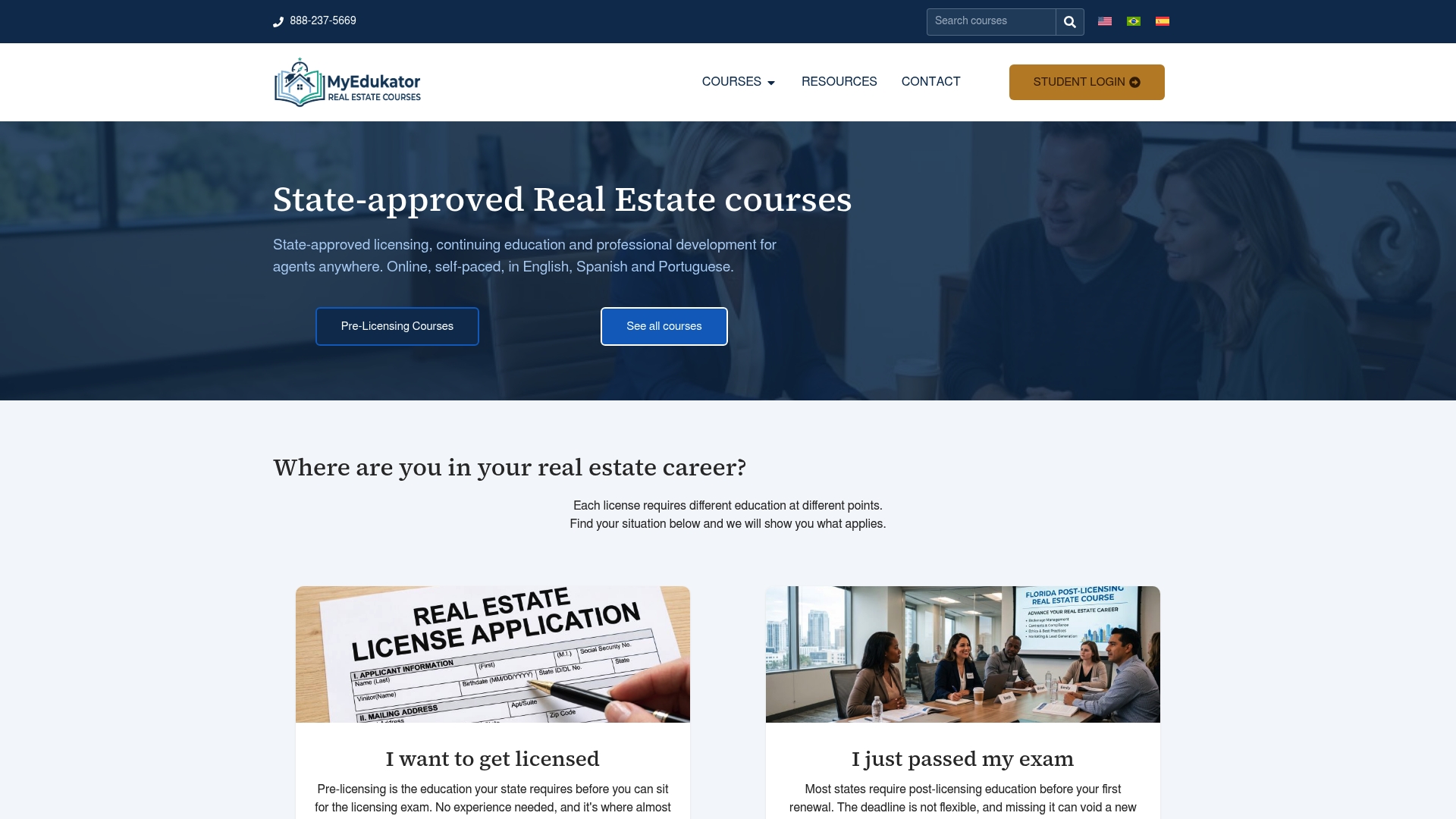
Once your compliance hours are in order, our professional development courses cover personal branding, lead conversion, the modern listing presentation, AI, photography and video, technology, social media, international real estate and open houses. Most are $29, and the International Real Estate Course is $49.
A simple plan for your next 30 days
- Find your requirement. Look up your license type on your state regulator’s site and note the hours and deadline.
- Check your record. Confirm what you have already completed and what remains.
- Pick an approved provider. Verify approval, format and language.
- Block study time. Put sessions on your calendar, not on a someday list.
- Confirm reporting. After you finish, verify that your completion appears on your state record.
- Add a business skill. Choose one professional development topic that fits your next goal.
Think of the license as a milestone, not a finish line. The legal knowledge you build now keeps paying off with every transaction.
FAQ
Is a real estate law course the same as a law degree?
No. A real estate law course introduces legal concepts around property, transactions and land use so you can recognize issues and know when to involve an attorney. It does not qualify you to practice law or give legal advice.
Will a real estate law course satisfy my license requirements?
Only if your state regulator approves the provider and the course for that purpose. Pre-licensing, post-licensing and continuing education each have their own hour requirements, so confirm yours on your regulator’s website before you enroll.
How many continuing education hours does Florida require?
Florida requires active brokers, broker associates and sales associates to complete at least 14 hours of approved continuing education each biennium. Approved distance learning may be accepted. See the Florida statute for the current wording.
Can I take a real estate law course online?
Yes, in many states. Florida’s rule permits approved distance education under specified requirements, including a score of at least 70% on the end-of-course exam for pre-licensing. Always confirm that the online provider is approved in your state.
What topics should I expect?
Expect property rights, estates, easements, liens, deeds and title, contracts and leases, zoning, taxation and fair housing. Exact content depends on your state’s curriculum and the course level.
Sources
- Real Estate Law, Michigan Ross Weiser Center for Real Estate
- Real estate law syllabus, University of Washington Runstad Department of Real Estate
- Hawaii Real Estate Commission salespersons’ pre-licensing curriculum
- South Carolina Fundamentals of Real Estate Practice standards
- Washington real estate fundamentals required curriculum
- Florida Rule 61J2-3.008, Pre-licensing Education
- Florida Statutes 2025, Section 475.182
- Texas Real Estate Commission qualifying course list
- Practical legal knowledge for real estate transactions
Recommended
- Real Estate Finance Course: How to Choose the Right One
- International Real Estate Course
- Real Estate Post-Licensing Courses: Hours, Deadlines, How to Choose
- Florida 14-Hour Real Estate CE Course
This article is provided for general information and is not a professional advice.