



The fastest way to get better at real estate exam math is to work a small set of problem types repeatedly until the setup becomes automatic: write the formula, plug in the numbers, check that the answer makes sense. This guide gives you that set, with a worked solution for each, plus a method for the questions that look unfamiliar. If you are preparing for a state exam, start here, then build the rest of your plan around the coursework your state requires.
If you are a Florida candidate, our Florida Sales Associate 63-hour pre-licensing course is state-approved, self-paced and priced at $99, with a 30-day money-back guarantee.
Key Takeaways
- Most exam math comes from a handful of problem types: commission, loan-to-value, interest, proration, area and capitalization.
- Every one of them is a single formula. Your job is to pick the right one and keep the units straight.
- Write the formula before you touch the numbers, and test the answer for reasonableness before you move on.
- Practice by problem type, not by random test, so you can see which setup trips you up.
- Math is a skill you build with repetition. Plan short, frequent sessions in the weeks before your exam date.
Table of Contents
- What Real Estate Exam Math Really Tests
- A Four-Step Method for Any Math Question
- Commission and Broker Split Problems
- Loan-to-Value, Down Payment and Points
- Interest Problems
- Proration of Taxes and Expenses
- Area, Acreage and Unit Conversion
- Capitalization Rate and Income Value
- Appreciation and Depreciation
- How to Practice So the Skill Sticks
- Our Perspective on Exam Math
- Build Your Math on a State-Approved Course
- Exam-Day Math Habits
- FAQ
- Sources
What Real Estate Exam Math Really Tests
The math on a licensing exam is arithmetic and percentages, not algebra or geometry class. You multiply, divide, convert units and move a decimal. Nothing requires more than a basic calculator, and most state testing providers publish what calculator rules apply, so check your candidate handbook before exam day.
What the questions test is whether you understand the transaction. A commission question checks that you know who pays whom. A proration question checks that you know who owned the property on which days. A loan-to-value question checks that you know which value the lender uses. The numbers are easy once the situation is clear, which is why memorizing formulas without understanding the deal is where most candidates lose points.
The topics that come up most often are:
- Commission and broker splits
- Loan-to-value ratio and down payment
- Interest, points and monthly payments
- Property tax and expense proration
- Area, acreage and unit conversion
- Capitalization rate and income value
- Appreciation, depreciation and net-to-seller
Exact weighting differs by state, so treat the list as a map, not a promise. Your state’s candidate handbook is the authority on what is tested.
A Four-Step Method for Any Math Question
Use the same routine on every problem. It prevents most careless errors.
- Identify what is being asked. Underline the final unknown: the commission, the loan amount, the acreage, the seller’s share.
- Write the formula. Put it on your scratch paper before any numbers. If you cannot name the formula, reread the question for a clue word such as “rate,” “per,” “percent of” or “annual.”
- Convert units first. Percentages become decimals (6% = 0.06). Months, years and days must match the rate. Square feet and acres must match.
- Estimate, then calculate. If a 6% commission on a $400,000 sale comes out to $2,400, you have moved a decimal. A quick mental check catches it.
Many instructors teach the T-bar or triangle method: a three-part box where the total sits on top and the two factors sit below. Cover the unknown, and the layout tells you whether to multiply or divide. It works for commission, interest, cap rate and many others, because they share one shape: part = whole × rate.
Commission and Broker Split Problems
Commission questions are the most common starting point because the formula is the simplest: commission = sale price × commission rate.
Practice problem 1. A home sells for $385,000. The listing agreement sets a 6% total commission, split evenly between the listing brokerage and the buyer’s brokerage. How much does the listing brokerage receive?
- Total commission: $385,000 × 0.06 = $23,100
- Listing side: $23,100 ÷ 2 = $11,550
Practice problem 2. The listing agent in problem 1 has a 60/40 split with the brokerage, with 60% going to the agent. What does the agent earn?
- $11,550 × 0.60 = $6,930
Watch for two traps. First, the question may give you a rate per side, not a total rate. Second, the split may be stated for the agent or for the brokerage. Read which one the percentage belongs to before you multiply.
Practice problem 3 (working backward). A seller wants to net $285,000 after paying a 5% commission and nothing else. What price must the home sell for?
The seller keeps 95% of the price, so: $285,000 ÷ 0.95 = $300,000. Check it: 5% of $300,000 is $15,000, and $300,000 − $15,000 = $285,000.
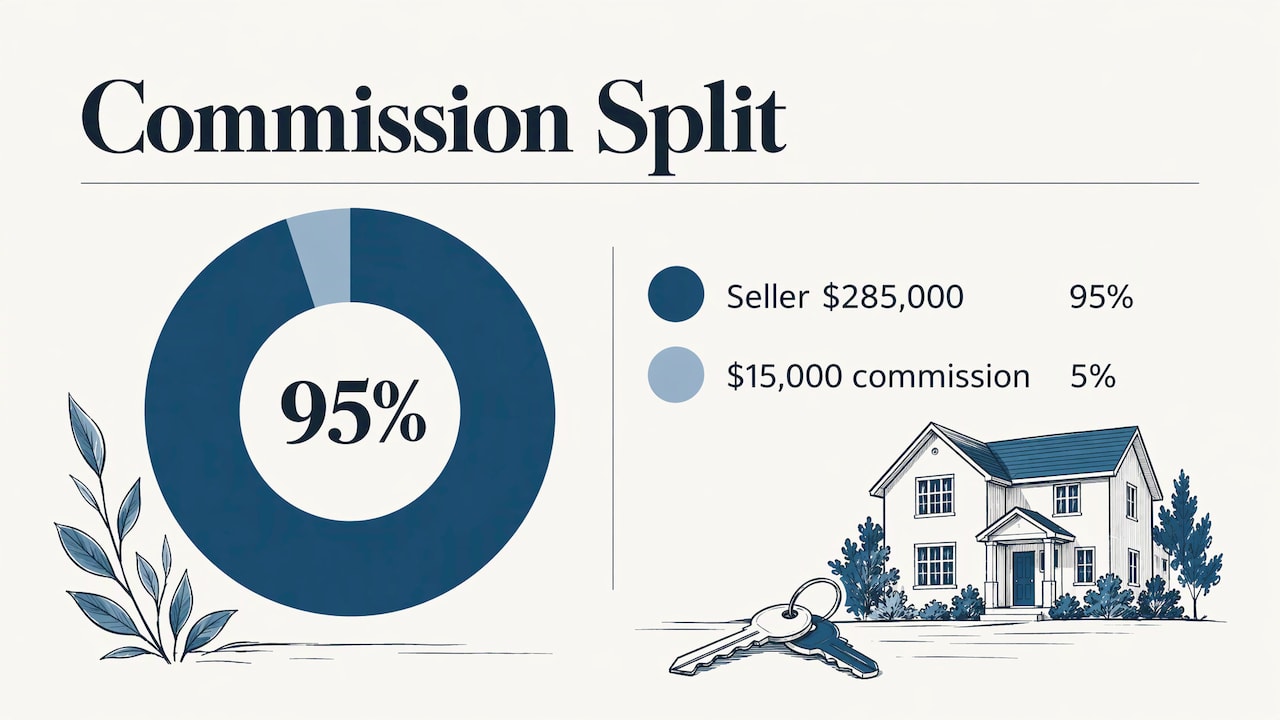
When the answer is the whole and you know the part, you divide. When you know the whole and want the part, you multiply. That one habit solves a large share of exam questions.
Loan-to-Value, Down Payment and Points
Lenders measure risk by comparing the loan to the property’s value: LTV = loan amount ÷ value. The detail that catches candidates is which value to use. For a purchase, lenders generally use the lower of the sale price and the appraised value.
Practice problem 4. A buyer agrees to pay $300,000. The appraisal comes back at $290,000. The loan is $240,000. What is the LTV?
- Use the lower value: $290,000
- $240,000 ÷ $290,000 = 0.8276, or about 82.8%
If you had used the price, you would have gotten 80%, which is a tempting wrong answer on a multiple-choice exam.
Practice problem 5. A buyer puts 10% down on a $325,000 home. What is the loan amount?
- Down payment: $325,000 × 0.10 = $32,500
- Loan: $325,000 − $32,500 = $292,500 (or $325,000 × 0.90)
Practice problem 6. A lender charges 2 discount points on a $240,000 loan. What do the points cost?
One point equals 1% of the loan amount. So 2 points = 2% × $240,000 = $4,800.
Interest Problems
Simple interest follows interest = principal × rate × time, with the rate and time in matching units. The exam usually asks about a single payment period, not a full amortization schedule, so you rarely need a payment table.
Practice problem 7. A borrower has a $250,000 balance at 6.5% annual interest. How much interest accrues in the first month?
- Annual interest: $250,000 × 0.065 = $16,250
- Monthly: $16,250 ÷ 12 = $1,354.17
Practice problem 8. If the borrower’s monthly principal-and-interest payment is $1,580, how much of the first payment goes to principal?
- $1,580 − $1,354.17 = $225.83
That second step is a common exam pattern: calculate the interest, then subtract it from the payment to find the principal reduction. The new balance is the old balance minus that principal.
Proration of Taxes and Expenses
Proration divides a recurring cost between buyer and seller based on who owned the property for how many days. Candidates find it intimidating because the question includes dates, but the logic is plain: daily cost × days owned = each party’s share.
Two questions to answer before you calculate:
- Is the expense paid in advance or in arrears? Property taxes are often paid after the tax period, so the seller owes the buyer a credit for the days the seller owned the home. Prepaid items such as an insurance premium work the other way: the seller gets credit for unused time.
- What day-count convention does the question say to use? Some questions use a 365-day year, others a 360-day year with 30-day months. The question will state it. Follow it exactly.
Practice problem 9. Annual property taxes are $4,380, unpaid at closing. Use a 365-day year. The seller owned the property for 180 days of the tax year. What is the seller’s share, and who gets the credit?
- Daily rate: $4,380 ÷ 365 = $12.00
- Seller’s share: $12 × 180 = $2,160
- The seller owes this amount, so it is a debit to the seller and a credit to the buyer, who will pay the full tax bill later.
The closing statement lists a debit and a credit for each party, and exam questions often ask which column an item lands in. If you cannot remember the direction, ask: who owes whom for days they did not pay for?
Area, Acreage and Unit Conversion
Area problems use a few shapes. A rectangle is length × width. A triangle is ½ × base × height. For irregular lots, the question usually asks you to split the shape into rectangles and triangles, calculate each and add them.
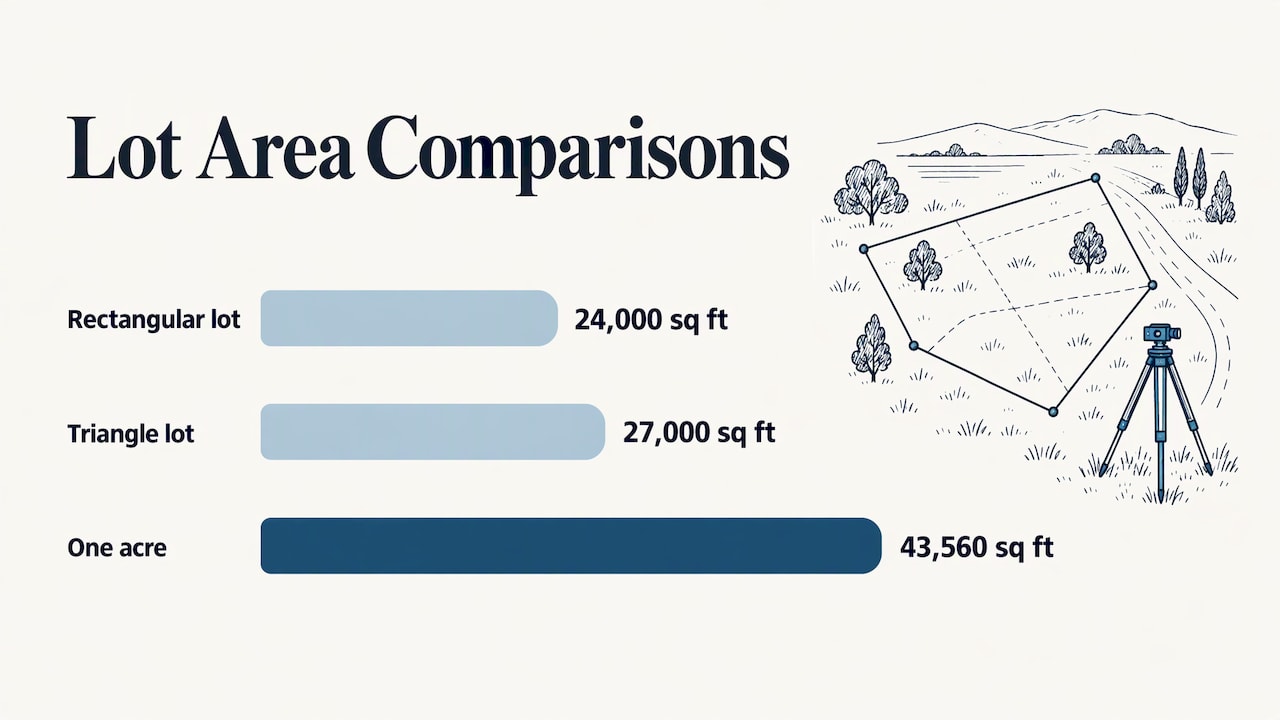
The number to know cold is that one acre is 43,560 square feet, which is the legal definition used in the US. Candidates who forget it cannot finish an entire category of questions.
Practice problem 10. A rectangular lot measures 120 feet by 200 feet. How many acres is it?
- Area: 120 × 200 = 24,000 sq ft
- Acres: 24,000 ÷ 43,560 = 0.55 acre
Practice problem 11. A parcel is a right triangle with a base of 300 feet and a height of 180 feet. What is its area?
- ½ × 300 × 180 = 27,000 sq ft, or about 0.62 acre
Practice problem 12. A builder prices a home at $210 per square foot, and the home is 1,850 square feet. What is the price?
- 1,850 × $210 = $388,500
When a question mixes units, such as yards and feet, convert everything to one unit before multiplying. Three feet make a yard, and nine square feet make a square yard. Missing the square on that last conversion is a classic mistake.
Capitalization Rate and Income Value
Income property questions use net operating income (NOI), the income left after operating expenses and before debt payments. The formula is cap rate = NOI ÷ value, which rearranges to value = NOI ÷ cap rate.
Practice problem 13. A small apartment building earns $42,000 in NOI and is priced at $600,000. What is the cap rate?
- $42,000 ÷ $600,000 = 0.07, or 7%
Practice problem 14. An investor wants a 7% cap rate on a property with $42,000 NOI. What is the most the investor should pay?
- $42,000 ÷ 0.07 = $600,000
Practice problem 15. A property has $96,000 gross annual income, 5% vacancy and $31,000 operating expenses. What is NOI?
- Vacancy loss: $96,000 × 0.05 = $4,800
- Effective income: $96,000 − $4,800 = $91,200
- NOI: $91,200 − $31,000 = $60,200
Mortgage payments are not an operating expense. If a question lists them, they are a distractor for NOI.
Appreciation and Depreciation
Percent change questions use change ÷ original value. If a home bought at $250,000 is now worth $275,000, the change is $25,000 and the appreciation is $25,000 ÷ $250,000 = 10%.
The common error is dividing by the new value. Always divide by the starting figure. For depreciation, the same logic applies: a $400,000 building losing 3% of its value per year loses $12,000 in the first year, and the exam may ask for the value after several years.
How to Practice So the Skill Sticks
Working 15 problems once does not build exam speed. Structure your practice this way:
- Learn one type at a time. Do five problems of the same type in a row so the setup becomes familiar.
- Mix the types. After a week, shuffle them. The exam will not tell you which formula to use.
- Keep an error log. Note whether each miss was a formula error, a unit error or an arithmetic slip. Patterns appear fast, and each type has a different fix.
- Practice with the calculator you will use. Different calculators handle percentages and order of operations differently.
- Time yourself late in your prep. Speed matters on a timed exam, but accuracy comes first in the early weeks.
Math practice should sit inside a larger plan that also covers law, contracts, agency and finance concepts. Our guides to passing the real estate exam and the Florida 4-week study plan show how to divide your weeks so math gets steady, short sessions without crowding out the rest of the material.
Our Perspective on Exam Math
We talk with new agents who dread the math section more than any other. In our view, the fear usually has less to do with arithmetic than with unfamiliar vocabulary. Once a candidate knows what an escrow proration, a discount point or a split actually is, the calculation shrinks to a single line.
That is why we build our licensing courses around the transaction first. Our state-approved pre-licensing courses are self-paced, so you can slow down on the topics that need it and move quickly through the ones that do not. Read-along narration lets you follow the text while you listen, which many learners find useful for dense material. And our courses are available in English, Spanish and Portuguese, so you can learn the terms in the language you think in.
The exam is a milestone, not a finish line. The same formulas return when you price a listing, explain a net sheet to a seller or compare an investment property for a client, and the agents who understand them early carry that confidence into the business.
the author
Build Your Math on a State-Approved Course
If you are earning your license in Florida, the Florida Sales Associate 63-hour pre-licensing course costs $99, and the Florida Broker 72-hour pre-licensing course costs $159. Both are self-paced, available in English, Spanish and Portuguese, and backed by a 30-day money-back guarantee. You can see the full lineup on our Florida pre-licensing page.

Already licensed? Our post-licensing courses cover the Sales Associate 45-hour requirement at $79 and the Broker 60-hour requirement at $149. For renewals, the Florida 14-hour continuing education course is $23.95, and completions are reported electronically. Once the exam math is behind you, our professional development library, starting at $29 per course, covers listing presentations, lead conversion and more on the professional development page.
Exam-Day Math Habits
- Do the math questions in a second pass if they slow you down. Mark them, answer the concept questions first, and return with the time that remains.
- Use scratch paper for every problem. Even simple ones. Writing the formula takes five seconds and prevents the wrong-operation error.
- Check the answer choices for reasonableness. If three of four options are wildly off your estimate, you have probably caught a decimal problem.
- Read the last sentence first. It tells you what the question is really asking before you wade through the numbers.
- Do not round until the end. Intermediate rounding shifts the final answer enough to land on a different choice.
For what the day itself looks like in Florida, see our Florida real estate state exam guide.
FAQ
How much math is on the real estate exam?
It depends on your state, because each state’s exam outline sets the topics and weights. Expect a modest share of questions that need a calculation, with the rest testing law, contracts and practice. Your state’s candidate handbook lists the content areas, so use it to plan how much time math deserves.
Do I need to be good at math to pass?
No. The questions use multiplication, division, percentages and unit conversion, and most follow one of a dozen patterns. Learning each pattern and practicing it until the setup is automatic matters more than any natural talent for numbers.
What formulas should I memorize first?
Start with part = whole × rate, which covers commission, LTV, interest, cap rate and appreciation. Then memorize the area formulas, 43,560 square feet per acre, and the proration rule of daily cost × days owned. Those few facts unlock most problems.
Can I use a calculator on the exam?
Policies vary by state and testing provider. Many allow a basic, non-programmable calculator, and some supply one. Check your candidate handbook before exam day and practice with the type of calculator you are allowed to use.
Sources
Recommended
- Passing the Real Estate Exam: A Practical Plan
- Virginia Real Estate Exam: Format, Fees and How to Pass
- Florida Real Estate State Exam Prep: A 4-Week Study Plan
This article is provided for general information and is not a professional advice.