



A real estate negotiation course is worth taking when it teaches you to handle objections, run a structured conversation with buyers and sellers, and represent a client honestly under pressure. Your best starting point is often the education you already have to complete. Some states build negotiation into post-licensing hours, and state-approved business-skills courses cover the client conversations negotiation depends on: the listing presentation, lead conversion and client communication. Here is what the skill involves, what the research says clients value, and how to pick training that fits your license stage.
Key Takeaways
- Clients rank negotiation highly: in the NAR 2020 buyer survey, 82% of buyers called negotiation skills “very important” in an agent.
- Some states write negotiation into required education. Idaho and Indiana both do, so check your own state’s post-licensing and renewal rules first.
- Objection handling is a repeatable method (restate, agree, probe, isolate, validate), not a personality trait.
- Honesty comes first for clients: 98% of buyers in a 2024 survey named honesty and integrity as the top quality in an agent.
- Pick training by your stage: pre-licensing, post-licensing, renewal or business skills each call for a different course.
Table of Contents
- What a real estate negotiation course actually teaches
- Why clients care: what the data says
- Handling objections: a method you can learn
- Where negotiation sits in your license journey
- Negotiation starts before the offer: the skills that carry it
- How to choose a negotiation course
- Perspective: negotiation is a skill built on client conversations
- Build your skills with state-approved courses
- A practical plan for the next 90 days
- Using negotiation skills ethically
- FAQ
- Sources
What a real estate negotiation course actually teaches
Negotiation in real estate is rarely a single moment at the table. It starts the first time you talk to a buyer or seller and runs through the listing agreement, the offer, the inspection response and the closing. A good course treats it that way. Most programs, whatever their length, work through the same building blocks.
Preparation. You learn to find out what your client actually wants before any offer is drafted: price, timing, certainty of closing, or flexibility on terms. Agents who skip this step negotiate on price alone because it is the only variable they know.
Questioning. Strong negotiators ask more than they tell. Inman contributor Bernice Ross suggests asking clients what is motivating them to move, and what the quality of their alternatives is if they decide not to buy or sell. Those questions help clients surface their own issues and make their own decisions, which keeps you advising rather than pushing.
Objection handling. Objections are the concerns a buyer, seller or other party raises before agreeing: “your commission is too high,” “we want to wait for spring,” “the price feels too low.” Handling them well is its own skill, covered below.
Role-play. Practice is what turns a technique into a habit. Certification-style negotiation courses use real-world scenarios and role-plays on both the buying and selling sides of a transaction, according to a 2025 Chicago Agent Magazine report on the RENE credential, the best-known negotiation designation among REALTORS®.
Ethics and representation. Negotiating for a client does not mean winning at any cost. It means advocating within your duties of honesty and disclosure.
Why clients care: what the data says
If you are deciding whether this skill deserves your time and money, start with what your clients say. The NAR Profile of Home Buyers and Sellers (survey period July 2019 to June 2020) found that 82% of all buyers considered negotiation skills “very important” in an agent. In the same survey, 13% of buyers wanted help negotiating the terms of sale and 11% wanted help with price negotiations.
Those numbers point to two things. Negotiation is an expectation, not a bonus. And buyers want help on terms as well as price, so an agent who only thinks about the number is covering half the job.
Trust sits underneath it all. A Statista survey covering July 2023 to June 2024 found that 98% of U.S. home buyers considered honesty and integrity the most important skill and quality in an agent, with responsiveness and knowledge of the purchase process also highly valued. Clients want a tough negotiator, but one they can believe. Your training should reflect that.
Handling objections: a method you can learn
Searches for “handling real estate objections” and “objection handling” are usually about one thing: what do I say when a client pushes back? The most useful answer is a sequence rather than a script.
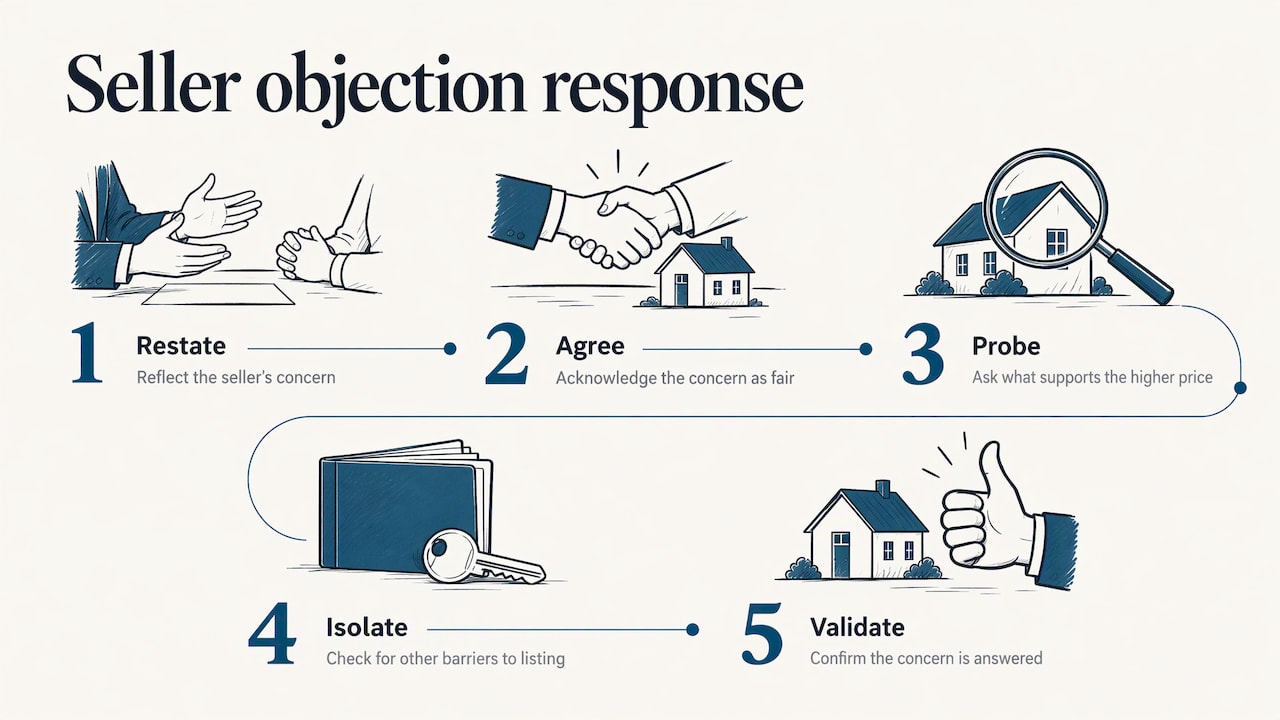
The Arizona Association of REALTORS® teaches a “restate, agree and probe” approach for listing presentations. In practice it works like this:
- Restate. Paraphrase the concern so the client knows you heard it. “So you are worried the commission cuts into your proceeds.”
- Agree. Acknowledge that the concern is reasonable. Agreeing with the feeling is not agreeing to the demand.
- Probe. Ask the client to share the reason behind the objection. The first objection is often a stand-in for a different issue.
- Isolate. Ask whether this is the only thing standing in the way. If you solve it and three more appear, you need to know now.
- Handle one at a time. Address each concern separately instead of defending everything at once.
- Validate. Confirm the client feels the concern has been answered before you move to the close of the listing.
A worked example
A seller tells you, “Another agent said we can list at $20,000 more.” Restate: “You want to be sure we are not leaving money on the table.” Agree: “That is a fair thing to want.” Probe: “What did the other agent show you to support that number?” Now you are comparing evidence, not defending your pricing. Isolate: “If we agree on the price strategy, is there anything else holding you back from listing with me?” Validate: “Does that answer your concern?” Each step is short, and the client does most of the talking.
Objections are information
The agents who struggle with objections treat them as attacks. Experienced agents treat them as a map of what the client values. A seller who objects to timing is telling you about a move-out date. A buyer who objects to price after touring may be telling you about monthly payment comfort. If you probe, you learn the real negotiating position, and that is what shapes a strong offer or counteroffer.
Where negotiation sits in your license journey
One reason people search “real estate negotiation classes” is to find out whether they are required. The answer depends on your state, and it can be yes.
- Idaho. The Division of Occupational and Professional Licenses requires salespersons renewing on active status for the first time to complete post-license education that must include Post License Fundamentals (8 hours) plus one of three 4-hour courses, one of which is “Post License Professionalism, Negotiation, and Closing”. Online courses require a final exam with a passing score of 70% or higher.
- Indiana. New licensees must complete 30 hours of post-licensing education in their first two years, and 5 of those hours must be in “Negotiating and Counseling”.
Other states set their own mixes of required topics, so a negotiation module may sit inside your pre-license, post-license or continuing education hours. Check your state commission’s current education page before you buy anything, and confirm that the provider’s course is approved for your state and license type.
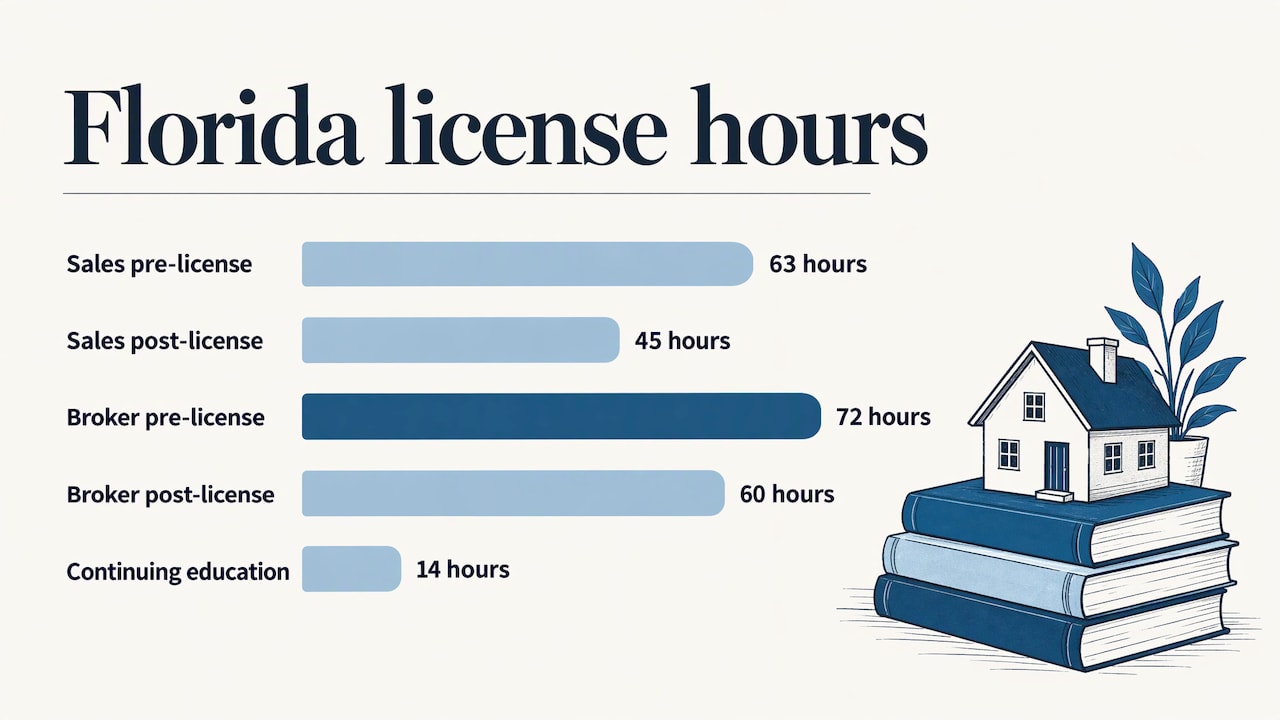
If you are licensed in Florida, the hours that count toward your license are set by the state. Florida sales associates complete a 63-hour pre-license course, then a 45-hour post-license course, and brokers complete a 72-hour pre-license course and a 60-hour post-license course. Florida licensees also complete 14 hours of continuing education on a recurring basis. The details of each are on our pages for Florida post-licensing courses and the 14-hour continuing education requirement.
Negotiation starts before the offer: the skills that carry it
The most common mistake new agents make is thinking negotiation begins when an offer lands. In reality, the negotiating position is set earlier, in four places.
The consultation
When you sit down with a buyer, you learn what they need, what they can afford and what they will trade away. Without that, you negotiate blind. Our guide to buyer consultation skills walks through that first meeting in practical terms.
The listing presentation
This is where sellers raise their strongest objections: price, commission, marketing plan, timeline. It is also where the terms of your agreement are set. If you want to understand how an exclusive listing agreement is structured, this overview of exclusive listing contract basics shows what is typically signed and reviewed. Your state’s forms and rules govern your own listings, so use your brokerage’s documents.
Everyday communication
A counteroffer is received in a mood your communication has already shaped. Clients who feel informed accept advice more readily. Responsiveness matters: it is one of the qualities buyers rated highly in the Statista survey above. Our piece on client communication skills every agent needs covers the habits that keep that trust intact.
Legal literacy
You cannot negotiate contract terms you do not fully understand. Contingencies, deadlines and remedies are all negotiable, and each carries legal consequences. A grounding in contract law pays off here, and our overview of the real estate law course explains what that training covers.
How to choose a negotiation course
Whether you are browsing certifications or state-approved education, use these criteria.
| Criterion | What to look for |
|---|---|
| Your license stage | New agents benefit from foundations. Experienced agents need advanced scenarios. |
| State approval | Confirm the course counts toward your hours if you need it for credit. |
| Format | In person, live virtual or self-paced online. Pick the one you will finish. |
| Practice | Role-plays and real scenarios on both buyer and seller sides. |
| Reporting | Completions should be reported to your state so credit is recorded. |
| Cost | Compare total cost, including any certification or application fees. |
| Refund terms | Look for a clear money-back policy. |
On format, there is a real difference between a two-day live course and a self-paced online one. The RENE certification, for example, runs two days and is available in person, live virtually or online self-paced. After completing it, agents apply and pay a one-time $159 certification fee. That is a designation pathway. It is separate from the state-approved education that keeps your license active, and the two do not replace each other.
If you are a new or newly licensed agent, put your required education first. Your license depends on it, and the hours are fixed by your state. Business-skills training comes next, once your compliance is covered.
Perspective: negotiation is a skill built on client conversations
We see negotiation as the end result of a chain of skills, not a standalone trick. An agent who has run a clear buyer consultation, delivered a confident listing presentation and kept clients informed starts every negotiation from a stronger position. That is why we build our courses around the full client relationship: licensing requirements first, then the business skills that help you attract and keep clients.
Compliance and skill-building belong together. Our state-approved courses are self-paced, available in English, Spanish and Portuguese, and include read-along narration, so you can study around showings and closings in the language you work in. Completions are reported electronically to state authorities, which takes paperwork off your plate. Every course comes with a 30-day money-back guarantee.
Our professional development catalog, including The Modern Listing Presentation and From Lead to Client, is designed to help agents win the conversations that come before an offer. For an agent serving a diverse client base, being able to learn and communicate in more than one language is a practical advantage at the table, too.
the author
Build your skills with state-approved courses
If you are earning or keeping a Florida license, start with the required hours. Our Florida courses are the 63-hour sales associate pre-license course at $99, the 72-hour broker pre-license course at $159, the 45-hour sales associate post-license course at $79, the 60-hour broker post-license course at $149 and the 14-hour continuing education course at $23.95. All are on our Florida courses page.
When your hours are in order, our professional development courses build the client-facing skills behind strong negotiations. The Modern Listing Presentation, From Lead to Client: Real Estate Lead Conversion and Building Your Real Estate Personal Brand are $29 each. For a bundled path, see the Real Estate Client & Presentation Skills Package.

Every course is self-paced and carries our 30-day money-back guarantee.
A practical plan for the next 90 days
Training only matters if it changes what you do on the next call. A simple plan keeps it concrete.
- Check your requirements. Open your state commission’s education page and note what is mandatory for your license stage and by when.
- Finish required hours first. Plan the schedule backward from your deadline, not forward from today.
- Write your own objection list. List the ten objections you hear most, then apply the restate, agree, probe, isolate, validate sequence to each in writing.
- Practice out loud. Run the responses with a colleague or in the car. Role-play is how certification-style courses build the habit, and it works the same on your own.
- Debrief every deal. After each negotiation, write down what the other side really wanted and what you learned from the first objection.
- Add one business skill. Pick the course that matches your weakest client conversation: consultation, listing presentation or lead conversion.
Negotiation skill is a milestone, not a finish line. The agents who get better treat each transaction as practice for the next one.
Using negotiation skills ethically
Clients reward honesty, and the data above shows how heavily they weight it. Ethical negotiation means representing your client’s interests while staying truthful with every party. It means disclosing what you are required to disclose, never inventing competing offers and never pressuring a client into a decision that serves your commission more than their goals.
The question Bernice Ross recommends, asking clients about the quality of their alternatives, is useful here because it keeps the decision with the client. You are there to inform and advocate. If a client leaves a negotiation feeling informed, even when they did not get everything, they are far more likely to refer you.
For questions about what a specific clause means legally, or what your duties are in a specific transaction, speak with your supervising broker or a real estate attorney licensed in your state.
FAQ
Do I need a negotiation course to be a good negotiator?
Not as a separate requirement in most cases, but structured training speeds up the learning. Many agents build the skill through required education, role-play and debriefing real deals. Some states, such as Idaho and Indiana, include negotiation in required post-licensing hours.
What is the best way to handle objections from sellers?
Use a sequence: restate the concern, agree that it is reasonable, probe for the reason, isolate it from other issues, handle each one separately and confirm it has been answered. This is the approach the Arizona Association of REALTORS® teaches for listing presentations.
Are negotiation classes required for license renewal?
It depends on your state. Idaho and Indiana both require negotiation-related content within post-licensing education. Check your state commission’s current education requirements, and confirm that your course provider is approved for your license type.
How long does a negotiation certification take?
The RENE certification course runs two days and is offered in person, live virtually or online self-paced. After completion, agents apply and pay a one-time $159 certification fee. State-required courses follow different hour totals set by each state.
Can I take courses in a language other than English?
Yes. Our courses are available in English, Spanish and Portuguese, and include read-along narration, which helps if you serve clients across language groups or prefer to study in your first language.
Sources
- What you need to know about earning the RENE Certification (Chicago Agent Magazine, 2025)
- Profile of Home Buyers and Sellers, 2020 (NAR, via GAAR)
- Preferred skills and qualities of U.S. real estate agents (Statista)
- Listing Presentation (Arizona Association of REALTORS®)
- What Real Estate Agents Can Learn About Negotiating (Inman, 2026)
- Education for Licensees (Idaho Division of Occupational and Professional Licenses)
- CE Requirements (Indiana Commercial Board of Realtors)
Recommended
- Real Estate Law Course: What It Covers and How to Choose
- Real Estate Finance Course: How to Choose the Right One
- Real Estate Personal Branding Course
- From Lead to Client: Real Estate Lead Conversion
This article is provided for general information and is not a professional advice.