



A personal brand is the specific, consistent impression clients have of you: who you serve, what you know and what it is like to work with you. You build it by choosing a client group or niche, stating your value in one clear sentence, presenting it the same way everywhere, and staying inside the advertising rules that apply to licensees. This guide walks through each step in order, with the rules to check and the questions to ask before you pay for a branding course.
Key Takeaways
- Your brokerage brand supplies structure and credibility. Your personal brand shows clients what working with you is like, and it stays with you if you change firms.
- Start with a niche and a one-sentence value proposition. You do not need an elaborate logo to be memorable.
- Write down your brand guidelines (logo, voice, colors, messaging) so every post, flyer and email looks and sounds like the same professional.
- Check advertising rules before you publish: licensee and firm identification, correct use of the REALTOR® mark, permission for images and truthful listing photos.
- Choose a branding course that ends with something you can use this week, such as a positioning statement, a content plan or a profile rewrite.
Table of Contents
- What personal branding means for an agent
- Why a personal brand matters for trust and business
- Step 1: Choose your audience and niche
- Step 2: Write your values and value proposition
- Step 3: Make your brand consistent
- Step 4: Show up where your clients look
- Step 5: Check the advertising and professional rules
- What branding costs and where to start
- What to look for in a real estate branding course
- Our perspective
- Build your brand with a focused course
- A 30-day plan to put it into practice
- FAQ
- Sources
What personal branding means for an agent
In the US, personal branding for a real estate agent is a business strategy for communicating your identity, expertise and value. The need is real: the industry has roughly 1.5 million active REALTOR® members, and most of them look similar on a first search. A brand is how a seller or buyer tells you apart from the next licensee.
It is not a logo, a headshot or a slogan, although those can express it. It is the promise behind them. When a past client tells a friend, “She’s the one who explains everything and never pushes,” that sentence is your brand, whether you wrote it or not. Branding is the work of making sure the sentence is the one you want.
Personal brand versus brokerage brand
You will almost always work under a brokerage, and its name matters. The two brands do different jobs:
| Brokerage brand | Personal brand | |
|---|---|---|
| What it gives clients | Structure, credibility and resources | An individual connection with the agent |
| What it answers | “Is this a real, established business?” | “What is it like to work with this person?” |
| If you switch firms | Stays with the firm | Goes with you |
The brokerage brand gives you business context and credibility, while the personal brand helps clients understand what it is like to work with you. That is why the strongest approach is to use both. Show your firm’s name where the rules and your brokerage’s policies require it, and put your own voice, expertise and approach in everything around it.
The portability point matters over a long career. A brokerage’s reputation can rise or fall for reasons you do not control, but the relationships and recognition you build under your own name can travel with you if you move.
Why a personal brand matters for trust and business
Three benefits show up consistently in the research and in agents’ day-to-day work.
Competitive advantage and trust. A personal brand can give you an edge in a crowded market and build trust with your audience. Trust is the real product in a business where clients make one of the largest financial decisions of their lives.
Social capital and referrals. An interdisciplinary academic review of personal branding research found that it helps professionals create social capital, establish authority and strengthen professional relationships, which can lead to referrals and business growth. For an agent, referrals are the cheapest leads you will ever get, and they depend on people remembering what you do and being able to describe it.
Stronger position in fee conversations. When clients can clearly see the value and professional investment you bring, a strong brand can increase your leverage in commission discussions. You are no longer being compared on price alone, because the client already understands what you do differently.
There is also a quieter benefit: educating your audience. Helpful insights, such as how a local market is moving or what a first-time buyer should prepare, position you as someone to turn to for guidance. That is the habit that turns a stranger into a lead.
Step 1: Choose your audience and niche
You cannot be memorable to everyone. Narrowing your focus feels risky at first, but a clear niche gives people something to repeat when they refer you.
The National Association of REALTORS® describes six categories for defining a niche:
- Geographic farming (a neighborhood, a condo community, a county)
- Customer type (for example, seniors)
- Property type (waterfront, condos, new construction, land)
- Experience level (first-time buyers, seasoned investors)
- Individual attributes (your background, languages, hobbies)
- Specific professional expertise (relocation, short sales, international buyers)
You can combine two. “Condo specialist for first-time buyers in Tampa” is a niche. “I work with everyone” is not.
To find yours, you can use your own identity and your mission, vision and values to identify the client you are best placed to serve. Ask yourself:
- Which past clients did I enjoy most, and what did they have in common?
- Which transactions did I handle better than other agents would have?
- What do I know, speak or understand that most agents in my market do not?
- Where is there steady demand I can reach cost-effectively?
If you serve a multilingual community, that is a strong differentiator in its own right. In Florida and many other states, language is often the most concrete reason a client chooses one agent over another.
Step 2: Write your values and value proposition
Once you know who you serve, say what you offer in one sentence. A workable formula:
I help [specific client] [achieve specific result] by [your distinctive approach].
Examples of the structure, not copy to paste: “I help first-time buyers in Orlando understand every line of their contract before they sign it, with plain-language walkthroughs.” The sentence should be something you can actually deliver, because your brand is only as strong as the experience behind it.
Next, write three to five values that guide how you work, such as transparency, responsiveness or education. Then test each against your behavior. If you list “responsiveness” but take two days to return calls, remove it or fix the habit. Clients will check your claims against their own experience, and so will your reviews.
Keep the standard realistic. Consistently showing your expertise, perspective and approach gives people something specific to remember. An elaborate personal logo is not necessary.
Step 3: Make your brand consistent
Consistency is where most agents lose ground. A clean website, a bubbly Instagram feed and a plain email signature suggest three different professionals.
A simple fix is a one-page brand guide, sometimes called a brand bible. It sets out how your logo, voice, visuals and messaging should appear across all platforms, including social media, your website and print materials, so every touchpoint reinforces the same professional identity. A cohesive brand also makes it easier to produce consistent content and helps people recognize your logo or your face.
Your guide should include:
- Positioning statement: your niche and value proposition in one or two sentences.
- Voice notes: formal or relaxed, how you greet people, words you use and words you avoid.
- Visual basics: one or two colors, two fonts, your approved headshot, and how your logo sits next to your brokerage’s.
- Standard text: a short bio, a long bio, your email signature and your phone greeting.
- Do-not list: claims, phrases or image styles that do not fit you.
Store it where you can find it in 30 seconds. Update it when your niche or brokerage changes, and then update your profiles the same week.
Step 4: Show up where your clients look
A brand exists in repeated, useful contact. Pick two or three channels you can maintain rather than six you will abandon.
- Social media. Short local market updates, neighborhood spotlights, client questions answered on video, and behind-the-scenes looks at how you prepare a listing. Our guide to lead generation for Realtors covers which channels are worth the time and money.
- Email. The most direct way to stay in touch with past clients and sphere of influence. See our practical guide to real estate email marketing for what to send and how often.
- Your conversations. Branding does not stop at the screen. How you respond to inquiries, run a listing appointment and follow up is the brand in action, which is why client communication skills belong in any branding plan.
A simple weekly rhythm is enough to start: one market or education post, one personal or community post, one email or text to past clients, and one new review request. Repeat it for 90 days before judging the results.
Step 5: Check the advertising and professional rules
A brand that breaks the rules is a liability. Before you publish, check the following. These points reflect NAR guidance; your state real estate commission and your brokerage may add requirements, so confirm them with your managing broker.
Identify yourself and your firm. NAR’s Internet Advertising Policy requires internet brokerage-service advertising by licensees to identify the licensee and firm, the office city and state or province, and the licensing jurisdictions. A stylish personal brand does not replace this.
Use the REALTOR® mark correctly. Only NAR members can call themselves REALTORS®. In social media usernames, the mark can appear next to a member’s name but not in descriptive wording. If you are licensed but not a member, do not use it.
Be truthful in every image. Article 12 of the NAR Code of Ethics requires REALTORS® to present a true picture in all advertising, so listing photos and other marketing materials must be accurate and not misleading. Heavy editing that changes a property’s condition or surroundings is the kind of thing to avoid. Accuracy is a brand asset everywhere: even international property agencies rely on honest presentation of listings to earn buyers’ trust.
Get permission for people and media. Make sure you are authorized to use any audio or video, and obtain permission before posting another person’s image for marketing. That covers client testimonials with photos, open house video and music in your reels.
A short pre-publish check: Is my name, firm and license information visible where required? Is the image accurate? Do I have permission? Does the post use any protected marks in the wrong way? Four questions take less than a minute.
What branding costs and where to start
Branding can be expensive if you hire it all out. One industry report on whether agents should build their own brand put the upfront investment for marketing materials and design at $1,500 to more than $10,000. That figure dates from 2016, so treat it as a sign of scale rather than a current quote.
You do not need to spend at that level on day one. The thinking work (niche, value proposition, voice, guidelines) costs time rather than money, and it makes any later design spend far more effective. A designer can only make you look distinctive if you already know what you want to be known for.
What to look for in a real estate branding course
A good course should shorten the path from idea to a working brand. Judge any option against this list:
- A clear outcome. You should finish with a defined niche, a positioning statement and a plan, not just inspiration.
- Real estate context. Examples should use listings, open houses, past-client follow-up and the rules licensees face, not generic small-business advice.
- Compliance awareness. Branding advice that ignores advertising rules creates risk.
- Practical exercises. Templates, checklists and worksheets you fill in as you go.
- Flexibility. Self-paced lessons you can complete between appointments, with accessibility features such as narration if you learn better by listening.
- Risk reduction. A clear refund policy, so you can try the material before committing.
How lessons apply at each career stage
- Newly licensed agents: you have no track record, so lean on your background, languages and a clear niche. Set up consistent profiles from the first week, before habits form.
- Agents in their first few years: you have some clients and reviews. Use them to refine your niche and build content around the questions your clients actually ask.
- Experienced agents: you already have a reputation. The task is to make it deliberate: identify what clients say about you, state it clearly and build systems such as email and video that scale it.
- Agents changing brokerages: this is when portability pays off. Your personal brand should make the move easier because clients follow you, not the sign.
Our perspective
Most agents come to us for a requirement: pre-licensing hours, post-licensing, or continuing education. Licensing gets you permission to practice. It does not tell a single client why they should call you first.
We build our courses on that idea. State-approved coursework covers what you must know and complete, and professional development covers what helps you grow a business. Both matter, and the second is where careers separate. An agent who knows their niche, speaks clearly about their value and presents the same professional image across every channel does not have to chase business as hard.
That is why we offer branding as a focused, self-paced course rather than a long program. Agents are busy, many serve clients in more than one language, and learning has to fit around showings. Our courses are available in English, Spanish and Portuguese, with read-along narration, so you can learn in the way that works for you. Every course carries a 30-day money-back guarantee, because we want you to judge the material by what you can use.
Treat your brand as a milestone, not a finish line. It grows as your market, your clients and your skills do.
the author
Build your brand with a focused course
If you want a structured way to work through the steps above, our Building Your Real Estate Personal Brand course is a self-paced option priced at $29. It is part of our professional development catalog for agents who want to grow their business after, or alongside, their licensing requirements.
If you want to go further, you can browse the full professional development courses, including lead conversion, the modern listing presentation, social media and content marketing, and AI for real estate professionals, each at $29. Courses are self-paced, include read-along narration, and come with a 30-day money-back guarantee. If you still need to meet licensing requirements in Florida, you can find pre-licensing, post-licensing and continuing education on our Florida courses page.
A 30-day plan to put it into practice
If you would rather start today, here is a simple sequence.
Week 1: Decide. Review your last ten transactions or conversations. Pick a niche and write your one-sentence value proposition. Choose three values and one proof point for each.
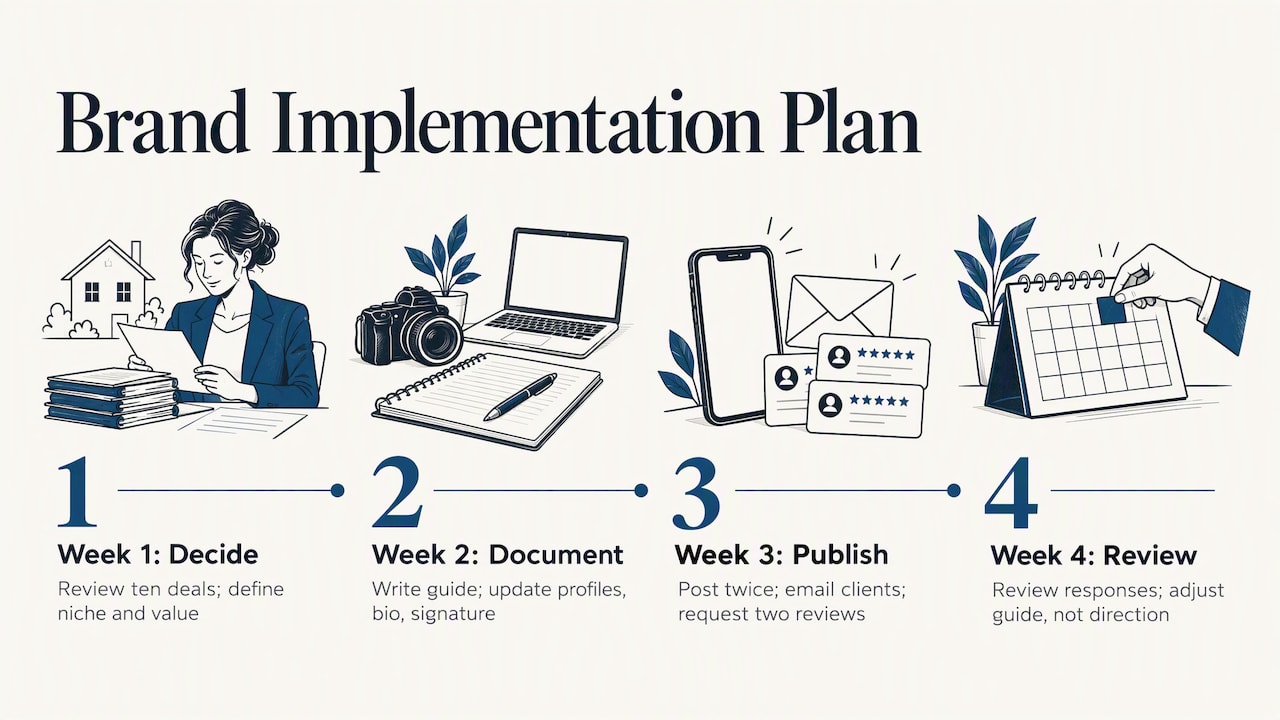
Week 2: Document. Write your brand guide: voice, colors, fonts, bio, headshot and signature. Rewrite your social profiles, website bio and email signature to match, with the required licensee and firm identification in place.
Week 3: Publish. Post twice, send one email to past clients and ask two happy clients for reviews. Keep each post tied to your niche.
Week 4: Review. Note which posts drew questions or replies, what clients asked, and what you can turn into next month’s content. Adjust your guide, not your whole direction.
Then repeat. Brand recognition builds through repetition, and the agents clients remember are usually the ones who kept showing up with the same clear message.
FAQ
Do I need a logo to build a personal brand as a real estate agent?
No. A logo can help people recognize you, but what makes a brand memorable is the expertise, perspective and approach you show consistently. Start with your niche, value proposition and a good headshot, and add a simple logo later if it fits.
Should I use my own brand or my brokerage’s brand?
Use both. Your brokerage brand provides credibility and structure, while your personal brand shows clients what working with you is like. Follow your brokerage’s policies and the licensee and firm identification rules in your ads.
How long does it take to build a personal brand?
You can define it in a few weeks, but recognition builds through months of consistent activity across your channels. Plan on at least 90 days of steady posting, emails and follow-up before you judge what is working.
Can I call myself a REALTOR® in my username or bio?
Only NAR members can use the REALTOR® mark. Members can show it next to their name in a username, but not in descriptive wording. If you are licensed but not a member, describe yourself as a licensed real estate agent instead.
Is a real estate branding course worth it for a new agent?
It can be, if it ends with practical outputs such as a niche, a positioning statement and a content plan. A focused, self-paced course with a refund policy lets you start early and avoid common mistakes. Our personal branding course is $29 and includes a 30-day money-back guarantee.
Sources
- Company Brand vs. Personal Brand, RealtyTimes
- Personal Brand vs. Brokerage Brand for Real Estate Agents, AARE
- How to Build a Personal Brand as a Real Estate Agent, Opendoor
- Your personal real estate brand vs. brokerage branding, Realtor.com
- What is Personal Branding? Forbes Books
- Personal Branding: Interdisciplinary Systematic Review
- How to Build a Strong Personal Brand, U.S. Chamber of Commerce
- 6 Criteria for Finding Your Perfect Niche, NAR
- 4 Steps to Building a Personal Brand for Real Estate Agents, Realtor.com
- NAR Internet Advertising Policy
- 4 Social Media Tips to Stay Out of Legal Trouble, NAR
- Create a Social Media Usage Policy, NAR
- Should Real Estate Agents Cultivate Their Own Brand? Inman
Recommended
- Real Estate Personal Branding Course
- Client Communication Skills Every Real Estate Agent Needs
- Real Estate Client & Presentation Skills Package
- Real Estate Marketing & Sales Accelerator
This article is provided for general information and is not a professional advice.