



A real estate post-licensing course is a one-time block of state-mandated education that a newly licensed agent (and in some states a new broker) must finish within a set window after the license is issued. The hours, the deadline and the penalty for missing it are set by your state, so the first step is to find your state’s rule and your own deadline. If you hold a Florida license, we offer the 45-hour sales associate course and the 60-hour broker course, both online and self-paced.
Key Takeaways
- Post-licensing education is a one-time requirement, separate from the continuing education (CE) you repeat for the rest of your career.
- Hours and deadlines vary widely: 12 hours in Idaho, 20 in Ohio, 45 in Louisiana, 90 in North Carolina.
- Missing the deadline can mean inactive status, suspension or a license that lapses, so treat the date as fixed.
- In Florida, our 45-hour sales associate course costs $79 and our 60-hour broker course costs $149, with a 30-day money-back guarantee.
- Always confirm your own deadline and education record with your state regulator before you enroll.
Table of Contents
- What post-licensing education is
- Post-licensing vs. continuing education
- Hours and deadlines by state
- What happens if you miss the deadline
- What post-licensing courses cover
- How to choose a post-licensing course
- Our view: why finishing early pays off
- Florida post-licensing with us
- A simple plan to finish on time
- FAQ
- Sources
What post-licensing education is
Passing the state exam gets you a license. Post-licensing education is what some states require next. It is a milestone, not a finish line: the state wants a new licensee to go deeper on contracts, agency, listings, escrow handling and law now that real transactions are underway.
The Louisiana Real Estate Commission describes it as foundational knowledge for new licensees, and notes it is a one-time requirement that ends with an examination on the course content. That exam detail matters. Post-licensing is not a pile of hours you can simply sit through; most courses end with a test you must pass.
Not every state has one. Some states fold the first-renewal education into ordinary CE, and others have no separate requirement at all. That is why searching for “post-license” without your state attached gives you a confusing mix of answers.
Post-licensing vs. continuing education
The two are easy to confuse, and mixing them up is how licenses get into trouble.
| Post-licensing | Continuing education | |
|---|---|---|
| How often | Once, early in your career | Every renewal cycle |
| Purpose | Build foundational practice knowledge | Keep you current |
| Exam | Usually required | Often per course, varies by state |
| Counts toward the other? | Depends on state | Depends on state |
The rules about overlap differ by state. Louisiana says post-license hours may count toward part of the annual CE requirement but cannot satisfy the mandatory CE topics. North Carolina treats the two as fully separate: its commission states that completing one does not change the deadlines for the other.
The safe habit is to assume nothing carries over until your regulator says it does. Once you are past your first renewal, your ongoing requirement is CE, and our continuing education courses cover it for Florida licensees.
Hours and deadlines by state
The numbers below come from state regulators. They show how different the requirement can look, and none of them is a substitute for checking your own record.
- Idaho: salespersons need 12 hours of post-license education to renew on active status for the first time. Students must attend the full course and score at least 70% on the online exams.
- Ohio: the post-licensure requirement is one specific 20-hour course, not several courses adding up to 20. The certificate is due one year from the license issue date.
- Louisiana: new licensees complete the 45-hour post-license course within the first 180 days after the initial license date.
- North Carolina: provisional brokers complete three courses (Post 301, 302 and 303) within 18 months of initial licensure to stay eligible for active brokerage work.
- Florida: sales associates take a 45-hour course and brokers a 60-hour course. We publish both, and you can read the details on our Florida post-licensing page.
Notice the different clocks. Ohio counts from the issue date, Louisiana from the initial license date in days, North Carolina in months. Write your own date down the day your license is issued.
Inactive licenses and the clock
In Louisiana, a licensee who moves to inactive status within 180 days of initial licensure does not have to take the 45 hours right away, but must complete them before going back to active. North Carolina works similarly: provisional brokers can finish their 90 hours without activating the license, which removes provisional status so the license is full broker status when you activate.
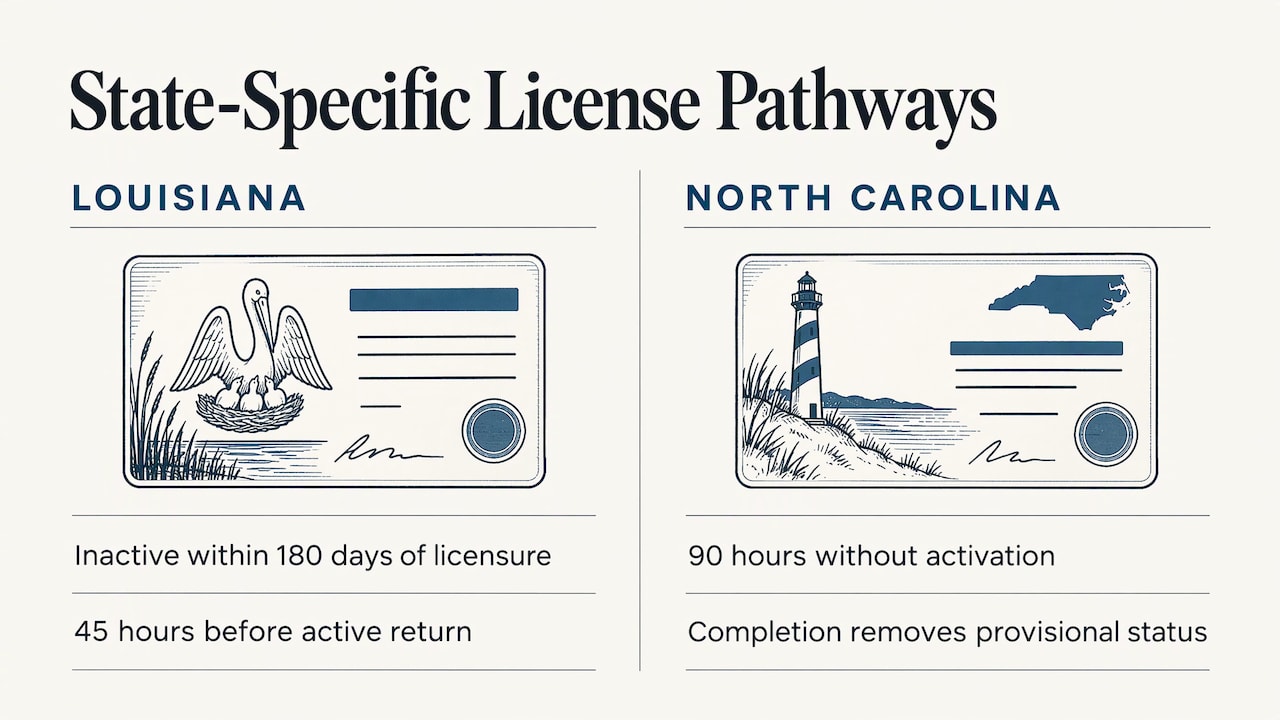
This is state-specific. Never assume going inactive pauses your obligation in a state where you have not read the rule.
What happens if you miss the deadline
The stakes are higher than a late fee. Consequences depend on the state:
- North Carolina: a provisional broker who does not finish on time is placed on inactive status and may not perform brokerage activities or collect fees, referral fees included. Courses also time out after two years, so they may have to be repeated, according to the commission’s bulletin.
- Ohio: the license is suspended if proof is not submitted in time, and can eventually be revoked, according to a summary of Ohio Revised Code 4735.09. Check the Ohio Division of Real Estate directly for the current wording.
- Florida: the first-renewal education is a hard requirement for renewal, and a lapse can mean requalifying from the start. Check your DBPR record and your exact expiration date in your MyFloridaLicense account.
The pattern is consistent: working without active status is the real cost, because you cannot be paid for brokerage activity while inactive. Plan the schedule backward from your deadline, not forward from today.
What post-licensing courses cover
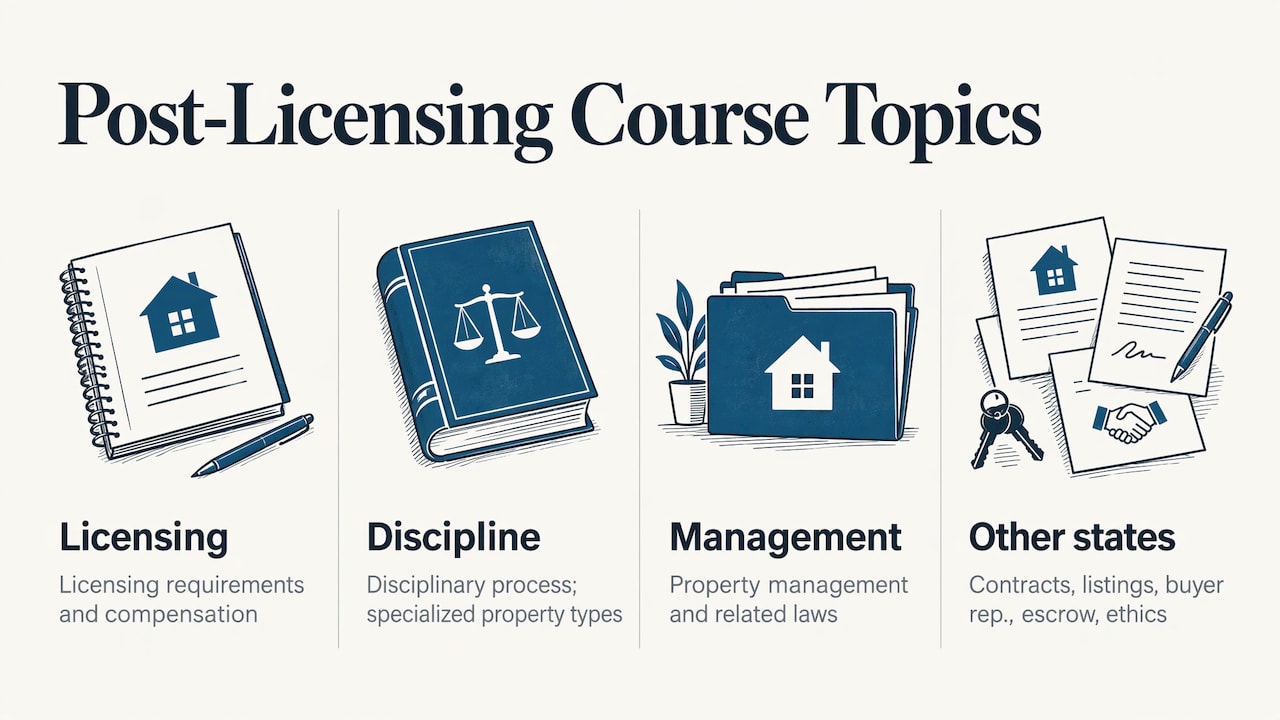
Topics vary, but expect practical, transaction-level material. North Carolina’s Post 303, for example, covers licensing requirements, brokerage compensation, the disciplinary process, specialized property types, property management and related laws. Other states emphasize contracts, listings, buyer representation, escrow and ethics.
Format options depend on what your state has approved. North Carolina allows in-person, synchronous distance, self-paced distance or blended delivery, and each delivery type needs its own approval, per the course syllabus. Whatever your state, make sure the provider is approved for the exact course and delivery type you are buying.
How to choose a post-licensing course
Use these criteria in order.
- State approval for your license type. A sales associate course does not satisfy a broker requirement, and the reverse. Confirm the course name and hours match what your regulator lists.
- Delivery format. If you work full time or show properties on weekends, self-paced online study lets you fit lessons around appointments instead of a fixed class calendar.
- Completion reporting. Find out whether the provider reports your completion to the state electronically, or whether you must file the certificate yourself. Some states, like Ohio, require you to send it in.
- Language and accessibility. If you serve multilingual clients or study more comfortably in another language, check that the course is offered in it. Read-along narration helps if you absorb material better by listening.
- Total cost. Look beyond the sticker price. Proctoring can be extra: one industry roundup reports $15 to $25 per exam at some large providers, and the fees multiply when a state requires several exams.
- Refund terms. A written money-back window lowers your risk if the course turns out not to fit.
On price alone, the same roundup found advertised post-licensing prices ranging from $25 in Georgia to $629 in North Carolina, so the state drives the cost more than anything else. For a broader view of what getting licensed costs, see our guide to real estate license cost in the U.S..
Our view: why finishing early pays off
We see the same pattern every year: agents treat post-licensing as paperwork, push it to the last month, and then find that the deadline is tighter than they thought.
Our position is simple. The course is where a new licensee learns the contract, agency and compliance details they are already being asked to handle with real clients. Taking it early turns a requirement into a head start.
That is why we built our courses to be self-paced, state-approved and available in English, Spanish and Portuguese, with read-along narration so you can study in the way that suits you. Completions are reported electronically, so you spend your time learning rather than chasing paperwork. And every course carries a 30-day money-back guarantee, because we want enrollment to be a low-risk decision.
A first license is a milestone. The agents who build lasting businesses are the ones who keep learning after it.
the author
Florida post-licensing with us
For Florida licensees, our post-licensing offer is built around the two courses the state’s first renewal calls for:
| Course | Who it is for | Price |
|---|---|---|
| Florida Sales Associate 45 Hour Post Licensing | New sales associates | $79 |
| Florida Broker 60 Hour Post Licensing | New brokers | $149 |
Both are one-off payments, self-paced and state-approved, with electronic completion reporting and a 30-day money-back guarantee. You can see both on our Florida courses page, or read the full requirements for the sales associate course and the broker course.
If your exam is still ahead of you, start with our Florida pre-licensing courses, and plan your post-licensing right after.
A simple plan to finish on time
- Find your deadline. Look up your license issue date and your state’s window (days, months or one year).
- Match the course to your license type. Sales associate and broker requirements differ.
- Block study time. Split the total hours across weeks. A 45-hour course at five hours a week takes nine weeks.
- Finish the final exam early. Leave room to retake it if your state allows.
- Verify the record. After completing, check your state record or send the certificate if your state requires it.
- Switch to CE planning. After your first renewal, track your recurring hours. Our CE credits guide explains how they work.
Once the requirement is behind you, business-skills courses are a natural next step. We offer short courses on lead conversion, listing presentations, social media and AI at $29 each on our professional development page.
FAQ
Is post-licensing education the same as continuing education?
No. Post-licensing is a one-time requirement for new licensees, usually ending in an exam, while CE repeats every renewal cycle. Some states let a few post-license hours count toward CE and others keep them completely separate, so confirm with your regulator.
How many hours of post-licensing education do I need?
It depends on your state and license type. Idaho requires 12 hours, Ohio 20, Louisiana 45 and North Carolina 90 across three courses. In Florida, sales associates take 45 hours and brokers take 60.
Can I take a post-licensing course online?
In many states, yes, provided the provider is approved for that course and delivery type. North Carolina, for example, approves self-paced distance delivery separately from classroom delivery. Check that your provider holds approval for your state.
What if I miss my post-licensing deadline?
The result depends on the state: inactive status in North Carolina, suspension in Ohio, and a serious renewal problem in Florida. Contact your regulator right away and complete the course as soon as you can, since waiting rarely improves the outcome.
Do I need post-licensing to become a broker?
Broker requirements vary by state. Some, such as Illinois, include post-license hours in the path to a base broker license, according to a state-by-state broker summary. Check your state’s broker licensing rules before planning your path.
Sources
- Louisiana Real Estate Commission: Post-Licensing Education Requirements
- Louisiana Real Estate Commission: For New Licensees
- North Carolina Real Estate Commission: Postlicensing FAQ
- NCREC Bulletins: Postlicensing and CE, Myths vs. Reality
- NCREC Bulletins: What’s Next Once You Receive Your License?
- NCREC Post 303 Student Syllabus
- Idaho Division of Occupational and Professional Licenses: Education for Licensees
- Ohio Division of Real Estate: Real Estate FAQ
- Ohio Real Estate Post-Licensing summary
- Real Estate Post License Courses by State
- Real Estate Broker License Requirements by State
Recommended
- Florida Post-Licensing Courses
- Florida 60-Hour Broker Post-License Course Requirements
- Real Estate Finance Course: How to Choose the Right One
This article is provided for general information and is not a professional advice.