



Real estate social media marketing means using platforms such as Facebook, Instagram, LinkedIn, YouTube and TikTok to build your brand, show your listings and market knowledge, and start conversations with buyers and sellers. It works best as a steady system: two platforms you choose on purpose, a repeatable content mix, a clear way to turn comments into conversations, and a monthly look at the numbers. This guide walks you through each part, with the data behind it.
Key Takeaways
- Social media is the top lead-generating technology for 39% of REALTORS®, ahead of CRM and the local MLS, according to NAR’s 2025 Technology Survey.
- Pick one or two platforms where your clients already spend time, then post a mix of educational, personal and property content three to five times a week.
- Likes are not the goal. Track saves, shares, profile visits, direct messages and real inquiries.
- Fair housing, brokerage identification and client privacy rules apply to every post you publish.
- Skills compound: a structured course in branding, lead conversion and content can shorten the learning curve.
Table of Contents
- Why social media matters for agents now
- Choose your platforms before you choose your content
- Build a content mix that people actually want
- Turn followers into conversations and leads
- Measure what predicts business, not what feels good
- Stay compliant: fair housing, identification and privacy
- Our perspective: skills, not shortcuts
- Build your skills with Merecourses
- A 30-day starting plan
- FAQ
- Sources
Why social media matters for agents now
The short answer: your future clients look you up before they call you. Social platforms have become places where people research agents, listings and neighborhoods, and realtor.com PRO notes that audiences now prefer content that feels real, relatable and helpful over polished content.
The numbers back this up. In NAR’s 2025 Technology Survey, 75% of REALTORS® reported using social media in their business, and 39% named it the top technology for generating leads, ahead of CRM (23%) and the local MLS (17%). The Forbes Agency Council reports that Gen Z and Millennials made up 41% of buyers in 2024, and 41% of them used social media to learn about real estate.
There is a caution worth building into your expectations. One 2026 analysis citing NAR data puts the median business attribution from social media at 2%, which it reads as a sign that social builds trust and visibility over time rather than producing instant leads. Treat it as a long game. You are making sure that when someone is ready to move, your name is already familiar.
Choose your platforms before you choose your content
The most common mistake is trying to be everywhere. realtor.com PRO advises focusing on one or two platforms where your audience is active. Here is how agents actually use the main options, based on NAR’s 2024 Technology Survey:
| Platform | Share of REALTORS® using it (2024) | Best suited for |
|---|---|---|
| 87% | Listings, community updates, client communication | |
| 62% | Photos, Stories and Reels, visual property marketing | |
| 48% | Professional networking, referrals, brand authority | |
| YouTube | 25% | Tours, neighborhood guides, educational video |
| TikTok | 15% | Short property videos for younger audiences |
| X (formerly Twitter) | 10% | Quick updates and market conversation |
The use cases come from realtor.com PRO’s platform overview. Popularity is not the same as fit, though. Florida Realtors describes Facebook users as generally a more mature audience interested in information and communication, while Instagram is favored by Millennials and Gen Z. If you work with move-up sellers in their fifties, Facebook and LinkedIn may do more for you than TikTok. If you work with first-time buyers, Instagram Reels deserve your attention.
A simple way to decide
- Write down your three most recent clients and where you could find each of them online.
- Pick the platform that appears most often as your primary channel.
- Pick a second platform only if you can keep both going for 90 days.
- Make sure your profile names you, your license status and your brokerage (more on that in the compliance section below).
Build a content mix that people actually want
Listing posts and “just sold” graphics have a place, but they are not a strategy on their own. Jenn Herman, quoted on NAR’s social media resource page, makes the point that posting only listings, sold announcements and new-agent welcomes shows you can get the job done but gives the audience little value. Her advice: share information clients can use at any time, such as seasonal home tips, property maintenance reminders and local referrals for landscapers, plumbers and cleaners, and then engage with the people who respond.
realtor.com PRO suggests balancing three kinds of posts:
- Educational: buying and selling tips, answers to frequently asked questions.
- Personal: why you love your community, client stories, your reason for doing this work.
- Property-focused: listings, tours, just listed and just sold.
A workable weekly rhythm for a solo agent looks like this:
| Day | Post type | Example |
|---|---|---|
| Monday | Market update | “What 30 days of local inventory looked like” |
| Wednesday | Educational Reel | Three questions to ask before touring a home |
| Friday | Property or neighborhood | A listing walkthrough or a favorite local coffee shop |
That is three posts, inside the three to five per week that realtor.com PRO calls enough to stay visible without burning out. Use a scheduler or calendar so the plan survives a busy closing week.
Repurpose instead of reinventing
One idea can feed several formats. A client tip you share in a Reel can become a quote graphic, an Instagram carousel, a LinkedIn post or a short voiceover for another platform. Consistent themes help too. Inman points to recurring series such as “On Market Monday” or “Tour Tuesday” as an easy way to make posting predictable for you and familiar for your audience.
Timing and format notes
Florida Realtors offers a useful format guide: Instagram Stories keep your core followers updated in real time, Reels reach new audiences, standard posts suit longer-lasting updates, and going Live is a fast way to spark interest. Posting windows vary by market, so treat any “best time” chart as a starting point and check your own insights after a month.
Turn followers into conversations and leads
Visibility only pays when it leads to a conversation. Three tactics have documented results.
The 5x5x5 habit
Inman describes a daily 20-minute routine: comment on five posts from people in your community, send five direct messages to people you already know, and add five new local contacts. It costs nothing and works because it is personal.
Calls to action that feel easy
The same article recommends low-pressure prompts such as “Comment INFO and I’ll send it” or “DM me TOUR and I’ll share my three-home checklist.” Your audience gets something useful, and you get a warm conversation. Franklin Florida Real Estate’s founder, quoted in Hootsuite’s expert roundup, recommends creating content for people at every stage, from casual browsers to those ready to move, and offering checklists, guides or market reports that can go straight to followers by DM or email.
Community campaigns
NAR profiles an agent team that ran weekly Facebook giveaways. One Mother’s Day giveaway drew about 533 registrations in five days, and three months later it had led to eight appointments, five showings, one listing sold and 116 new leads in their database. That is one team’s result, not a promise, but it shows what a clear offer and follow-through can do.
Respond fast, then ask one question at a time
A 2026 breakdown of social lead flow describes a four-step pattern: a caption that names a keyword, an instant reply that delivers something before asking for anything, one capture question, then a short qualification on timeline, financing and geography. Even without automation, the principle holds. Give value first, ask for little, and move people to a call or email while the conversation is still warm. If you want to sharpen that step, our lead conversion course covers it in depth, and our guide to lead generation for realtors shows how social fits with your other sources.
Move people off the platform
Platforms change their algorithms; your contact list does not. Invite followers to an email list with a market update or buyer checklist. We cover this in our real estate email marketing guide.
Measure what predicts business, not what feels good
Likes feel good and rarely pay a commission. According to Peachgum, better signals are saves, shares, profile visits after a post, direct messages, link clicks and real inquiries. Reach and impressions do not correlate strongly with lead generation. It also suggests a simple lead rate: divide actual inquiries by posts published.
Go one step further and think in closed deals. Keeping Current Matters argues that cost per closed deal matters more than cost per lead. Its example: 100 leads at $10 each that convert at 0.5% cost $2,000 per closed deal, while 10 leads at $60 each that convert at 8% cost $750 per closed deal. If you boost posts or run ads, this is the math to apply.
A monthly review takes 30 minutes:
- List every inquiry that mentioned a post, a Reel or a DM.
- Note which three posts drove the most saves, shares or messages.
- Make more of those formats and topics next month.
- Record any closed deal that began on social, even if it took months.
Patience is part of the process. A Florida Realtors contributor notes that some posts take off months after they go up, and that agents need exposure more than likes.
Stay compliant: fair housing, identification and privacy
Your posts are advertising, and your license comes with you onto every platform. NAR’s social media policy template states that agents are responsible for complying with laws governing real estate business, including fair housing, antitrust and license laws. It also advises that:
- A blog or professional page should identify your name, your real estate licensee status and your brokerage.
- Brokerage-related posts should make the brokerage relationship clear.
- You should understand each platform’s privacy practices and avoid unauthorized disclosure of client information.
- You need permission before using another person’s image in your marketing.
In practice: check your brokerage’s advertising policy before you publish, avoid language that describes who a neighborhood is “right for,” and get written permission before posting a client’s photo or closing details. If you are unsure whether a post meets Florida advertising requirements, confirm it with your broker or review your state’s rules before it goes live.
Our perspective: skills, not shortcuts
We see the same pattern with agents who come through our courses. The ones who get results from social media treat it as a professional skill, learned and practiced like contract law or negotiation, not as a side hobby.
That is why we build our professional development courses around the pieces that make social media work: a clear personal brand, a content system you can sustain, a way to convert conversations into clients, and the technology and AI tools that save you hours. Social posts get attention. Conversion skills, listing presentations and follow-up habits turn that attention into signed agreements.
We also know your time is limited. Our courses are self-paced, available in English, Spanish and Portuguese, and include read-along narration, so you can learn between showings and serve the clients in your market in the language they speak. If you are licensing or renewing in Florida, we report completions electronically, and every course carries a 30-day money-back guarantee.
Start with the brand, build the habit, then measure what happens. That order is what we teach.
the author
Build your skills with Merecourses
If you want a structured path rather than piecing tips together, our professional development library is built for working agents. Courses are $29 each, including Building Your Real Estate Personal Brand, From Lead to Client: Real Estate Lead Conversion, Social Media & Content Marketing for Real Estate, and AI for Real Estate Professionals. Prefer a bundle? See the Digital Real Estate Marketing & AI Package.
Browse the full list on our professional development page. Florida licensees can also handle pre-licensing, post-licensing and the 14-hour continuing education course ($23.95) on our Florida courses page.
A 30-day starting plan
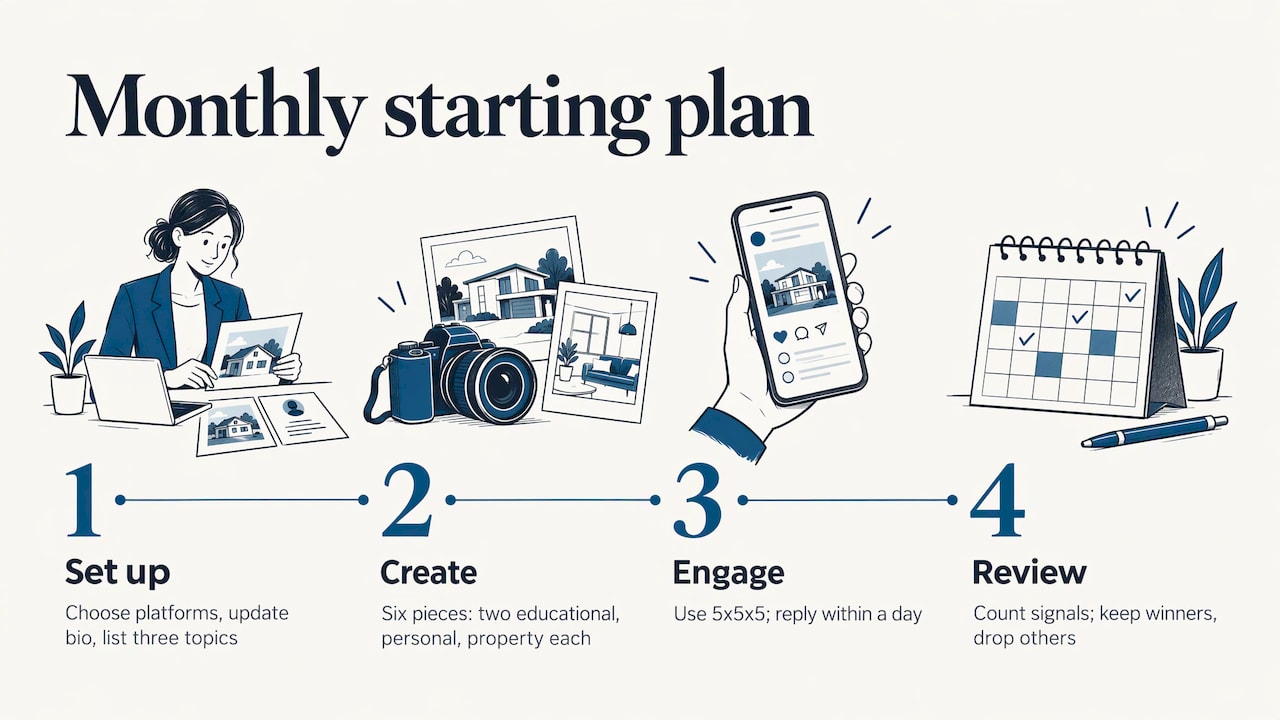
Week 1: Set up. Choose your platforms, update your bio with your name, license status and brokerage, and write down three topics your clients ask about most. Our guide to personal branding for real estate agents helps you shape the message.
Week 2: Create. Film or write six pieces of content in one sitting: two educational, two personal, two property-focused. Schedule them across the following two weeks. Batching is a major time saver, and our agent productivity guide offers more ways to protect your hours.
Week 3: Engage. Add the 5x5x5 routine. Reply to every comment and DM within a day.
Week 4: Review. Count inquiries, saves, shares and messages. Keep what worked, drop what did not, and plan the next month.
FAQ
What is social media marketing in real estate?
It is the practice of using social platforms to build a brand presence for your real estate business. Sprout Social describes the work as coordinating publishing, engagement, listening and reporting. For an individual agent, that mostly means building a personal brand and showcasing properties and local expertise.
How often should a real estate agent post?
realtor.com PRO recommends three to five times per week, which is enough to stay visible without burning out. Consistency matters more than volume, so choose a schedule you can keep for months. Use a calendar or scheduler to hold yourself to it.
Which platform is best for real estate agents?
There is no single best platform. Facebook has the widest use among REALTORS® at 87%, Instagram suits visual content, and LinkedIn fits networking and referrals. Start with one or two where your target clients already spend time.
How do I know if my social media marketing is working?
Look at saves, shares, profile visits, direct messages, link clicks and inquiries rather than likes alone. Over time, track which closed transactions started on social. Review these numbers monthly and adjust your content accordingly.
Do I need to follow special rules when posting?
Yes. Fair housing and license law apply to your posts, and your name, licensee status and brokerage should be clear. Protect client information and get permission before using anyone’s image. Check your brokerage policy and state requirements before publishing.
Sources
- NAR 2025 Technology Survey
- NAR 2024 Technology Survey
- NAR: Social Media
- NAR: Create a Social Media Usage Policy
- NAR: 5 Lead Generation Ideas for Real Estate Agents
- Florida Realtors: Posting on Social
- realtor.com PRO: Your social media blueprint
- realtor.com PRO: Social media strategies for real estate
- Inman: 5 Strategies To Build Your First Social Media Pipeline
- Forbes Agency Council: Social Media Marketing For Real Estate
- Hootsuite: Real estate social media marketing expert tips
- Sprout Social: Social Media for Real Estate
- Peachgum: Local Market Data Social Content
- Keeping Current Matters: Real Estate Agent Advertising Guide
- Apaya: Real Estate Social Media Strategy
- CreatorFlow: Real Estate Leads on Social Media
Recommended
- Real Estate Email Marketing: A Practical Guide for Agents
- Personal Branding for Real Estate Agents: A Practical Guide
- Lead Generation for Realtors: What Works and What to Pay For
This article is provided for general information and is not a professional advice.