



Spanish real estate classes come in two kinds. The first is a state-approved course taught in Spanish, which can count toward a license. The second is a language class that teaches an English-speaking agent the vocabulary to serve Spanish-speaking clients, which will not count toward any license. Which one you need depends on your goal, and mixing them up is an expensive mistake. This guide explains both, shows how to confirm that a course meets your state’s rules, and gives you a working glossary of real estate words in Spanish.
Key Takeaways
- A course that counts toward a license must be approved by your state’s real estate regulator. A Spanish vocabulary class, however good, does not count.
- Course hours, renewal rules and exam language differ by state. Confirm all three with your regulator before you pay.
- Spanish-language instruction helps most with the legal and contract concepts that decide whether you pass the exam and serve clients well.
- Spanish-language service builds trust with buyers and sellers, so vocabulary and professional-development classes can pay off after you are licensed.
- Check how completion is reported to the state. Electronic reporting saves you from chasing certificates.
Table of Contents
- What “Spanish real estate classes” actually means
- Types of Spanish-language real estate courses
- How to check that a Spanish course meets your state’s requirements
- Why learning in Spanish helps, and where it stops
- Spanish real estate terms: a working glossary
- Why Spanish matters for client trust
- Our perspective
- Florida courses in Spanish from MyEdukator
- Business-skill classes to grow with Spanish-speaking clients
- How to choose the right class
- FAQ
- Sources
What “Spanish real estate classes” actually means
People type this search for three different reasons, and each one leads to a different product.
- You want to get licensed and you learn better in Spanish. You need a state-approved pre-licensing course delivered in Spanish.
- You are already licensed and need to keep the license active. You need post-licensing or continuing education hours that your state accepts, in the language you prefer.
- You are an English-speaking agent who wants to serve Spanish-speaking clients. You need vocabulary, conversation practice and cultural context, plus perhaps business-skill classes.
The first two are regulated. The third is a personal and business investment. A Spanish-for-agents class can make you more useful at a showing, but your regulator will not accept it as education credit.
Types of Spanish-language real estate courses
Pre-licensing
Pre-licensing courses cover the content you need before you can sit for the state exam: property law, contracts, agency, financing, disclosures and ethics. The required hours vary widely. In Florida, for example, the sales associate course is 63 hours and the broker course is 72 hours. Other states ask for more or fewer.
Post-licensing
Some states require newly licensed agents to complete additional hours soon after licensing. South Dakota, for instance, requires new broker associates to complete 60 postlicensing hours. Florida has its own post-licensing requirement for sales associates and brokers. Missing it can put your license in jeopardy, so put the deadline on your calendar the day you are licensed.
Continuing education
Once you are past the post-licensing stage, you renew through continuing education. The same South Dakota page shows how this works in one state: active broker associates complete 24 hours during the preceding two license years. Other states use different cycles and different hours, so never assume your old state’s rule applies after a move.
Professional development
These are optional business-skill courses: lead conversion, listing presentations, social media, technology and personal branding. They do not satisfy a license requirement, but they are where many agents find new clients, including Spanish-speaking ones.
How to check that a Spanish course meets your state’s requirements
A course can look professional and still be useless for your license. Run this check before you enroll.
- Find the regulator’s list of approved schools. Every state publishes one, usually on the real estate commission or licensing department site. In Florida, that is the Department of Business and Professional Regulation (DBPR). Search the school and the specific course.
- Match the hours to the requirement. Compare the course length with the state’s current number for your license type. Hours change when laws change.
- Confirm the course type. Pre-licensing, post-licensing and continuing education are separate approvals. A school may be approved for one and not the others.
- Ask about the language of the course materials and the final exam. The course may be in Spanish while a school’s end-of-course test or your state exam is not. Ask directly.
- Ask how completion is reported. Some schools report to the state electronically. Others hand you a certificate you must upload or mail.
- Read the refund policy. A written money-back window protects you if the format does not suit you.
Exam language is a separate question
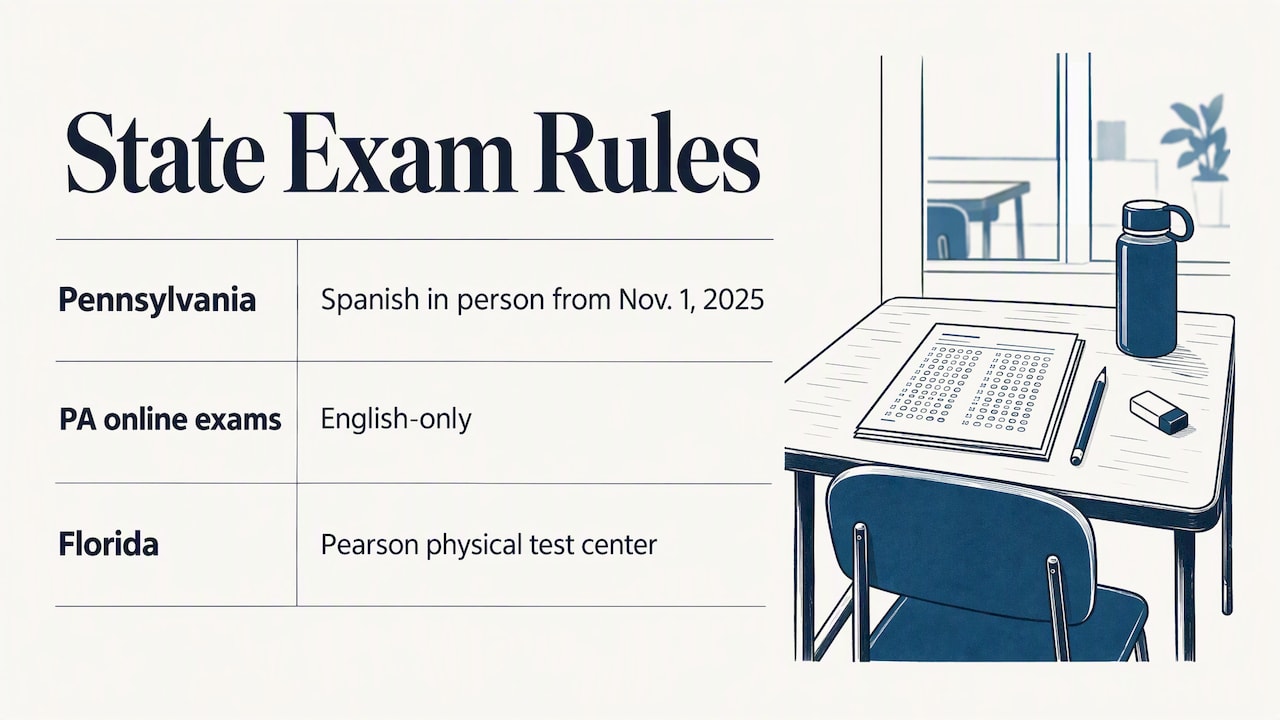
Taking a course in Spanish does not mean you will take the state exam in Spanish. Pennsylvania only recently changed its approach: from November 1, 2025, candidates could take real estate license exams in Spanish in person at test centers, while online exams stayed English-only. Florida is different again. Its candidates must take the state exam in a physical test center run by Pearson. For the language options on your exam, ask your state regulator or the exam vendor, because those rules are set state by state and change.
That gap matters for how you study. If you learn the material in Spanish but sit the exam in English, learn the English terms as you go. The glossary below helps with that.
Why learning in Spanish helps, and where it stops
Real estate law is dense. Concepts like agency, disclosure, escrow and title are hard enough in your first language. Studying them in the language you think in can mean fewer misunderstandings and more confidence when you reach the exam.
There is a limit. Your contracts, disclosures and many forms will still be in English in most transactions. A good Spanish-language course teaches the concept in Spanish and names the English term next to it. If a course does not do that, you may understand the idea but freeze when you see the English form on a client’s kitchen table.
Pairing a course with exam practice
A course gives you the knowledge. Practice questions and repetition lock it in. If you want a structured way to review, tools that turn your notes into study modules and flashcards can help you drill terms in either language between course sessions. Treat them as a supplement. Your approved course is what counts for the state.
Spanish real estate terms: a working glossary
The National Association of Hispanic Real Estate Professionals (NAHREP) identified a need for guidance and consistency in Spanish-neutral translations of words frequently used in real estate transactions. In practice, Spanish speaking clients come from many countries, and a word that is natural in Mexico may sound unfamiliar in Colombia or Argentina. The terms below are widely understood. When in doubt, ask the client which word they prefer.
Buying and selling
| English | Spanish | Notes |
|---|---|---|
| Real estate agent | agente de bienes raíces | Also “corredor” in some regions |
| Broker | corredor de bienes raíces | Licensing level, not just a job title |
| Buyer | comprador / compradora | |
| Seller | vendedor / vendedora | |
| Listing | listado / propiedad en venta | |
| Offer | oferta | |
| Counteroffer | contraoferta | |
| Closing | cierre | The final step where ownership transfers |
| Closing costs | costos de cierre | |
| Contract | contrato | |
| Disclosure | divulgación | Required statements about property condition |
| Inspection | inspección | |
| Appraisal | avalúo / tasación | Regional variation |
Money and financing
| English | Spanish | Notes |
|---|---|---|
| Mortgage | hipoteca | |
| Down payment | pago inicial / enganche | “Enganche” is common in Mexico |
| Interest rate | tasa de interés | |
| Pre-approval | preaprobación | |
| Credit score | puntaje de crédito | |
| Escrow | depósito en garantía / fideicomiso | Explain the concept, not just the word |
| Earnest money | depósito de buena fe | |
| Property taxes | impuestos sobre la propiedad |
Property and rentals
| English | Spanish | Notes |
|---|---|---|
| Title | título de propiedad | |
| Deed | escritura | |
| Lease | contrato de arrendamiento | |
| Landlord | arrendador / propietario | |
| Tenant | inquilino / arrendatario | |
| Security deposit | depósito de seguridad | |
| Homeowners association | asociación de propietarios | Often shortened to HOA even in Spanish |
| Open house | casa abierta |
A word list is a start. A word like “escrow” has no clean one-word equivalent, because the arrangement itself works differently in many Latin American countries. Learn how to explain it in a sentence, and keep the English term nearby.
Why Spanish matters for client trust
The National Association of REALTORS® notes that Spanish-language services build trust and strengthen confidence in decision-making. The same page points to the scale of the opportunity: 48.5% of Hispanic American households were homeowners by 2025, and NAR provides a “NAR en Español” resource hub for agents who serve these clients.
For you, that translates into three practical points.
- Clients ask better questions when they understand. A buyer who follows the explanation of an inspection contingency makes better decisions and is less likely to walk away from a fair deal.
- Accuracy protects you. Mistranslating a disclosure or a deadline is a liability, not a courtesy. If your Spanish is not strong enough for a legal term, say so and bring in a qualified interpreter or your broker.
- Language is only part of the work. You still need to find clients. Learning buyer lead tactics and applying them to Spanish-speaking communities is how language skill becomes business.
Our perspective
We see the same pattern again and again: agents are told to take “Spanish classes” without anyone asking which problem they are solving. If you are an aspiring agent, the first question is not vocabulary. It is whether the course you buy is approved by your state for the license you want. Everything else comes second.
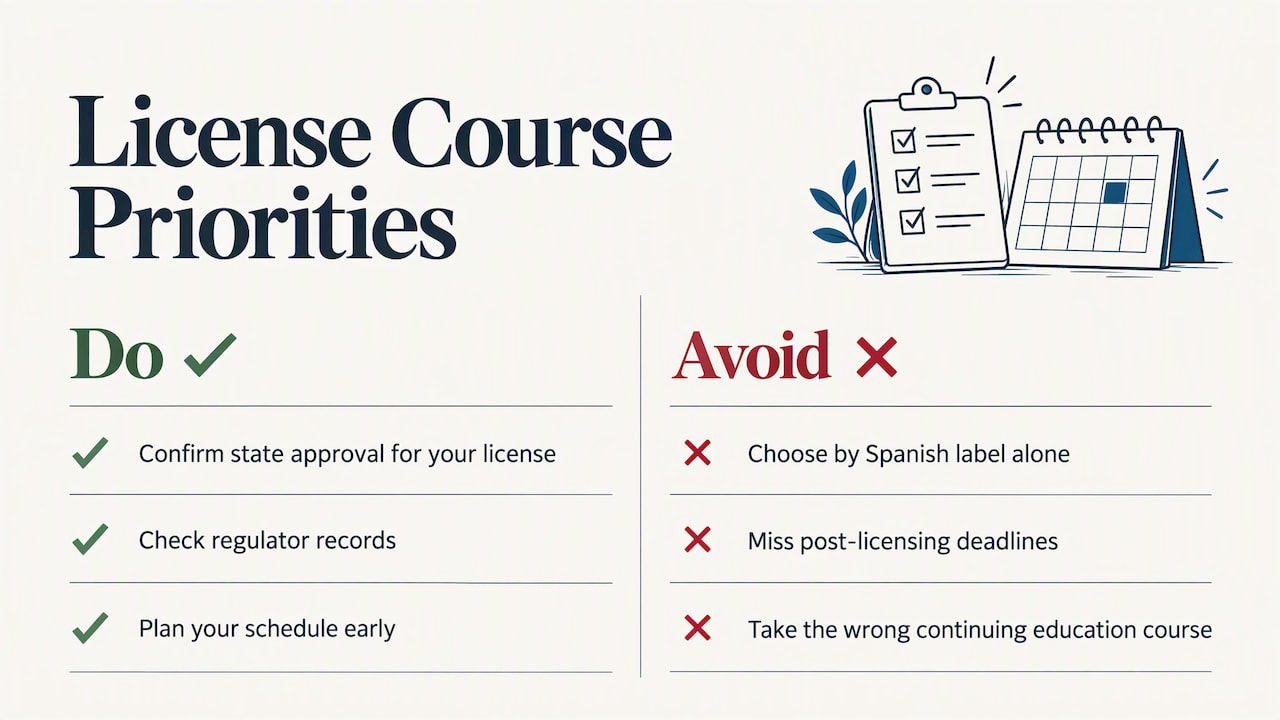
We built our courses around that priority. Our state-approved real estate courses are self-paced and available in English, Spanish and Portuguese, because agents serve diverse clients and many of them learn best in their first language. Read-along narration lets you follow the text while you listen, which helps if you absorb dense legal material better by ear, or if you are building confidence in a second language. We report completions electronically, so you are not hunting for a certificate when your deadline arrives.
The stakes are real. A missed post-licensing deadline or the wrong continuing education course can affect your license, so check your regulator’s record and plan your schedule early. A license is a milestone, not a finish line. The agents who keep growing are the ones who treat education as part of the business, both the hours the state requires and the skills that bring in clients.
— the author
Florida courses in Spanish from MyEdukator
If you are pursuing a Florida license, our Spanish-language course catalog shows the courses in Spanish, and our Florida courses page lists every license level with its current price. All courses are online, self-paced and covered by a 30-day money-back guarantee.
Here is what we offer for Florida, with prices as published:
| Course | Who it is for | Price |
|---|---|---|
| Sales Associate 63 Hour Pre Licensing | New agents | $99 |
| Broker 72 Hour Pre Licensing | Aspiring brokers | $159 |
| Sales Associate 45 Hour Post Licensing | Newly licensed sales associates | $79 |
| Broker 60 Hour Post Licensing | Newly licensed brokers | $149 |
| 14-Hour Continuing Education | Renewing licensees | $23.95 |
You can read the details on our pages for pre-licensing, post-licensing and continuing education. Before you enroll in any course, including ours, confirm the current requirement with DBPR for your license type.
Business-skill classes to grow with Spanish-speaking clients
Once your license is in order, optional classes help you turn language skill into a pipeline. Our professional development courses are $29 each unless noted, and cover topics such as:
- Building Your Real Estate Personal Brand
- From Lead to Client: Real Estate Lead Conversion
- The Modern Listing Presentation
- Social Media & Content Marketing for Real Estate
- Running Better Open Houses
- AI for Real Estate Professionals
- Real Estate Photography, Video & Property Marketing Basics
- Real Estate Technology & Productivity Toolkit
- International Real Estate Course ($49), useful if you work with buyers who invest across borders
These do not count toward your license. They are for the agent who wants a stronger brand, tighter follow-up and better presentations.
How to choose the right class
Use this decision path.
- Not yet licensed: choose a state-approved pre-licensing course in the language you learn best. Verify the school and course on your regulator’s list. Then plan for the exam, and learn the English terms alongside the Spanish ones.
- Newly licensed: find your state’s post-licensing rule and deadline. Do the hours early, not in the last month.
- Renewing: check your state’s cycle and hours. Confirm the school reports completion to the state, or keep your certificate safe.
- Licensed and serving Spanish-speaking clients: use vocabulary practice for everyday conversation, and invest in business-skill courses to attract and keep these clients. Use a qualified interpreter for legal terms you cannot explain precisely.
FAQ
Do Spanish real estate classes count toward a license?
Only if the course is approved by your state regulator for the type of education you need, such as pre-licensing or continuing education. Vocabulary or conversation classes do not count. Check the regulator’s list of approved schools before you pay.
Can I take the state real estate exam in Spanish?
It depends on the state. Pennsylvania began offering in-person Spanish-language exams at test centers from November 1, 2025, while Florida requires a physical test center. Ask your state’s regulator or exam vendor which languages are available for your exam.
How do I learn real estate words in Spanish quickly?
Start with the terms you use every day: offer, closing, inspection, mortgage and deposit. Learn each in a full sentence, not only as a single word. Ask clients which regional word they prefer, since usage varies between countries.
Are Spanish-language courses cheaper or easier than English ones?
No. The state sets the required hours and content, so the course covers the same material. Language only changes how you study it. Compare price, approval status, support and the refund policy.
Sources
- Pennsylvania Department of State: real estate license exams in Spanish
- NAR: Working With Spanish-Speaking Clients
- South Dakota Real Estate Commission: continuing education requirements
- Pearson VUE: Florida Real Estate exams
- Examo study platform
- Yuppsy: how to get buyer leads for real estate
Recommended
This article is provided for general information and is not a professional advice.