



The most reliable lead generation for realtors starts with people who already know you, then adds open houses, local content and a website that captures contact details. Paid leads can work too, but only if you can answer every inquiry within minutes and follow up many times. This guide shows where leads come from, how to build a weekly routine, what paid sources cost, and which legal rules apply when you contact people.
- Referrals and repeat clients drive most agent business. Build your sphere before you spend on ads or portals.
- New agents can trade time for leads: sphere outreach, open houses and local content cost little but build slowly.
- Paid leads are prospects, not clients. Test one source at a time with a spending cap and a response rule.
- Speed and persistence convert leads: reply within minutes and expect 8 to 12 touchpoints.
- Get consent before texting or auto-dialing. Federal TCPA rules apply to how you contact leads.
Table of Contents
- Where real estate leads actually come from
- A weekly plan for new agents
- Online lead generation strategies
- Offline lead generation strategies
- Should you pay for leads?
- Follow-up: where leads are won or lost
- Stay legal when you contact leads
- Our perspective: leads are a skill, not a purchase
- Build the skills behind the leads
- FAQ
- Sources
Where real estate leads actually come from
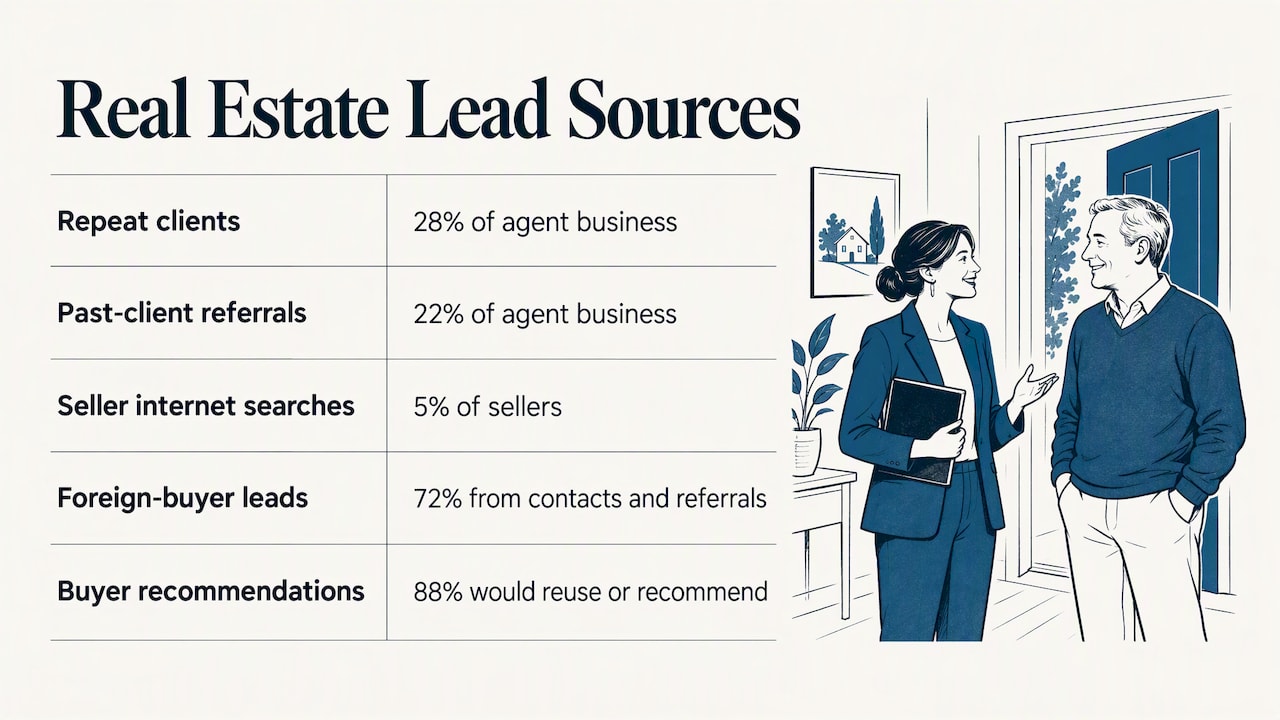
Before choosing tactics, look at what the data says about how clients find agents. In the 2026 National Association of REALTORS® Member Profile, the typical REALTOR® earned 28% of business from repeat clients and 22% from referrals by past clients in 2025. That is half of a typical agent’s business from people who have already worked with them.
Buyers tell the same story. NAR reported in April 2025 that referrals from friends, neighbors or relatives remained the primary way buyers found their agent, and 88% said they would use their agent again or recommend them. Sellers lean on personal connections even more. NAR’s 2024 summary of generational trends found that sellers most often found agents through people they know, and only 5% used internet searches. Those sellers valued reputation, honesty and trustworthiness.
The pattern holds in niche markets too. Among agents working with foreign residential buyers, referrals and personal and business contacts made up 72% of leads between April 2024 and March 2025.
What this means for you: every lead source you add should feed a relationship, not replace one. A portal inquiry you never follow up on is worth nothing. A past client you stay in touch with can be worth several closings.
A weekly plan for new agents
If you just got licensed, you have more time than money. That is fine. New agents commonly start by working their personal network and open houses, then adding paid sources once they can answer every call quickly.
A realistic weekly rhythm, based on guidance from realtor.com® PRO, looks like this:
- Reach out personally to five people in your sphere.
- Post two pieces of local content.
- Host or support one open house.
- Block two 30-minute sessions just for follow-up.
Notice how small it is. The point is consistency. Five real conversations a week is 250 in a year, and each one reminds someone that you are the person to call when a friend asks about buying or selling.
Make the sphere outreach specific
Do not send a generic announcement. Ask a question you can help with: whether a neighbor is thinking about moving, what a coworker would change about their home, what a relative’s timeline looks like. Log the answer in a spreadsheet or CRM. Next month, follow up on what they told you.
Tell your sphere what you do
People refer agents they understand. Write one sentence about who you serve and where, then use it everywhere. Our personal branding course covers how to build that message if you are starting from scratch.
Online lead generation strategies
Online tactics scale beyond your personal network, but most take months to pay off. The common ones, as outlined in a 2026 guide from Opendoor, are IDX websites, local content, social media and paid ads.
An IDX website that captures contact details
An IDX-enabled site displays active MLS listings directly. The benefit is that you capture visitor contact data instead of relying solely on third-party portals. Owning the data matters: a portal can change its pricing or rules, but your email list stays with you.
Social media
Social platforms have been the top technology source of quality leads for years. NAR’s 2021 Real Estate in a Digital Age report found REALTORS® named social media (52%), CRM systems (31%) and MLS sites (28%) as leading sources. In the same report, 90% used Facebook, 52% Instagram and 48% LinkedIn. That report is a few years old, so treat the platform mix as a guide and test where your own clients spend time.
Post things neighbors find useful: a local market snapshot, a new restaurant opening, a short explanation of how an offer works. Reply to comments. Message people who engage.
Video
A short listing tour or neighborhood video builds trust before anyone calls you. NAR’s practitioner article suggests free phone-shot video distributed through YouTube and social media. You do not need a studio. You need steady light, a clear voice and a call to action.
If you want a structured path through content, photography and tools, the Digital Real Estate Marketing & AI Package covers those skills in one place.
Paid ads
Paid social and search ads work when your follow-up is ready. We cover costs below.
Offline lead generation strategies
Offline work is slower per hour but builds trust that online leads rarely start with.
Open houses
Open houses are the classic new-agent lead source. NAR’s open-house guidance recommends promoting at least two days ahead through social media, the MLS and major real estate sites, email, signage and Facebook Live. Then collect contact details at the door and send a personal follow-up note. The sign-in sheet is the lead source. The follow-up note is what turns it into a conversation.
Our Running Better Open Houses course is $29 and focuses on this exact skill.
Geographic farming
NAR describes geographic farming as consistently marketing within a defined area through direct mail, neighborhood events, local sponsorships and resident engagement. The key word is consistently. A farm of a few hundred homes you contact every month for a year beats a huge area you mail once.
Networking and community involvement
Face-to-face networking, giveaways and community involvement appear again and again in NAR’s list of practitioner tips. Join a group where you would genuinely spend time anyway: a parent association, a running club, a local business group. Be useful first.
Should you pay for leads?
The honest answer: sometimes, if you are ready. Lead generators can fill the top of the funnel, but leads are rarely ready to close. A purchased lead usually identifies a prospect. You still have to follow up, develop the opportunity and obtain a buyer-agency or listing agreement.
Many agents do not pay at all. NAR-based data summarized by one industry guide shows median 2025 spend of $950 on marketing services, $620 on listing marketing and $740 on technology, with many agents reporting zero spend on paid lead generation.
What leads cost
Prices vary widely by channel and keyword. One 2026 analysis reports paid social leads at $5 to $30, Google Ads buyer leads at $20 to $60, and seller-keyword leads at $150 to $400. Treat these as benchmarks, not quotes, because your market and competition will move them.
Conversion matters more than price
A cheap lead that never answers costs more than an expensive one that signs. RealScout reports that expired listings convert at 43% to 44%, FSBOs at 27% to 38% and portal leads at 0.4% to 1.2%. These are one company’s figures, so do not expect to match them exactly. The direction is the lesson: leads that already intend to act convert far better than casual browsers.
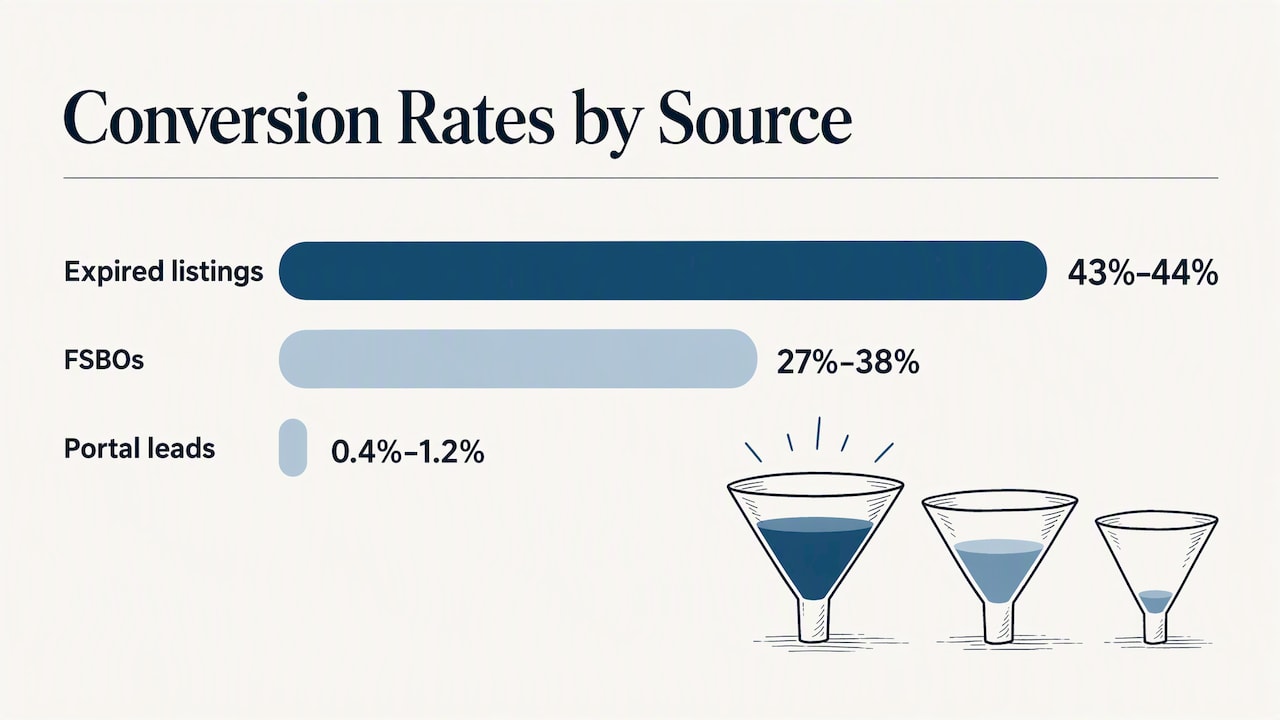
The better measure is cost per signed client by source. Comparing channels on lead price alone often misidentifies the best source, because conversion rates vary more than prices do.
Questions to ask before you pay
HousingWire advises checking lead freshness, how reliable the contact information is, and whether you can respond immediately and repeatedly. Inman’s checklist adds that you should research complaints and reviews, ask brokers and colleagues, start with a short commitment, and cancel when leads are poor or out of area. Inman also advises buying online leads only when you have a system to follow up and nurture them.
A 30-day test for any new source
The Bauer Group suggests a simple 30-day test:
- Pick one source only.
- Set a firm spending cap.
- Set a response rule, such as a same-day call attempt.
- Log every lead.
- Review results on day 30.
Changing three things at once teaches you nothing. Change one.
Follow-up: where leads are won or lost
Most agents do not have a lead problem. They have a follow-up problem.
Speed matters first. Opendoor cites XANT research that contacting a new lead within five minutes makes you 100 times more likely to connect than waiting 30 minutes. Persistence matters second: the same guide states the average lead needs 8 to 12 touchpoints before converting. Those are vendor-cited figures, so use them as a reminder rather than a law of nature.
A simple follow-up routine:
- First five minutes: call, then text if you have consent.
- First day: send a short email with one useful answer to what they asked.
- First two weeks: vary your touches: a call, a market update, a listing that fits, a check-in.
- After that: move them into a monthly nurture list until they are ready or ask to stop.
Conversation skills matter as much as the schedule. Our From Lead to Client: Real Estate Lead Conversion course ($29) is built around moving a new contact to a signed agreement.
Stay legal when you contact leads
Lead generation involves calls, texts and emails, and federal rules apply. This is general information, not legal advice. If you run a team, buy lead lists or use auto-dialers, talk to your broker or a telecommunications attorney.
- Consent for automated contact. The Telephone Consumer Protection Act generally requires prior express consent for autodialed or prerecorded calls or texts to cell phones, subject to exceptions. The FCC’s advisory puts the burden of proving consent on the caller, so keep records.
- One seller per consent. Since January 27, 2025, the FCC’s one-to-one consent rule bars lead generators from using one consumer’s written consent for robocalls or robotexts from multiple sellers. Ask any lead vendor how they document consent for you specifically.
- Prerecorded messages. They must identify the responsible party at the start, using the official business name, and give a phone number.
Also check your state’s real estate commission and your brokerage’s policies on advertising, since both set their own requirements.
Our perspective: leads are a skill, not a purchase
We train agents who are getting licensed, renewing, or building their business, and we see the same pattern. Agents often treat lead generation as something to buy, when it is a set of habits and skills they can learn: talking to people, presenting well, following up and using tools sensibly.
The research above points the same way. Experienced agents lean on referrals and repeat clients, and NAR’s deputy chief economist described a structural shift toward seasoned professionals relying on those relationships in a low-inventory, affordability-strained market. That shift raises the stakes for new agents: you need a reputation, not just a lead count.
Our advice is to treat your license as a milestone, not a finish line. Spend your first months on relationships and skills that last. Add paid sources later, once you can answer fast and follow up consistently. And invest in education that you will use on Monday morning, not only the hours your state requires.
— User
Build the skills behind the leads
If you are choosing where to start, we offer business skills courses that match the topics in this guide. Our professional development courses are self-paced and online, and most are $29 each, including From Lead to Client, Building Your Real Estate Personal Brand, Social Media & Content Marketing for Real Estate, and AI for Real Estate Professionals ($29). You can see them all on our professional development page. For a bundled path, look at the Real Estate Marketing & Sales Accelerator. All courses come with a 30-day money-back guarantee.
If you are still getting licensed in Florida, see our Florida real estate courses, where the Sales Associate 63 Hour course is $99.
FAQ
How do new agents find leads?
Most start with people they know and with open houses, trading time for leads rather than money. Tell your sphere you are licensed, ask for introductions, and host or support an open house each week. Add paid sources only after you can respond to every inquiry quickly.
Do real estate lead generators work?
They can, but purchased leads are usually prospects, not ready clients. Results depend on lead freshness, accurate contact information and your own follow-up. Start with a short commitment and a spending cap, then measure cost per signed client.
How can I get free real estate leads?
Cultivate your sphere, host open houses and post helpful local content on social media. These cost little money, but organic lead generation tends to be slower than paid. Consistency over several months is what makes them work.
How much do real estate leads cost?
It depends heavily on the channel. One 2026 analysis puts paid social leads at $5 to $30, Google Ads buyer leads at $20 to $60 and seller-keyword leads at $150 to $400. Judge each source by how many leads become signed clients, not by price per lead.
Sources
- The Feature Sheet: 2026 Member Profile (NAR)
- Baby Boomers Regain Top Spot as Largest Share of Home Buyers (NAR)
- What Buyers, Sellers Want Most From Real Estate Agents (NAR)
- 2025 International Transactions in U.S. Residential Real Estate (NAR)
- Where Real Estate Leads Come From (The Bauer Group)
- What is real estate lead generation? (realtor.com PRO)
- Real Estate Lead Generation: The Ultimate Guide for Agents (Opendoor)
- Real Estate in a Digital Age (NAR, 2021)
- 8 Invaluable Lead Generation Ideas for Agents and Brokers (NAR)
- Help Agents Make Their Open Houses Stand Out (NAR)
- Farming & Prospecting (NAR)
- Is buying real estate leads really worth it? (HousingWire)
- 7 Things Everyone Should Do Before Paying For Online Leads (Inman)
- 25 Real Estate Lead Generation Strategies That Work (Inman)
- How Realtors Generate Leads in 2025 to 2026 (SixPL)
- How to Get Real Estate Leads in 2026 (Getlead)
- Real Estate Lead Generation Strategies That Convert (RealScout)
- FCC TCPA advisory, 2016
- FCC One-to-One Consent Rule for TCPA
- Experienced REALTORS® Anchor the Industry (NAR)
Recommended
- From Lead to Client: Real Estate Lead Conversion
- Real Estate Marketing & Sales Accelerator
- Digital Real Estate Marketing & AI Package
- Real Estate Business Builder Package