



Client communication skills come down to a handful of habits: answer fast, listen more than you talk, explain what clients are signing, set expectations early and follow up before anyone has to ask. Agents who practice these habits build trust, and trust is what turns one transaction into years of referrals. Agents who skip them end up in complaint files. This guide shows you what each habit looks like in a real estate practice, with examples you can use this week.
Key takeaways
- Poor communication shows up in most licensing complaint investigations, according to one state real estate commission, so good communication is also risk management.
- Set your response time, preferred channel and update schedule in the first conversation, then keep to them.
- Listen first. A common guideline is to listen about 80% of the time and talk about 20%.
- Update clients even when there is no news. Silence is what creates anxiety.
- Never overpromise on price, timeline or outcome. A hard truth delivered with care costs less than a broken promise.
Table of Contents
- What client communication means in real estate
- Why poor communication ends up in complaint files
- The core client communication skills
- The 7 Cs of communication, applied to real estate
- Setting expectations in the first meeting
- Examples of client communication at each stage
- Common mistakes to avoid
- Our perspective: communication is a licensed skill
- Build the skills with a course
- A weekly practice plan
- FAQ
- Sources
What client communication means in real estate
Client communication is every interaction you use to pass information to a client: calls, texts, emails, showings, listing consultations, and the notes you send afterward. Realtor.com’s agent resources describe it as the way you build trust and strengthen the relationship during a transaction.
In real estate the stakes are higher than in most service businesses. Your client is making what is often the largest financial decision of their life, on a deadline, with strangers on the other side of the table. They do not know what an addendum is, why an inspection period matters or how escrow works. You do. The gap between what you know and what they know is the space where misunderstandings, frustration and complaints grow.
There is also a business case. As one industry trainer, Ken Holman, puts it, clients are the lifeblood of a brokerage, and your relationship with them runs over years, not weeks. Every conversation either adds to that relationship or draws it down.
Why poor communication ends up in complaint files
This is not only a soft-skills issue. A state real estate commission’s guidance on communication, published in 2023, states that in most, if not all, of its complaint investigations poor communication played a role, producing frustration, mistrust and dissatisfaction before a complaint was ever filed.
The same document tells licensees not to assume clients know things they may not. You are expected to explain and educate clients about what they are signing and to set reasonable expectations. That is a regulator’s view of communication: a professional duty, not a courtesy.
Check your own state’s rules and your brokerage’s policies on required disclosures and record keeping. Your designated broker is the right person to ask when a client situation is unclear.
The core client communication skills
A trade group lists five keys to effective communication: making it meaningful, consistent, branded, action-oriented and responsive. The sections below turn those ideas, and the habits regulators and brokers keep returning to, into specific practices.
1. Responsiveness
Speed is the skill clients notice first. You do not need to solve the problem in the first reply. You need to acknowledge it and say when you will have an answer.
Publishing a standard helps. An Inman piece on client texting reports that setting and sharing responsiveness standards, such as replying to active clients within the same business day, builds trust. Put yours in your listing presentation, your buyer consultation and your email signature.
A practical version:
- Active clients: reply the same business day, even if only to say you are checking.
- Offer or inspection deadlines: reply within the hour during business hours.
- Evenings and weekends: say plainly when you will respond, and then do.
2. Active listening
Active listening means concentrating, understanding, responding and remembering. A Transactly post on managing client communication lists paraphrasing and open-ended questions as core techniques.
Try this in a buyer consultation:
- Ask an open question: “What would make this house feel like the right one?”
- Paraphrase: “So you need a home office, a short commute and a yard for the dog. Did I get that right?”
- Write it down and refer to it when you send listings: “This one has the office you wanted but the commute is longer. Is that a trade-off you’d consider?”
That last step is what clients remember. It proves you heard them.
The 80/20 guideline from REALTOR® Resources is a useful check: listen about 80% of the time. The same article warns that when your communication turns into a monologue of stats and features, you risk sidelining the client’s real goals and concerns.
3. Plain explanations
Talk in words the client understands. “Contingency,” “title commitment” and “earnest money” are daily vocabulary for you and a foreign language for a first-time buyer.
A HousingWire article on small client moments suggests explaining the process clearly and patiently, using analogies to make big concepts understandable. For example, you might explain an appraisal contingency as a safety net: if the bank’s valuation comes in below the contract price, the buyer has a defined way to renegotiate or step back, within the terms of the contract.
After explaining, check understanding without talking down: “I want to be sure I explained that well. How would you describe it back to me?”
4. Honesty about what you can and cannot control
Overpromising is the fastest way to lose a client’s trust. REALTOR® Resources warns that overpromising on timelines, pricing or outcomes to win the listing can do more damage than a tough truth delivered with care. Its guidance on managing expectations is blunt: say what you mean and mean what you say, and do not dodge tough questions.
A seller asking for a price the comps do not support is the classic test. Compare:
- Weak: “We can try it and see.”
- Better: “Here are the three closest sales and what they sold for. At your price, I’d expect fewer showings and a likely reduction. Here’s what I recommend and why.”
If you do not know an answer, say so. The Maine commission guidance advises asking your designated broker or doing the research, then coming back with a straight answer.
5. Empathy
Empathy is not agreeing with everything. It is understanding what the client is feeling so you can respond to the real concern. Inman’s piece on empathy and the client experience quotes Jen Berbas on how empathy moves agents from reacting to anticipating questions before they are asked, and notes that keeping sellers informed about the work being done on their behalf avoids needless anxiety.
The skill is to name the emotion, then give the facts: “I know waiting on the appraisal is stressful. It’s usually back within the window we discussed, and I’ll call you the moment I hear.”
Empathy also has limits. Be warm, but hold your professional principles, including fair housing obligations and your fiduciary duties, when a client asks for something you cannot do.
6. Consistency and follow-up
The NAREA piece makes consistency its own pillar: market to your client database systematically so clients hear from you regularly, not only when you need something.
Follow-up closes the loop. Transactly recommends following up after every meeting or showing to solicit feedback and show professionalism. A short text works: “Thanks for touring today. Which of the three felt closest? I’ll adjust tomorrow’s list based on your answer.”
The 7 Cs of communication, applied to real estate
The 7 Cs are a checklist taught in business communication: clear, concise, concrete, correct, coherent, complete and courteous. Use it as a last check before you send any email or text to a client.
| The C | What it means for an agent | Example |
|---|---|---|
| Clear | One main message per message | “Inspection is Thursday at 10 a.m. Please confirm you can attend.” |
| Concise | Cut the preamble | Lead with the action or answer |
| Concrete | Dates, amounts, names | “Earnest money is due by Friday” instead of “soon” |
| Correct | Verify figures and spelling before sending | Re-check the address, price and deadline |
| Coherent | Logical order, same thread | Keep one email chain per transaction step |
| Complete | Everything they need to act | Include the attachment, the link and the next step |
| Courteous | Respectful tone, even when it’s urgent | Say thank you and acknowledge their time |
The fourth C matters more than it looks. A wrong figure in a text is not just awkward. In a transaction it can become a dispute. Double-check numbers and dates every time.
Setting expectations in the first meeting
Most communication problems start because nobody agreed on the rules. Matterport’s real estate guide suggests establishing a communication schedule, preferred contact methods and response times at the outset. It adds that clear expectations from day one remove confusion later and create accountability on both sides.
Cover these points in the first meeting:
- Channel. Does the client prefer calls, texts or email? Which one for urgent matters?
- Frequency. Weekly update call? Updates after every showing? Daily during the inspection and closing window?
- Response time. What they can expect from you, and when you are unavailable.
- Decisions. Which decisions need a conversation rather than a text, such as price changes and counteroffers.
- Process. A plain-language walk through the steps from offer to closing.
Put the plan in writing in a follow-up email. It takes two minutes and gives you something to point to later.
Examples of client communication at each stage
Before you are hired
Your listing presentation or buyer consultation is communication under a spotlight. Ask more than you tell, bring a clear plan and explain how and when you will report. Clients hire the agent who made them feel understood, not necessarily the one with the longest list of features.
While you are under contract
This is when anxiety peaks. Proactive updates matter most here. HousingWire’s article recommends calling or texting with updates before the client asks, even to say there is nothing new. Darryl Davis frames reputations as the sum of dozens of small moments, like showing follow-ups and timely replies, rather than one big gesture.
A sample update: “Quick update: the lender confirmed the appraisal is scheduled for Tuesday. Nothing needed from you. I’ll call as soon as I hear the result.”
When news is bad
Call, do not text. Lead with the fact, explain what it means, then give options and your recommendation. For example, if an inspection finds a roof problem, say what was found, what the contract allows, and what you suggest asking the seller for. Clients forgive bad news. They rarely forgive being surprised by it.
After closing
The relationship is a milestone, not a finish line. Stay in touch with useful, personal and consistent contact: a market update on their neighborhood, a home anniversary note or a check-in a few months after the move. This is where referrals come from.
Common mistakes to avoid
- Going silent between milestones. Clients fill silence with worst-case assumptions.
- Talking in jargon. If they nod but do not ask questions, check understanding.
- Assuming knowledge. The regulator’s guidance says not to.
- Promising what the market decides. You control your effort and your honesty, not the price a buyer pays.
- Using the wrong channel. Do not negotiate a counteroffer by text when a call would prevent a misunderstanding.
- Skipping the record. Keep notes of key conversations and send written confirmation of decisions.
Our perspective: communication is a licensed skill
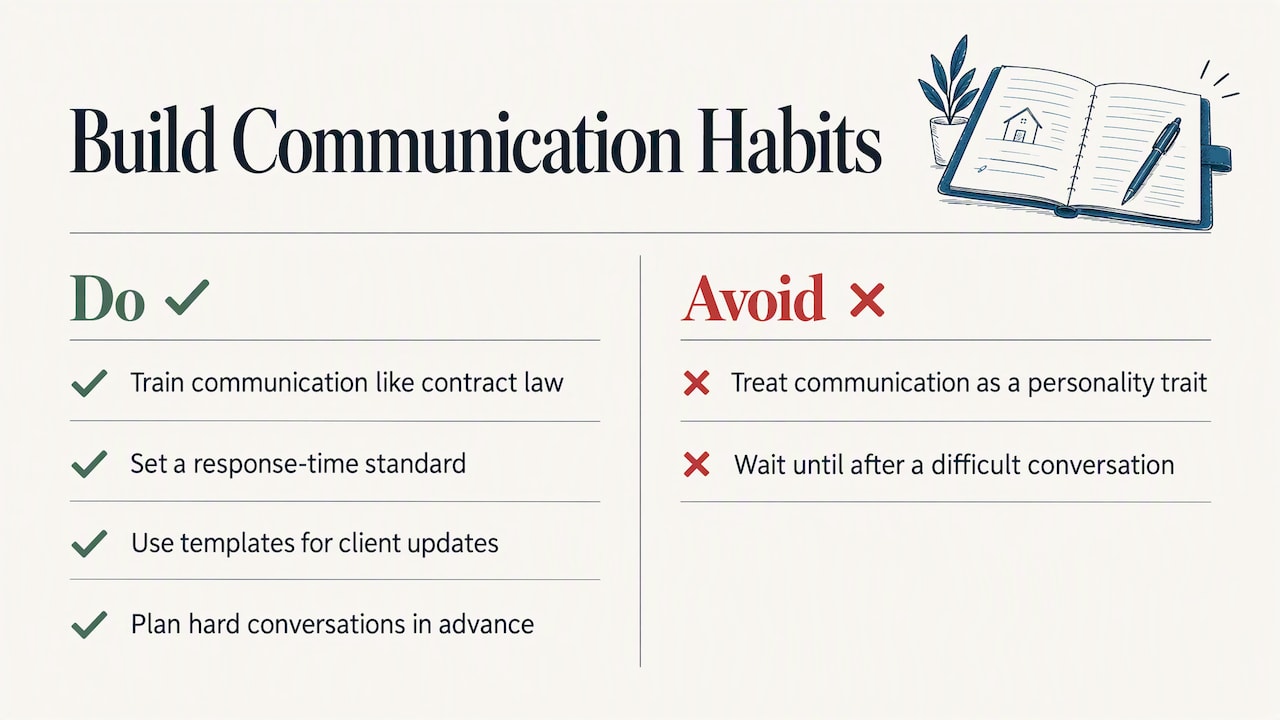
We work with agents at every stage, from people studying for their first license to experienced agents renewing. What we see is that communication is treated as a personality trait, when it is really a professional competency you can train, like contract law or disclosure rules.
The agents who struggle are rarely the ones who lack knowledge. They are the ones who have not turned their knowledge into a repeatable way of talking to clients: a first-meeting script, a standard for response times, a template for updates, a plan for hard conversations. A system makes you consistent on busy days, and consistency is what clients call reliability.
We also see how many agents serve clients who speak other languages. If that describes your market, clear communication includes making sure information is understood in the language the client is most comfortable with. That is why our courses are available in English, Spanish and Portuguese, with read-along narration, so you can study at your own pace in the way that works for you.
Continuing education is required for compliance, but treat it as more than that. The best time to sharpen how you talk to clients is before the next difficult conversation, not after it.
— User
Build the skills with a course
If you want structured practice, our professional development library includes courses on turning leads into clients, listing presentations, personal branding and more. From Lead to Client: Real Estate Lead Conversion is $29 and focuses on moving a prospect from first contact to signed agreement. For a broader set, the Real Estate Client & Presentation Skills Package groups courses on client and presentation skills together. Individual courses such as Building Your Real Estate Personal Brand and The Modern Listing Presentation are $29 each, and you can browse them all on the professional development page.
All courses are self-paced and come with a 30-day money-back guarantee. If you also need Florida license requirements, our Florida courses cover pre-licensing, post-licensing and the 14-hour continuing education course, with completions reported electronically.
A weekly practice plan
Skills improve through repetition. A simple routine:
- Monday: Review your active clients. Who has not heard from you in the last several days? Send a short update.
- After each showing: Send a follow-up within hours and ask one specific question.
- Midweek: Reread two of your sent emails against the 7 Cs. Fix the pattern you notice.
- Friday: Tell each active client what happens next week.
- Monthly: Contact past clients with something useful, not a sales pitch.
Track your response times for a month. Most agents find they are slower than they believed.
FAQ
What is an example of client communication in real estate?
A good example is a proactive update. You text a seller the afternoon after a showing, share the buyer’s feedback, and explain what you plan to do next. You can also send an update during the appraisal window that says nothing has changed. Both show clients you are working on their behalf.
What are the five key communication skills for agents?
One trade group’s list calls for communication that is meaningful, consistent, branded, action-oriented and responsive. In practice that translates to listening, explaining clearly, being honest, showing empathy and following up. Choose one to work on each month.
How do you communicate with clients effectively?
Set expectations in your first meeting: channel, frequency and response time. Ask open-ended questions, paraphrase what you hear and explain documents in plain language. Reply promptly, keep clients updated even without news, and say so when you need to check with your broker.
How fast should you respond to clients?
There is no universal rule, so set your own standard and publish it. Replying to active clients the same business day is a commonly recommended benchmark. Move faster when a deadline is close, and tell clients in advance when you will be unavailable.
Sources
- COMMUNICATION, state real estate commission guidance, May 2023
- Do You Have Effective Client Communication?, NAREA
- 7 tips for improving client communications, REALTOR® Resources
- 7 real estate communication mistakes to avoid, REALTOR® Resources
- Managing client expectations in real estate, REALTOR® Resources
- SMILE moments, HousingWire
- How Empathy Can Lead The Way To A Five-Star Client Experience, Inman
- How To Turn Every Client Text Into A Trust-Building Moment, Inman
- Efficiently Managing Client Communication, Transactly
- How to Optimize Client Communication in Real Estate, Matterport
- The 7 Cs of Communication, Mindtools
Recommended
- Real Estate Client & Presentation Skills Package
- Real Estate Personal Branding Course
- Real Estate Marketing & Sales Accelerator
- From Lead to Client: Real Estate Lead Conversion
This article is provided for general information and is not a professional advice.