



Real estate email marketing works when you treat it as a relationship channel, not a broadcast tool. You build a permission-based list, send useful, local, consistent messages to the right segments, follow the federal rules for commercial email, and measure replies and clicks rather than vanity numbers. This guide walks through each step, in the order you will actually do them.
Key Takeaways
- Email gives you direct control over your audience and message, which is why it suits long sales cycles and repeat and referral business.
- Federal law covers your commercial email. You need truthful headers and subject lines, a physical address and a working opt-out, and you must honor opt-outs within 10 business days.
- Local relevance beats generic content. Market stats, neighborhood news and events earn more attention than recycled national advice.
- Pick a schedule you can keep, segment by buyer, seller and area, and judge results by replies, clicks and conversions.
- In Florida, your email is advertising. It must identify your licensed brokerage.
Table of Contents
- Why email still earns its place in an agent’s marketing
- Build your list the legal way
- Florida advertising rules apply to your email too
- Your sender name and signature
- The campaigns worth sending
- Writing emails people open and answer
- How often to send
- Choosing an email platform
- Measure what matters
- Our perspective: email is a skills problem, not a software problem
- Build the skills behind the emails
- A simple 30-day launch plan
- FAQ
- Sources
Why email still earns its place in an agent’s marketing
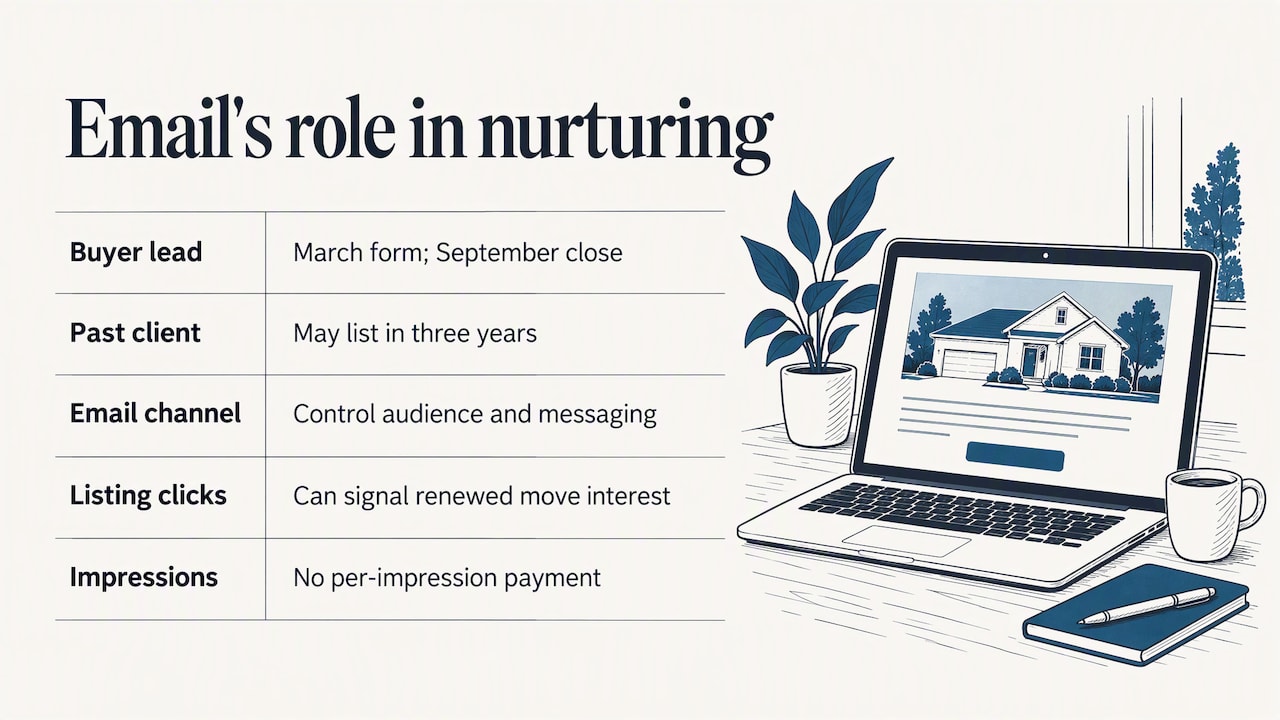
Most of your leads are not ready to transact today. A buyer who fills in a form in March may close in September, and a past client may list in three years. Email lets you stay present for that whole stretch without paying for each impression.
The national agent association’s marketing arm describes email as a channel where you control your audience and your messaging, supporting lead generation, nurturing, retention and referrals. A 2026 guide from an email software company frames it as a long-term relationship channel. Scheduled messages keep contact alive between transactions, and clicks on listing or home-value content can signal that someone is thinking about a move again.
Another platform’s guidance adds the mechanism: segmentation and personalization make messages feel individual, which keeps you top of mind and can make email a relatively low-cost channel.
The point is not that email replaces calls, social media or open houses. It is the one channel where a lead you already earned keeps hearing from you, on your terms.
Build your list the legal way
Your list is an asset only if the people on it expect to hear from you. Start with the people you already have a relationship with, then add sign-up points.
Where subscribers come from
The national agent association’s list-building guide suggests:
- Website pop-ups, which it reports convert at an 11% rate
- Open-house sign-in sheets with a clear email opt-in
- Regular CRM clean-ups so new contacts are not lost
- An opt-in link in your social media bios
- A forward-to-a-friend link in every email
The same guide warns that a submit button does not replace a consent checkbox. Put a plain sentence next to the box saying what people will receive and how often.
Offer something worth the address. A neighborhood market snapshot, a first-time buyer checklist or a monthly sales summary for one zip code gives people a reason to sign up. “Subscribe to my newsletter” does not.
Skip purchased lists
The FTC says commercial email can generally be sent until the recipient opts out, but purchased lists are risky. Addresses may belong to people who already opted out elsewhere, and they may generate spam complaints. Complaints damage your sender reputation, and a damaged reputation sends even your good emails to spam.
What CAN-SPAM requires of you
The FTC’s CAN-SPAM compliance guide sets out the core rules. Your emails must:
- Carry truthful header information and a subject line that matches the content.
- Be identifiable as an ad.
- Include your valid physical postal address.
- Offer a clear way to opt out.
- Honor opt-outs within 10 business days.
The guide also says the law covers all commercial email, including messages to past clients and business contacts, not only bulk mail. Each violating email can carry a civil penalty of up to $53,088. Your email platform will normally add the unsubscribe link and address footer, but the responsibility is yours. Check that your sender name and subject lines are honest, and process unsubscribes immediately.
Florida advertising rules apply to your email too
If you are licensed in Florida, a marketing email is also real estate advertising. Under the Florida Real Estate Commission’s advertising rule, all advertisements must include the licensed name of the brokerage firm. If your personal name appears, at minimum your last name must be used as it is registered with the Commission. Ads must not be false, deceptive or misleading.
The same rule says that on an internet site, the brokerage name must sit adjacent to, or immediately above or below, the point of contact information, including an email address. The practical takeaway: build the brokerage name into your email template and your signature once, so no message goes out without it. Rules change, so confirm the current text with the Department of Business and Professional Regulation (DBPR) or your broker before you launch a campaign.
Your sender name and signature
Set this up before you write a word of content. People decide whether to open an email based on who it is from.
- Sender name: use your own name, optionally with your brokerage, for example “Maria Lopez, Your Brokerage”. Readers respond to people, not brands.
- Reply-to address: use a real inbox you check. A “no-reply” address contradicts everything a relationship channel is for.
- Email address: a professional address on your own domain looks more trustworthy than a free webmail account, and it keeps your sender reputation under your control.
- Signature: your name, license type, brokerage name, phone number and website. In Florida, that brokerage name is the compliance piece described above.
- Footer: your physical address and the unsubscribe link, as CAN-SPAM requires.
The campaigns worth sending
You do not need twenty campaigns. Most agents get the bulk of the value from five.
1. A welcome sequence
When someone joins your list, send a short automated series: who you are, what you cover, your most useful local resource, and a simple invitation to reply with a question. This is your highest-attention moment, so do not waste it on a generic “thanks for subscribing.”
2. A monthly market and neighborhood update
The agent association’s marketing guide recommends recurring market updates, dynamic content and behavior-based follow-ups after property views or link clicks, plus saved-search targeting. Keep your update to one area and a few numbers: median price, days on market, and what changed since last month. Add one sentence of your own interpretation. That sentence is what a portal cannot give.
3. New listings and open-house invitations
Send these to the segment that cares. A buyer looking in one school district does not need every listing across the county. Sending fewer, better-matched messages protects your unsubscribe rate.
4. Past-client check-ins
A home anniversary note, a seasonal maintenance checklist, or a “what is my home worth now?” prompt keeps you in the running for the next transaction and for referrals. These are often your most profitable emails per send, because the trust already exists.
5. Event and community messages
A practitioner guide in a major industry publication advises prioritizing locally relevant market statistics, events, businesses and policy changes, because local relevance is what makes a newsletter stand out. A new restaurant opening, a zoning change or a school ranking update gives you something to say that national content cannot.
Writing emails people open and answer
Keep the structure simple and repeatable:
- Subject line: specific and honest. “3 homes under $450,000 near Lake Eola” will outperform “Newsletter, October.” It also keeps you inside the CAN-SPAM rule against misleading subjects.
- Opening line: the reason this email exists, in one sentence.
- Body: one main idea. Short paragraphs, mobile-friendly layout, one or two images.
- Call to action: one clear next step, placed high in the message. Industry guidance recommends putting it early and testing subject lines.
- Signature: your name, brokerage and a reply invitation.
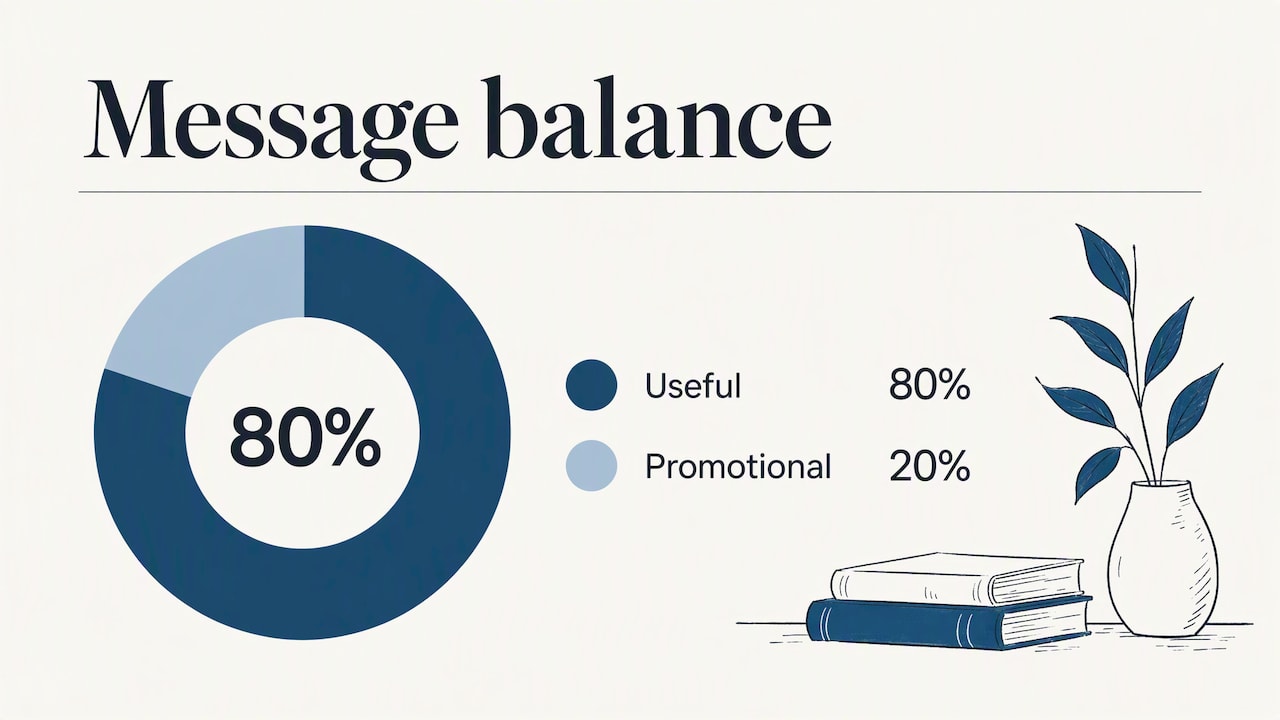
A useful rule from practitioner advice is an 80:20 balance: roughly four useful messages for every one that promotes you.
If writing is not your strength, a creative team can help you build relevant email content that earns attention. Even then, the local insight and the personal voice should be yours.
How often to send
Consistency matters more than frequency. The same practitioner guide on newsletters recommends a monthly newsletter sent in the morning. A reasonable setup for a solo agent:
| Audience | Content | Frequency |
|---|---|---|
| Past clients and sphere | Market update, home-care tips, local news | Monthly |
| Active buyers | Matched listings, open houses | Weekly or as listings appear |
| Sellers and home-value leads | Neighborhood sales, pricing trends | Every two to four weeks |
| New subscribers | Welcome sequence | Automated, first two weeks |
Adjust based on unsubscribes and replies. If unsubscribes rise after you increase frequency, step back. Guidance says to adjust frequency and content to limit unsubscribes.
Choosing an email platform
You do not need the most expensive tool. When you compare platforms, which fall into a few types (general email services, real estate CRMs with built-in email, and listing-focused marketing platforms), look for the features that practitioner advice names: lead capture, mobile formatting, segmentation, analytics, support and disclosed delivery performance.
A CRM with email built in has one big advantage: your contact tags, deal stage and email history live in one place, so segmentation takes minutes rather than hours. If you already use a CRM, test its email tools before paying for another system.
Measure what matters
Open rates alone mislead, because mail apps can pre-load images. Track a small set of numbers every month:
- Unique and total opens, as a trend
- Clicks on links and the calls to action
- Replies, which are the strongest signal in a relationship business
- Goal conversions: appointments booked, valuations requested, showings scheduled
- Unsubscribes and bounces
One industry publication notes that experts it cites consider a response rate of 10% or higher good. Treat that as a benchmark to compare against, not a promise. Your own baseline matters more.
Individual behavior also matters. A real estate CRM company’s guide recommends looking at your highly engaged individuals instead of relying only on averages. A contact who clicks three listing links in a week deserves a phone call, not another newsletter.
Test one variable at a time: subject line, send day, or call to action. Change it, compare the results over a few sends, and keep what wins.
Our perspective: email is a skills problem, not a software problem
We see agents buy a platform, send two newsletters and quit. The tool was never the obstacle. The obstacle is knowing who you are writing to, what you can say that they cannot get elsewhere, and how to turn a reply into a conversation.
That is why we treat email as one part of a larger set of business skills: personal branding so your messages sound like someone, lead conversion so replies become appointments, and client communication so the relationship holds after closing. A good email program also depends on licensing basics. Your license, your brokerage registration and your continuing education keep you in a position to advertise at all, and in Florida the advertising rules make compliance part of every message.
Marketing skills are worth building after the compliance work is done, not instead of it. Plan time for both.
— the author
Build the skills behind the emails
If you want structured training rather than trial and error, our professional development courses cover the skills that make email work. Building Your Real Estate Personal Brand is $29 and helps you define the voice your emails will use. From Lead to Client: Real Estate Lead Conversion is also $29 and covers what happens after someone replies. Our Digital Real Estate Marketing & AI Package bundles related marketing topics.
All courses are self-paced, available in English, Spanish and Portuguese, include read-along narration, and come with a 30-day money-back guarantee. If you are also due for Florida licensing education, you can find pre-licensing, post-licensing and the 14-hour continuing education course (23.95 $) on our Florida courses page. Browse everything on our professional development page.
For the wider picture, read our guide to lead generation for realtors, and our piece on client communication skills.
A simple 30-day launch plan
- Week 1: Export your contacts from your CRM, remove anyone who asked not to be contacted, and tag buyers, sellers and past clients. Set up your sender name, signature with brokerage name, and footer.
- Week 2: Add a sign-up form with a consent checkbox to your website, and a sign-in opt-in at your next open house. Write your welcome sequence.
- Week 3: Draft your first monthly market update for one area, with three numbers and one opinion.
- Week 4: Send it in the morning, then review opens, clicks, replies and unsubscribes. Call everyone who replied or clicked twice.
Repeat monthly and add one test each time.
FAQ
Does email marketing work in real estate?
Yes, mainly as a nurturing and referral channel. Industry guides describe it as a way to keep in contact with buyers, sellers and past clients over long timelines. Results depend on list quality, local relevance and consistency, so measure replies and appointments rather than only opens.
Do I need permission to email past clients?
CAN-SPAM does not require prior opt-in for most commercial email, but it does require an honest header and subject, your physical address and a working opt-out honored within 10 business days. Collecting clear consent is still the better practice, since it keeps complaints and unsubscribes down. Ask your broker or an attorney about any special situation.
How often should I email my list?
Start with monthly for past clients and sphere, and more often only for active buyers who want listings. Watch unsubscribes after any increase. A schedule you keep beats an ambitious one you abandon.
What should my real estate email include?
A sender name people recognize, an honest subject line, one useful local idea, one clear call to action, and your signature. In Florida, include your licensed brokerage name. Add your physical address and unsubscribe link in the footer.
Sources
- The importance of email marketing for real estate agents
- Email Marketing Guide for Real Estate Agents
- How To Improve Your Real Estate Email Marketing
- 5 ways real estate agents can build their email list
- Candid answers to CAN-SPAM questions, FTC
- CAN-SPAM Act: A Compliance Guide for Business, FTC
- Fla. Admin. Code R. 61J2-10.025, Advertising
- How to Create A Real Estate Email Newsletter That Gets Read, Inman
- How Do You Know If Your Email Newsletter Is Getting Results, Inman
- The Ten Commandments of real estate email marketing, Inman
- The Ultimate Guide To Email Marketing for Real Estate Agents
Recommended
- Lead Generation for Realtors: What Works and What to Pay For
- From Lead to Client: Real Estate Lead Conversion
- Digital Real Estate Marketing & AI Package
- Client Communication Skills Every Real Estate Agent Needs
This article is provided for general information and is not a professional advice.