



For a real estate agent, productivity is the income-producing work you complete in the time you invest, and the habits that make that work repeatable. It is not busyness, and it is not only commission. You improve it by measuring the activities you control, protecting time for prospecting and follow-up, using a small set of tools well, and building the business skills that turn conversations into clients.
This guide covers each of those steps, with the numbers agents actually track, the time-management methods the industry’s own associations recommend, and where education fits in.
Key Takeaways
- Track controllable activities (conversations, appointments, follow-ups, listings taken), not just closed deals, because they show where your pipeline is headed.
- Time-block your income-producing work first and batch the rest. Admin should fit around prospecting, not replace it.
- Fewer tools used consistently beat a long list of disconnected apps. Training and adoption matter more than purchases.
- Follow-up after closing is the cheapest productivity gain: satisfied clients only refer you if they remember you.
- Short, targeted courses in lead conversion, listing presentations, branding and technology are a low-cost way to close skill gaps. Compliance education in Florida can double as a reset point.
Table of Contents
- What Productivity Means for a Real Estate Agent
- How to Measure Your Own Productivity
- Manage Your Time Around Income-Producing Work
- Technology: Use Fewer Tools, Better
- Follow-Up: The Highest-Return Habit
- Business Skills That Raise Your Output
- Where Education and Licensing Fit In
- Our Perspective: Treat Learning as Part of the Schedule
- Build Your Plan With a Course That Fits
- A 30-Day Productivity Reset
- FAQ
- Sources
What Productivity Means for a Real Estate Agent
Most productivity advice online is written for call centers and software teams. Real estate is different: you are self-directed, paid on results that arrive weeks or months after the work, and responsible for your own pipeline. A useful definition has to respect that.
Zillow’s “Measure What Matters” white paper argues that productivity should be tied to controllable behaviors and actionable outcomes, not treated as money alone. It points to leads generated, deals closed, and networking and sphere-of-influence activity, and it recommends comparing agents on equivalent criteria, adjusted for experience or expertise. A first-year agent and a ten-year agent with a referral base should not be measured against the same bar.
A simple way to hold both ideas is to split your numbers in two:
- Inputs you control: conversations held, appointments set, follow-ups completed, listing presentations given.
- Outputs that follow: contracts written, closings, gross commission, net income.
If outputs are low and inputs are low, you have an activity problem. If inputs are high and outputs are low, you have a conversion or skills problem. That distinction tells you whether to work more, work differently or learn something new.
How to Measure Your Own Productivity
Start with leading indicators
NAR’s 2026 guidance recommends scorecards built around leading indicators such as conversations held, appointments set, follow-ups completed and listings taken. These activities are more controllable than closings, and NAR notes they can signal pipeline health 60 to 90 days ahead. That matters when a deal falls apart: your closed-deal count drops overnight, but your activity score tells you whether the next quarter is safe.
A weekly scorecard can be as simple as five rows:
- New conversations with buyers, sellers or past clients
- Appointments set
- Appointments held (showings, consultations, listing presentations)
- Follow-ups completed on open leads
- Listings taken or buyer agreements signed
Write the numbers down every Friday. After a month you will see your own baseline, which is the only comparison that is truly fair.
Use time-based formulas
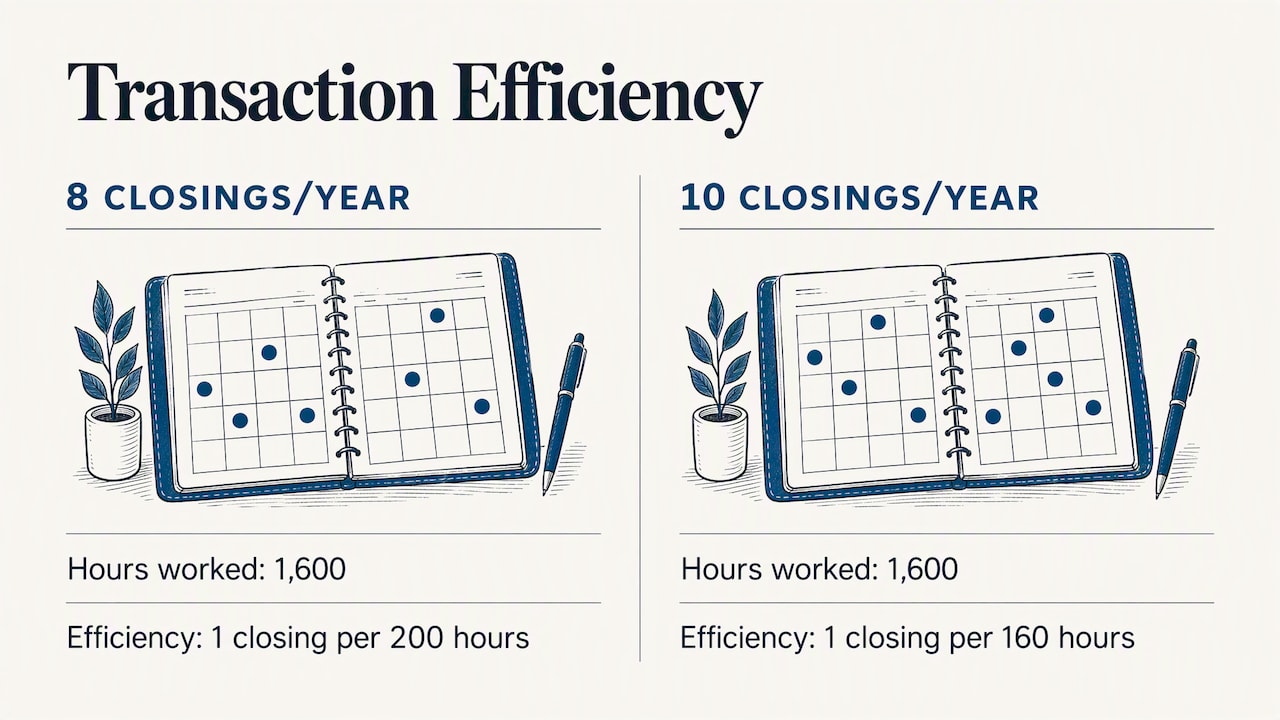
RealOffice360 defines real estate productivity as output relative to time invested and offers two formulas: sales-volume productivity is total sales volume divided by hours worked, and transaction efficiency is transactions closed divided by hours worked.
Here is a worked example with made-up numbers. Say you closed 8 transactions in a year and tracked about 1,600 working hours. Transaction efficiency is 8 divided by 1,600, or one closing per 200 hours. If better follow-up and a tighter listing presentation lift you to 10 closings on the same hours, you are at one closing per 160 hours. Same effort, 25% more output. That is what a productivity gain looks like.
The formulas have limits. Hours spent on a complex listing and hours spent on a simple rental are not equal, and a single large sale can distort the volume figure. Use them as a trend line, not a verdict.
Review your transaction history
The Chicago Association of REALTORS® recommends analyzing your transaction history by representation side, lead source, commission, split, expenses and net income, then comparing year-to-date sales, deal count and buyer-seller mix with prior periods. The same guidance suggests tracking average days on market, list-to-sale percentage, price changes, buyer negotiation percentage and market share from MLS data.
Two questions to answer from that review:
- Which lead source produces the most net income per hour, not just the most leads?
- Are you drifting toward a side of the business (buyers or sellers) that pays less for the time it takes?
The answers often change where you spend your next month.
Manage Your Time Around Income-Producing Work
Time-block the activities that grow the business
The Chicago guidance recommends time-blocking for prospecting, sphere-of-influence calls, client events and other business-growth activities. Inman’s time-blocking guide gives a practical sequence: set annual, monthly and weekly goals, schedule the high-impact income-producing activities first, batch similar tasks, preserve buffer time, and review the system weekly.
A workable week looks like this:
| Block | What goes in it |
|---|---|
| Early morning | Transaction review, planning, first outreach calls |
| Mid-morning | Prospecting, sphere-of-influence calls, lead follow-up |
| Midday | Showings, listing appointments, client meetings |
| Afternoon | Batched admin: paperwork, email, marketing content |
| Buffer slot | Overruns, urgent client issues, unexpected showings |
The buffer is not a luxury. Real estate is interruption-heavy, and a schedule without slack collapses on the first inspection issue.
Capture everything in one place
NAR’s 2025 organization guidance recommends capturing tasks and ideas in one consistent system, reviewing it regularly, triaging email, and using the first part of the day for transaction review, planning and outreach. The system itself matters less than using only one. Sticky notes, a phone list and an inbox flag are three systems, and each one leaks.
Know when to delegate
NAR notes that personal assistants can handle scheduling, email, documents, client logistics, market research, marketing and transaction coordination, freeing the agent for client service and business growth. A useful test: if a task does not require your license, your judgment or your relationship, someone else can probably do it. Delegate it once your income supports the cost, and write the process down first so the handoff works.
Technology: Use Fewer Tools, Better
Agents lose hours to software they bought and never mastered. NAR’s 2025 REALTORS® Technology Survey found that 66% of respondents adopted technology primarily to save time and 64% to enhance client experience. Social media, CRM and the local MLS were the leading lead-generating technologies. The same survey reported eSignature as the most popular tool at 79%, followed by social media and drone photography and video at 75% each.
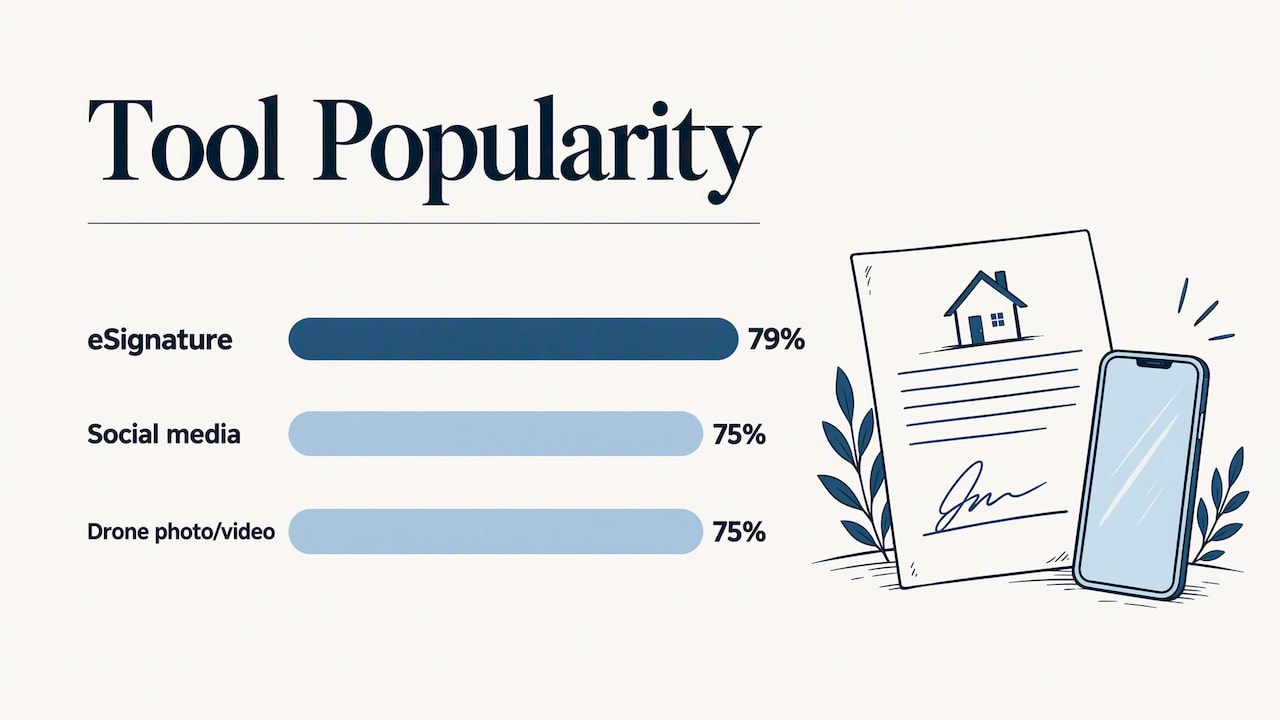
The lesson is in the ranking: the most widely used tools are the ones that remove friction from everyday work, such as signing documents and staying visible. NAR’s 2026 brokerage guidance says technology creates value when it improves efficiency and responsiveness, and that training and adoption should come before acquiring more tools.
A practical stack for most solo agents:
- One CRM that holds every contact, reminder and note
- eSignature for contracts and disclosures
- A scheduling link so clients book calls without email chains
- A content workflow for photos, video and social posts
- One AI assistant for first drafts of listing descriptions, emails and follow-up messages, with your review before anything goes out
Before adding a sixth tool, ask whether you have fully used the first five. If you want structured help, our AI for Real Estate Professionals and Real Estate Technology & Productivity Toolkit courses are each $29 and cover the practical side of tool choice and workflow.
Follow-Up: The Highest-Return Habit
Lead follow-up and client communication are where productivity and service quality meet. Faster is not always better; consistent is. Our guide on client communication skills covers tone and timing, and our overview of lead generation for realtors looks at which sources are worth paying for.
After the closing, the opportunity is even larger. NAR reported in 2025 that nearly 90% of buyers and sellers say they would recommend their agent, but post-transaction follow-up is what helps ensure they remember the agent and actually make the referral. NAR’s guidance recommends CRM workflows tied to closing dates, personalized messages, quarterly reminders, calls and texts, social engagement, and weekly tracking of outreach.
Set it up once:
- Enter the closing date in your CRM the day you close.
- Schedule a thank-you note, a one-month check-in and a quarterly touch for the first two years.
- Add the home anniversary and a yearly market update.
- Track how many touches you completed each week on your scorecard.
This is productivity in its cleanest form: a small amount of automated, personal effort that feeds your referral pipeline for years.
Business Skills That Raise Your Output
Time management cannot fix a weak conversion rate. When inputs are healthy but results lag, the gap is usually a skill. These are the ones that move numbers:
- Lead conversion: turning inquiries into appointments and appointments into signed agreements. Our From Lead to Client course focuses on exactly this step.
- Listing presentations: winning the listing is the highest-leverage hour in your week. The Modern Listing Presentation course is $29, and the Listing Agent Success Package bundles related skills.
- Personal branding: a clear identity makes every other marketing hour work harder. See the personal branding course, $29.
- Marketing and content: photography, video, social media and email, done in batches. The Real Estate Marketing & Sales Accelerator pulls these together.
- Client presentation and communication: the Client & Presentation Skills Package is built for agents who want to sound prepared in every conversation.
- Market knowledge: NAR’s research and statistics program provides data on U.S. housing markets, buyers and sellers and local areas, which you can turn into the market updates your clients value.
It is also worth understanding why clients want a skilled advocate. An academic study summarized by the National Bureau of Economic Research found that agents may use specialized knowledge to further their own interests at homeowners’ expense. The agents who last treat that research as a standard to beat: clear advice, transparent process, and communication clients can verify.
Where Education and Licensing Fit In
Required coursework and productivity are not opposites. Rules differ by state, so check your own regulator, but in Florida the pattern is clear. New sales associates complete a pre-licensing course before the exam, and then post-licensing education before the first renewal. After that, continuing education is a recurring requirement. Our Florida 14-hour continuing education explained page lays out the details of the renewal-cycle requirement.
These are our current Florida prices:
| Course | Price |
|---|---|
| Sales Associate 63 Hour Pre Licensing | $99 |
| Broker 72 Hour Pre Licensing | $159 |
| Sales Associate 45 Hour Post Licensing | $79 |
| Broker 60 Hour Post Licensing | $149 |
| 14-Hour Continuing Education | $23.95 |
Two practical points. First, put your renewal deadline on your calendar as a recurring block, and check your license record on the state regulator’s site, so a lapse never interrupts your income. Second, finish required hours early in a slow month rather than in a rush; self-paced online courses make that easy. If you are comparing routes into the field, our pages on Florida pre-licensing courses and post-licensing courses explain what each stage involves.
Our Perspective: Treat Learning as Part of the Schedule
We build state-approved courses for agents at every career stage, and we see the same pattern. Agents treat compliance education as a chore to be cleared at the deadline, and business-skill education as something for later. Both habits cost time.
We think the better approach is to schedule learning the way you schedule prospecting. A short course on lead conversion or listing presentations, taken in the quiet part of the month, often pays back faster than another tool subscription. Required hours can be a reminder to review your business at the same time: what did the last two years teach you, and which skill is holding your numbers back?
We also design for how agents actually work. Courses are self-paced, available in English, Spanish and Portuguese for agents who serve diverse clients, and include read-along narration. Completions are reported electronically, so you spend your time learning rather than chasing paperwork. Every course carries a 30-day money-back guarantee, because you should be able to judge a course by using it.
— the author
Build Your Plan With a Course That Fits
If your scorecard shows a gap, pick one skill and close it. Our professional development catalog lists focused courses at $29 each, including Building Your Real Estate Personal Brand, Social Media & Content Marketing for Real Estate, Running Better Open Houses and Real Estate Photography, Video & Property Marketing Basics. The International Real Estate Course is $49. Browse them on our professional development page or, if a Florida renewal is due, start with the 14-hour CE course at $23.95.

If you want one place to start, take the Real Estate Business Builder Package, which groups skills for building a steady pipeline.
A 30-Day Productivity Reset
You do not need a new system to improve. Run this for a month:
- Week 1: Build your scorecard. Record conversations, appointments, follow-ups and listings taken every day.
- Week 2: Review last year’s transactions by lead source and net income. Choose the one source to feed and the one to cut.
- Week 3: Time-block the next four weeks, with prospecting first, admin batched and a buffer each day. Set up post-closing workflows for every past client in your CRM.
- Week 4: Compare your numbers with week 1. Choose one skill gap and one course to address it.
Repeat quarterly. Productivity is a milestone, not a finish line: your market, your tools and your clients keep changing.
FAQ
What is a good productivity measure for a real estate agent?
Use a mix. Track leading indicators such as conversations, appointments and follow-ups, and pair them with outcomes such as closings per hour worked and net income. Compare yourself against your own past periods first, since agents at different experience levels are not equivalent.
How many hours should an agent spend prospecting?
There is no official number, and the sources we reviewed do not set one. The common advice is to put prospecting and sphere-of-influence outreach in your first scheduled blocks, then adjust the length by tracking whether appointments set per week rises or falls.
Does technology really make agents more productive?
It does when you adopt it fully. NAR’s survey shows most agents adopt technology to save time, but its guidance stresses training and responsiveness over tool count. One CRM, eSignature and a consistent content workflow cover most needs.
Can continuing education improve my business, not just keep my license?
Yes, if you choose well. Required hours keep your license active, while professional development courses target skills such as lead conversion, listing presentations and marketing. Taking both on a schedule keeps learning from being squeezed in at the deadline.
Sources
- Measure What Matters, Zillow white paper
- 10 Steps To Running Your Business Like An MBA, Chicago Association of REALTORS®
- How to Keep Agents Productive When a Deal Falls Apart, NAR
- Maximize Time in Real Estate with a Productivity Calculator, RealOffice360
- The Art Of Time Blocking, Inman
- Organize Your Way to a Better Bottom Line, NAR
- Personal Assistants, NAR
- 2025 REALTORS® Technology Survey, NAR
- How Brokers Can Help Agents Stay Competitive Right Now, NAR
- Teach Your Agents the Power of Staying in Touch After Closing, NAR
- Research and Statistics, NAR
- Do Real Estate Agents Exploit their Information Advantage?, NBER
Recommended
- Lead Generation for Realtors: What Works and What to Pay For
- Client Communication Skills Every Real Estate Agent Needs
- Real Estate Business Builder Package
- AI & Real Estate Technology Package
This article is provided for general information and is not a professional advice.