



Time management for realtors comes down to one rule: protect the hours that produce clients, and batch everything else around them. In practice that means a calendar with fixed blocks for prospecting, follow-up, appointments and administration, a short daily priority list, and a weekly review of what you actually did. This guide shows how to build that system, with sample schedules, the numbers worth tracking and the tasks you can hand off.
Key Takeaways
- Put prospecting and follow-up in your best morning hours, then schedule showings and appointments in the afternoon and batch administration into its own block.
- Time blocking works only if you include buffers and a flex block, because real estate schedules change without warning.
- Sort tasks by urgency and importance, and spend most of your working time on income-producing activity rather than paperwork.
- Track conversations, appointments and follow-ups weekly, and review them every Friday so you can move the blocks that did not work.
- Treat required education, such as license renewal, as a calendar item with a date, not something you squeeze in at the last minute.
Table of Contents
- Why Agents Lose Hours Without Noticing
- Build Your Week With Time Blocking
- Decide What Matters Most Each Day
- Protect Follow-Up and Batch Your Messages
- Plan Showings by Route, Not by Request
- Automate and Delegate What Does Not Need You
- Track Your Week and Review It Every Friday
- The 5 P’s of Time Management for Agents
- Our Perspective on Time and Professional Skill
- Make Education Part of Your Schedule
- FAQ
- Sources
Why Agents Lose Hours Without Noticing
Most agents do not lack hours. They lack a structure that decides in advance what each hour is for. Without one, the loudest request wins: the email that just arrived, the client who wants an answer now, the transaction that is wobbling. Each is a reasonable thing to respond to, and together they eat the part of the day meant for finding the next client.
Self-employment makes this worse. No manager sets your schedule, and your income depends on activity you can postpone indefinitely, such as calling past clients or following up with a lead from last week. The fix is not working longer. It is deciding the shape of the week before the week starts.
Build Your Week With Time Blocking
Time blocking means putting every kind of work on your calendar as a block, not just appointments. Inman’s guide to time management says that putting both required and desired tasks on the calendar makes your daily and weekly goals more likely to happen, and it recommends single-tasking and prioritizing by deadlines.
Start with fixed events and personal time
Block the things that cannot move first: listing appointments, closings, inspections, your own recurring commitments. RISMedia recommends blocking fixed events first, using morning time to set daily priorities, and setting specific calendar periods for answering email and phone messages.
Then protect your own time. HousingWire’s agent schedule guide suggests scheduling one to two days off per week, plus daily self-care, client work, drive time and white space. Its authors treat time off as a requirement of the business, not leftover time, because giving up too much personal time raises burnout risk. Plan your week the same way: personal blocks go in first, and work fills what remains.
A sample workday
There is no single correct schedule, but published examples agree on the order: lead generation and follow-up in the morning, people-facing work in the afternoon, administration after that. Here is a version based on monday.com’s schedule for agents, which you can shift to fit your market and your energy.
| Time | Block | Purpose |
|---|---|---|
| 9:00 to 10:30 a.m. | Prospecting | Calls, outreach and new conversations |
| 10:30 a.m. to 12:00 p.m. | Follow-up | Warm leads and client nurture |
| 12:00 to 5:00 p.m. | Showings and appointments | Face-to-face and scheduled client work |
| 5:00 to 6:30 p.m. | Administration | Transaction updates, paperwork, email |
| 6:30 to 7:00 p.m. | End-of-day review | Check results, set tomorrow’s priorities |
A morning-heavy variation comes from Realty Nodes: plan the day and update your CRM from 8:00 to 8:30, prepare for prospecting until 9:00, prospect from 9:00 to 11:00, handle messages from 11:00 to 11:30, and follow up from 11:30 to 12:30. Afternoons go to appointments or administration, with a second message and CRM block late in the day.
Notice what both have in common: the first two to three hours of the day go to the work that creates future business, before anyone else’s agenda gets a chance.
Keep some blocks flexible
HousingWire advises protecting consistent mornings while keeping later blocks flexible. That fits how the job works: a buyer’s availability moves your afternoon, but your morning prospecting block should not move for much. Add a flex block each day, and treat it as capacity, not wasted space. When nothing urgent comes up, use it to catch up on follow-up or get ahead on tomorrow.
Decide What Matters Most Each Day
A calendar tells you when. A priority method tells you what goes into the blocks.
The Eisenhower Box
Inman describes the Eisenhower Box as four categories:
- Urgent and important: do it now.
- Important but not urgent: schedule it.
- Urgent but not important: delegate it.
- Neither: delete it.
For an agent, a contract deadline tomorrow is urgent and important. Reaching out to your past-client list is important but never urgent, which is exactly why it gets skipped. Give those tasks a block and a day, or they will not happen. Rescheduling a vendor call that anyone could take is urgent but not important: hand it off.
The 80/20 rule for realtors
The 80/20 idea is that a minority of your activities produce most of your income. Applied to real estate, one broker-published guide suggests spending about 80% of work time on prospecting, lead follow-up, presentations, contract negotiation, price-reduction conversations and qualifying buyers, with about 20% on administration.
RISMedia’s version is more operational. It suggests at least 25% of work time on direct prospecting, roughly 50% to 60% on listing or selling appointments, and delegating administrative tasks where you can. It also recommends a weekly review and some form of accountability.
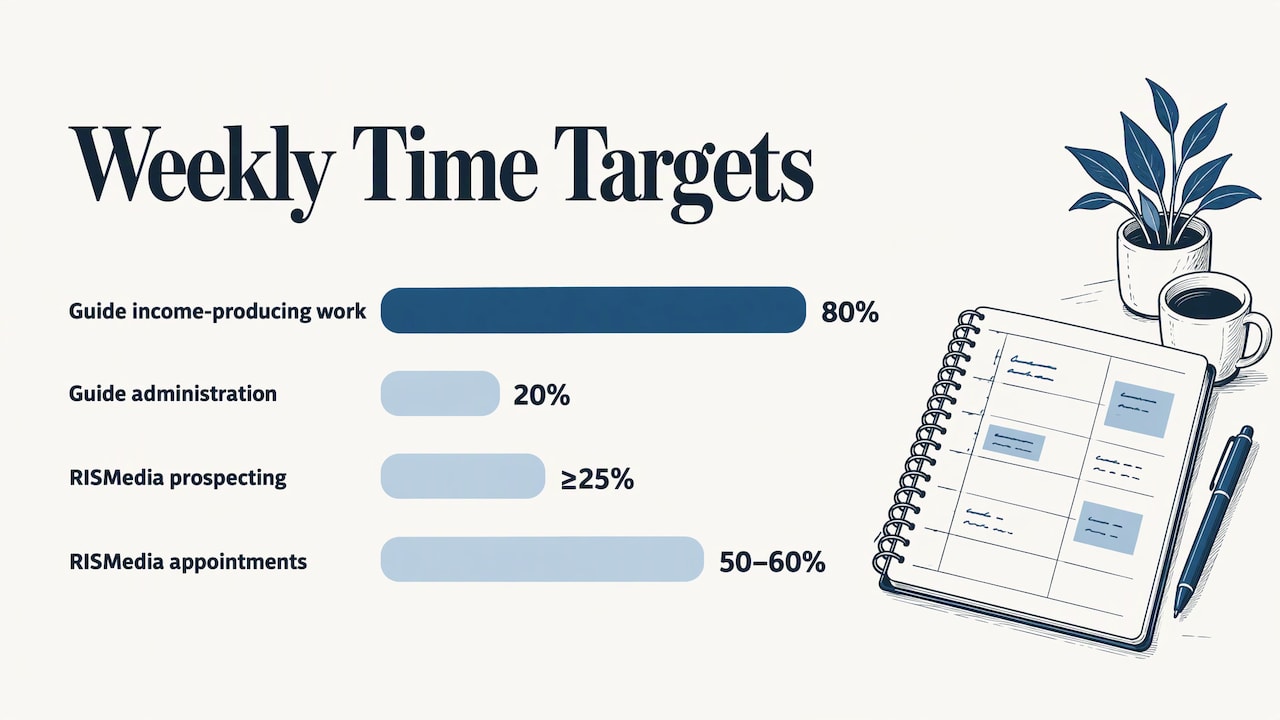
Treat these as targets to compare against your own week, not laws. If you find that half your time goes to paperwork and scheduling, the ratio tells you where to adjust.
When a deal starts to fall apart
One unstable transaction can swallow a whole week. The National Association of REALTORS advises separating active files that need your intervention today from files you only need to monitor, and using time blocks so one troubled deal does not consume the entire schedule. Give the problem file its own block, solve what you can inside it, and go back to prospecting.
Protect Follow-Up and Batch Your Messages
Follow-up is where many agents lose business, and it is the first thing to vanish on a busy day. HousingWire notes that many leads need multiple contacts, so follow-up deserves its own scheduled block. If you want a deeper look at turning inquiries into signed clients, our course From Lead to Client covers lead conversion step by step.
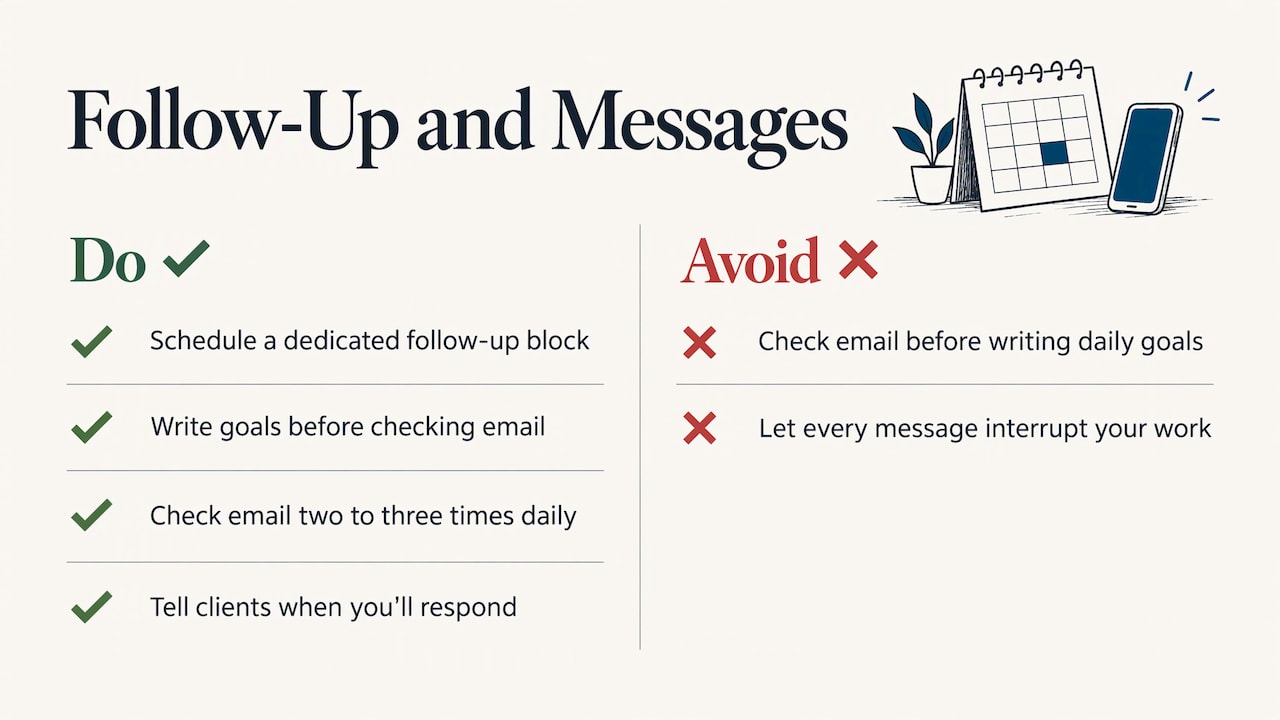
Messages are the other leak. Inman recommends writing your daily goals and task list before you check email, checking email two to three times a day, and scheduling short breaks. RISMedia adds a client-facing habit: tell clients when you will return calls and emails, so you are not interrupted every time a message arrives. A simple line in your email signature or first conversation does it: you respond to messages at set times each day, and anything truly urgent gets a call.
If lead generation is the weak point in your week, read our guide to lead generation for realtors, and use the email marketing guide to set up outreach that runs on a schedule.
Plan Showings by Route, Not by Request
Driving is the largest hidden cost in many agents’ calendars. Two habits help.
- Batch geographically. Monday.com recommends grouping showings by area, stacking similar appointments, and adding 15 to 30 minutes of buffer for travel and delays.
- Reduce trips to the office. RISMedia suggests organizing showings into a route and keeping blank forms in the car.
A buffer feels like wasted time until the first showing runs over and every appointment after it starts late. Build the buffer into the calendar and your day absorbs surprises instead of collapsing.
Automate and Delegate What Does Not Need You
Every hour spent on a task someone or something else could do is an hour not spent with a client. Three areas pay off first.
- Reminders and follow-up sequences. Use CRM reminders and automated follow-up so that no lead depends on your memory. Monday.com’s guide also recommends batching non-urgent email and grouping administrative and transaction tasks in one block.
- Transaction paperwork. Many agents hand deadlines and document tracking to a transaction coordinator, either on staff at the brokerage or from an outside service. Vendors publish their own time-saving figures, so compare services on what they handle and what they cost before you commit.
- Content and marketing production. Templates, scheduling tools and AI assistance can cut the time spent on posts, listing descriptions and client emails. Our AI for Real Estate Professionals course teaches agents to use these tools in their daily work, and the social media marketing guide shows how to plan a content week in a single block.
For a broader view of where agents save time, see our guide to agent productivity.
Track Your Week and Review It Every Friday
A schedule you never check is a wish. Reviewing is what turns it into a system.
Find out where your time goes
Before you rebuild your schedule, measure the current one. Realty Nodes suggests tracking a normal week in 30-minute increments, blocking personal time first, then translating income goals into conversations and appointments. A coaching firm, Mike Ferry, goes further and recommends tracking time hour by hour for two weeks. Either way, you will probably find at least one block of time you did not know you were losing.
Turn goals into daily activity
Work backward from income. Realty Nodes gives an example: if you want two appointments per week and roughly one appointment comes from every ten conversations, you need about 20 conversations weekly, or four a day. Your own ratio will differ, but the method is sound. Once you know the daily number, you know how big your prospecting block must be.
Keep a simple scorecard
The National Association of REALTORS recommends tracking leading indicators such as conversations, appointments set, follow-ups completed and listings taken, because they help predict business 60 to 90 days ahead. DMR Media’s business plan template suggests a weekly scorecard covering:
- Conversations
- Appointments set
- Appointments held
- Agreements signed
- New database leads
- Follow-up touches
- Closings
Review it every Friday. Where a number is low, ask what behavior sits behind it: a skipped block, a block at the wrong time of day, or a task that needs delegating. Then move the block. DMR also suggests four 90-day reviews a year comparing planned and actual closings, spending and cost per signed client by source. If you want a structure for that, our one-page plan for agents is a good place to start.
The 5 P’s of Time Management for Agents
You may see a framework called the 5 P’s: Prioritize, Plan, Prepare, Pace and Persist. One productivity guide describes them as focusing on goals and values, allocating time slots with breaks, gathering resources beforehand, balancing focused work with rest, and reviewing progress. For an agent, that translates neatly:
- Prioritize: pick the three tasks that move income today.
- Plan: block them on the calendar, with breaks.
- Prepare: load the car, the listing packet and tomorrow’s call list the night before.
- Pace: alternate focused work with short breaks.
- Persist: review on Friday and keep going, even after a slow week.
Our Perspective on Time and Professional Skill
We see the same pattern among the agents who study with us. The ones who feel most behind on time are rarely short on effort. They are short on a repeatable way to do the high-value parts of the job: converting a lead, presenting a listing, staying visible online.
That is why we build our courses to be self-paced and available in English, Spanish and Portuguese, with read-along narration, so you can learn in the gaps of a working day and in the language you work in. Our completions are reported electronically, so required education does not turn into a last-minute scramble over paperwork.
Time management is not only a calendar habit. It is also skill. An agent who converts leads more efficiently needs fewer conversations per signed client, and that frees hours. We designed our professional development courses to give you that kind of leverage, and every course comes with a 30-day money-back guarantee.
the author
Make Education Part of Your Schedule
Required courses are the easiest item to postpone and the most costly to miss. Put your pre-licensing, post-licensing or continuing education hours on the calendar the way you would a closing, with a start date and a daily block, and use your flex block to catch up.
If you are licensed in Florida, we offer state-approved courses you can take online at your own pace. Current prices on our site include the Florida 14-hour continuing education course at $23.95, the Sales Associate 45-hour post-licensing course at $79, and the Sales Associate 63-hour pre-licensing course at $99. Broker courses are listed too: $159 for the 72-hour pre-licensing course and $149 for the 60-hour post-licensing course. See everything on our Florida courses page.

For business skills, our professional development courses are $29 each for topics such as lead conversion, the modern listing presentation, open houses, technology and productivity, and social media content. The International Real Estate Course is $49.
FAQ
How should a realtor structure a day?
Start with fixed commitments and personal time, then put prospecting and follow-up in the morning, showings and appointments in the afternoon, and administration in a later block. End with a short review and tomorrow’s priorities. Keep a flex block and travel buffers so surprises do not break the whole day.
What is the 80/20 rule for realtors?
It means focusing most of your time on the activities that produce most of your income. One broker-published guide puts the split at 80% income-producing work and 20% administration. RISMedia suggests at least 25% of time on prospecting and about 50% to 60% on appointments, and delegating administration where you can.
How often should I check email as an agent?
Inman recommends checking email two to three times a day, after you have written your daily goals and task list. Tell clients when they can expect a reply, and call them for anything time-sensitive.
What should I track to know if my schedule works?
Track conversations, appointments set, follow-ups completed and listings taken each week. The National Association of REALTORS notes that these leading indicators help predict business 60 to 90 days ahead. Review them every Friday and adjust the blocks that are not producing.
Sources
- Inman: 9 Failsafe Time Management Strategies for Real Estate Agents
- RISMedia: 5 Time Management Strategies to Keep Your Day in Check
- HousingWire: The Ultimate Real Estate Agent Schedule
- monday.com: Real Estate Agent Schedule
- Realty Nodes: Time Blocking for Real Estate Agents
- Century 21 Discovery: Follow the 80/20 Rule
- RISMedia: Applying the 80-20 Rule to Maximize Sales
- National Association of REALTORS: How to Keep Agents Productive When a Deal Falls Apart
- Inman: 5 Time-Management Tips for Real Estate Agents
- DMR Media: Real Estate Business Plan
- Mike Ferry: Time Management Strategies for Real Estate Agents
- Timeflip: Guide to Popular Time Management Techniques
Recommended
- Agent Productivity: How Real Estate Agents Get More Done
- Real Estate Business Planning: A One-Page Plan for Agents
- Lead Generation for Realtors: What Works and What to Pay For
- Client Communication Skills Every Real Estate Agent Needs
This article is provided for general information and is not a professional advice.