


Getting a real estate license means completing your state’s pre-licensing education, passing the state exam and filing an application with the state’s real estate regulator. There is no national license, so the hours, fees and deadlines depend on where you plan to work. If you are starting in Florida, you can enroll in our Florida pre-licensing courses and finish the education requirement online, at your own pace, in English, Spanish or Portuguese.
Key Takeaways
- Each state controls its own real estate credential, so start by reading your state regulator’s licensing page, not a national checklist.
- The sequence is almost always the same: eligibility, approved pre-licensing course, exam, background check and application, then activation under a sponsoring broker.
- Licensing does not end at approval. Florida, for example, voids a sales associate license that skips the 45-hour post-licensing course before the first renewal.
- Total cost is course tuition plus exam, application, fingerprint and license fees, so budget for all of them, not only the class.
- Business skills courses help a newly licensed agent turn a license into clients.
Table of Contents
- There Is No National License: Start With Your State
- The Steps to a Real Estate License
- What It Costs: Three States Compared
- A Worked Example: Getting Licensed in Florida
- Post-Licensing, Continuing Education and Renewal
- Turning a License Into Clients
- Our Perspective
- Start Your Florida Course
- FAQ
- Sources
There Is No National License: Start With Your State
Real estate licensing in the United States is a state matter. Each state controls its own credential, application order, examination and deadlines, and you must be licensed in each state where you intend to work as an agent, as Investopedia explains.
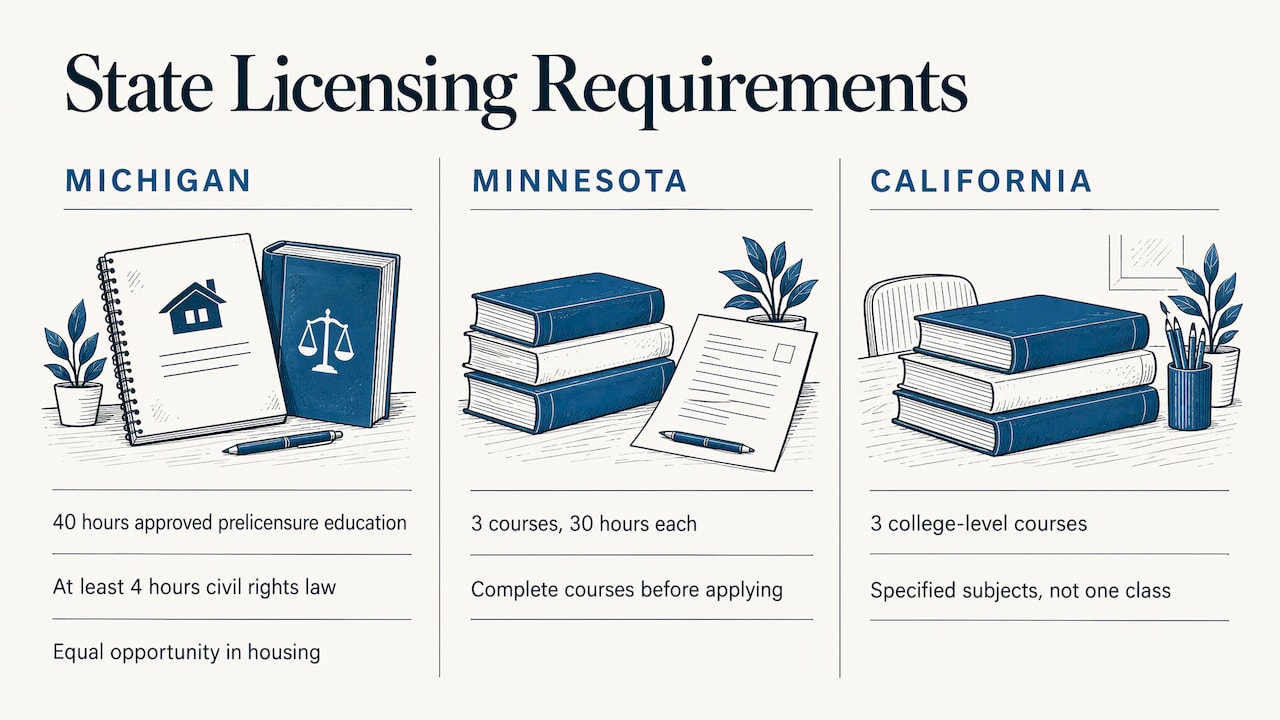
That is why two agents can describe “getting licensed” in completely different terms. A Michigan applicant needs 40 hours of approved prelicensure education, including at least four hours on civil rights law and equal opportunity in housing. A Minnesota applicant takes three 30-hour courses before applying. A California salesperson applicant needs three college-level courses in specified subjects rather than a single pre-licensing class.
Before you pay for anything, find your state’s real estate commission or department of real estate and read its licensing page. Everything below follows the common path. Confirm each number there.
The Steps to a Real Estate License
1. Confirm you are eligible
The minimum age is 18 in most states, while Alabama, Alaska and Nebraska require 19. Beyond age, regulators typically ask about your background. Plan for a fingerprint-based criminal check, and answer every question on the application honestly. A past conviction does not automatically end your plans in most states, but a misstatement on the form can.
2. Choose the license type
Most new agents start as a salesperson (called a sales associate in Florida), who must work under a licensed broker. A broker license carries more education and generally requires experience first. Decide which one your career plan needs, because the course you buy depends on it.
3. Complete state-approved pre-licensing education
The course must be approved by your state, or the hours will not count. This is the step where most of your time goes, and it is where format matters: self-paced online study lets you fit the hours around a job. Our courses are state-approved, self-paced and include read-along narration, which helps if you absorb legal terminology better by listening while you read.
4. Pass the state exam
You register for the exam after the education is complete, or partway through in some states. Kansas, for example, requires 30 of its 60 hours before you can sit for the exam. Passing scores differ by state, so check the candidate handbook your regulator links to. Exam results also expire: in Kansas, scores are valid for six months, and the application must reach the commission inside that window or you retake the exam.
5. Apply and complete the background check
You submit the application, fees and fingerprints. Some states want this before the exam, others after. Read your regulator’s order of steps closely, because filing out of sequence is a common source of delay.
6. Activate the license with a sponsoring broker
A new salesperson license generally does not let you practice independently. You affiliate with a broker, who files the registration. Choose a brokerage on training, commission structure and support, not only on name.
What It Costs: Three States Compared
Tuition is only part of the budget. Here is what three state regulators publish for the government side of the process.
| State | Education required | State fees published by the regulator |
|---|---|---|
| Florida | 63 hours (sales associate), 72 hours (broker) | Application and exam fee capped at $100; license fee capped at $50 per year of the license period |
| Kansas | 60 hours | $210 total to the Commission for salespersons ($15 application, $70 background, $125 license); $70 exam fee paid to the testing vendor |
| Michigan | 40 hours | $88 new application fee; $78 renewal fee on a 3-year cycle |
Sources for the table: Florida Statutes, chapter 475, the Kansas Real Estate Commission and the Michigan Department of Licensing and Regulatory Affairs. Fees change when states revise their rules, so confirm the current schedule on the regulator’s page before you pay.
Add to these figures the cost of fingerprinting, any exam prep, your brokerage’s desk or franchise fees and, in many states, membership dues. Total out-of-pocket cost is always higher than the education price alone.
A Worked Example: Getting Licensed in Florida
Florida shows how the steps fit together, and it is where our courses are built to work.
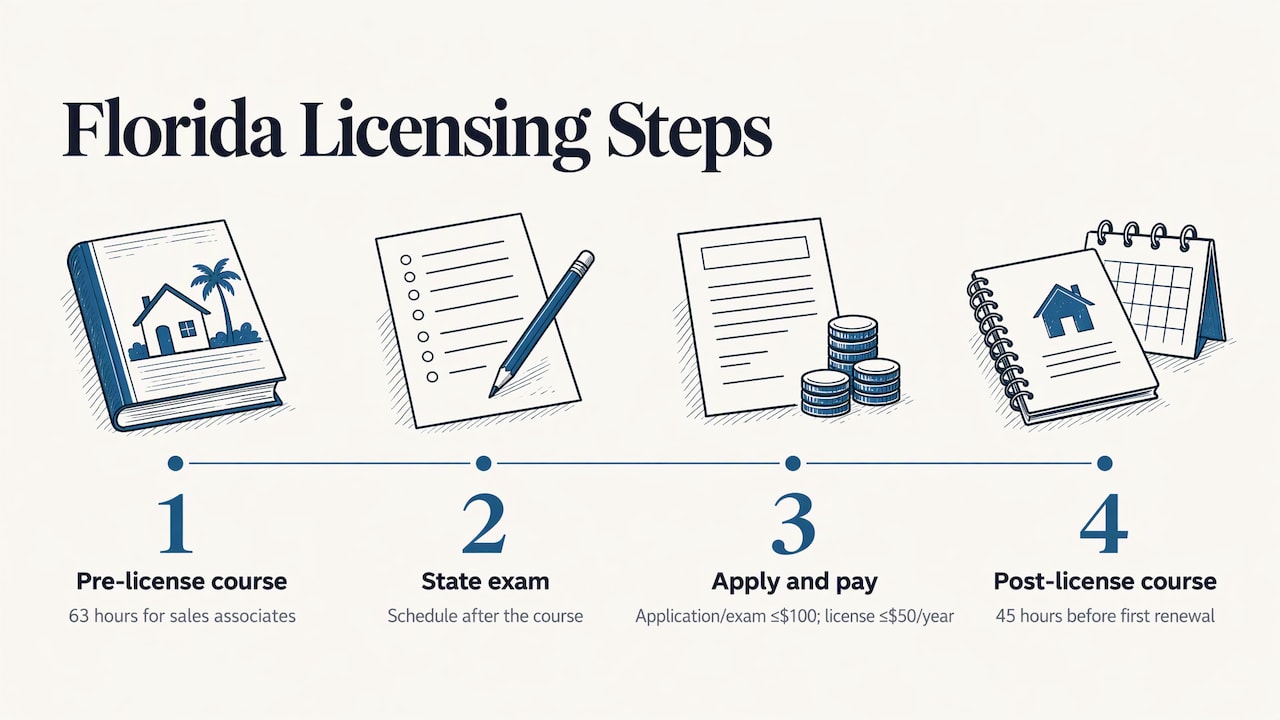
Education. Florida statute sets the sales associate pre-licensing course at 63 hours and the broker course at 72 hours, counted in 50-minute classroom hours. We offer the Florida 63-hour pre-license course for sales associates at $99 and the Florida broker 72-hour pre-licensing course at $159.
Exam. After the course, you schedule the state exam. Our Florida real estate state exam guide walks through the format and exam day.
Application. Florida’s initial application and examination fee may not exceed $100, and the initial license fee may not exceed $50 for each year of the license period. For a fuller walk-through, see our guide on how to become a real estate salesperson in Florida.
After you are licensed. This is the step many first-time applicants do not expect. A Florida sales associate must complete a 45-hour post-licensing course before the first renewal, or the license is considered null and void. Our Florida 45-hour post-license course for sales associates is $79, and the broker 60-hour post-licensing course is $149. Because we report completions electronically, the education side of the requirement is handled when you finish.
Post-Licensing, Continuing Education and Renewal
A license is a milestone, not a finish line. Every state attaches ongoing education to keeping it active, and the details differ widely:
- Florida: at least 14 classroom hours of continuing education in each biennium of the license period.
- California: first-time salesperson renewals need 45 clock-hours of continuing education, including five separate three-hour courses in ethics, agency, fair housing, trust fund handling and risk management.
- Michigan: at least 18 clock hours in each three-year renewal cycle.
- Minnesota: 30 hours before the June 30 renewal deadline, with at least 15 completed before the previous June 30, per the Commerce Department.
- Kansas: renewal within six months of expiration or the license is forfeited, and a $100 late fee applies to late renewals.
Plan the schedule backward from your renewal date. Check your regulator’s record for the exact deadline, and do not leave the hours for the last month. For Florida agents, our 14-hour continuing education course costs $23.95. If you want to understand how credits are counted, read our guide to CE credits for realtors.
Turning a License Into Clients
Passing the exam proves you know the rules. It does not bring in business. New agents often spend their first months with a license and no pipeline, so build marketing and conversion skills alongside compliance.
Our professional development catalog is priced at $29 per course for most topics, including:
- Building Your Real Estate Personal Brand
- From Lead to Client: Real Estate Lead Conversion
- The Modern Listing Presentation
- AI for Real Estate Professionals
- Social Media & Content Marketing for Real Estate
- Running Better Open Houses
The International Real Estate Course is $49. If you are weighing where to start, our guides to personal branding for real estate agents and real estate social media marketing show what the courses build on. You can browse the full range on the professional development page.
Our Perspective
Most people think of licensing as a single hurdle: finish the course, pass the exam, done. We see it as a sequence of obligations that runs for as long as you hold the license.
That is why we built our courses around the whole sequence. Pre-licensing, post-licensing, continuing education and business skills sit in one place, so the agent who studies with us for the exam can return for the post-licensing requirement and every renewal.
The way people learn matters too. Many agents serve clients who speak Spanish or Portuguese, and many learn better when they can listen as they read. Our courses are available in three languages and include read-along narration, and completions are reported electronically to the state, so you are not left chasing paperwork after you finish.
Money matters when you are starting out, so every course comes with a 30-day money-back guarantee. Study at a pace that fits your life, and keep the requirement from becoming a source of stress.
the author
Start Your Florida Course
If Florida is your state, the fastest way to begin is to pick the course that matches your license type: the sales associate 63-hour pre-licensing course is $99 and the broker 72-hour course is $159. Both are state-approved, self-paced and backed by a 30-day money-back guarantee. Compare them on our Florida courses page.
Already licensed? The same page covers post-licensing and the 14-hour continuing education course, so your next requirement is already planned.
FAQ
How long does it take to get a real estate license?
It depends on your state’s required hours and how fast you study. Hours vary, from 40 in Michigan to 63 for a Florida sales associate, and self-paced online study lets you set the timetable. After the course, allow time to schedule the exam, complete fingerprinting and wait for the regulator to process your application.
Can I use my license in another state?
Not automatically. You must be licensed in each state where you work as an agent. Some states have reciprocity or recognition agreements for licensed agents from other states, so check the new state’s regulator for what it accepts.
Can I get a real estate license with a criminal record?
Often yes, but every state runs a fingerprint-based background check and reviews each case. Crimes involving fraud, theft or dishonesty get the closest scrutiny. Disclose everything the application asks, and contact your state regulator before you invest in a course if you have a conviction.
Do I need more education after I get my license?
Yes. States require continuing education to renew, and some require post-licensing education first. In Florida, a sales associate must complete 45 hours of post-licensing education before the first renewal, then 14 hours of continuing education every two years.
What does it cost to get licensed in Florida?
Our Florida sales associate pre-licensing course is $99, and the broker course is $159. The state’s application and exam fee may not exceed $100, and the license fee may not exceed $50 per year of the license period. Fingerprinting and brokerage costs are additional.
Sources
- Steps to Becoming a Licensed Real Estate Salesperson, California Department of Real Estate
- Instructions to license applicants, California Department of Real Estate
- How to Get a Real Estate License: Requirements in Every State
- Step-by-Step Guide to Becoming a Real Estate Agent, Investopedia
- Florida Statutes, chapter 475
- Frequently Asked Questions, Kansas Real Estate Commission
- Real Estate Salesperson Licensing Guide & FAQ, Michigan LARA
- Real Estate Licensing, Minnesota Commerce Department
Recommended
- How to Become a Real Estate Salesperson in Florida: 7 Steps
- FL Real Estate Course: What You Need for a Florida License
- Real Estate License Schools in Florida: How to Choose One
- Florida Real Estate State Exam: Steps, Format and Exam Day Guide
This article is provided for general information and is not a professional advice.