



A real estate finance course teaches you how property is paid for and how its returns are measured: mortgages and other financing, cash flow, investment math and risk. Appraisal and valuation courses answer a different question: what a property is worth. Which one you need depends on your goal. If you want a license, the finance content usually sits inside your state-approved pre-licensing course. If you want to build investment models or become an appraiser, you need a specialized program.
This guide sorts those paths so you can spend your money and your hours once. It covers what each type of course teaches, how long each takes, what counts toward a U.S. real estate license, and where a Florida agent should start.
Key Takeaways
- Finance, appraisal and valuation are three different skill sets. Finance covers how deals are funded and how returns are measured. Appraisal and valuation cover how value is estimated.
- Licensing courses already include finance. Some states spell out the hours: Nevada’s salesperson pre-licensing curriculum includes 12 hours of finance and 12 hours of valuation and economics.
- Appraiser education is a separate, much longer track. National minimums run from 75 hours for a trainee to 300 hours for a Certified General Appraiser.
- Your state decides what counts. A course only satisfies pre-licensing, post-licensing or continuing education if your state’s regulator approves it.
- Pick by outcome. Licensing, a compliance deadline, an investing skill and a career change each point to a different course.
Table of Contents
- What a real estate finance course actually teaches
- Finance, appraisal and valuation: three different courses
- How long these courses take and how they are delivered
- What you need before you enroll
- Does a finance course count toward your license?
- Choosing the right course for your goal
- Our perspective: licensing first, specialization second
- Florida course prices at a glance
- Start your Florida licensing path
- A practical way to decide
- FAQ
- Sources
What a real estate finance course actually teaches
“Financing real estate” means funding a purchase, development or investment with some mix of your own cash and borrowed money, then managing the debt. A finance course teaches the mechanics behind that.
Expect topics like these:
- Mortgage types, loan terms, interest and amortization
- Sources of financing, from lenders to private capital
- Loan-to-value ratios, down payments and closing costs
- Cash flow, net operating income and capitalization rates
- Return measures such as cash-on-cash return and internal rate of return
- Risk, leverage and how interest rate changes affect a deal
The depth varies enormously. Introductory courses aimed at entry-level professionals can run about eight hours, as one widely listed introductory real estate finance course shows in its description of eight modules. University executive programs run far longer and cost far more. Financial modeling courses go further still, with 20 or more hours of video and Excel work building models from scratch.
For an agent, the practical payoff is simpler. A finance degree or finance coursework can help agents work with appraisers and mortgage loan officers, project profits and losses, and explain mortgage types to buyers. You do not need a degree to do any of that well. You need to understand the numbers your clients ask about.
Finance, appraisal and valuation: three different courses
Readers often type these terms as if they meant the same thing. They overlap, but they lead to different jobs.
| Finance | Appraisal | Valuation | |
|---|---|---|---|
| Core question | How is the deal funded, and what does it return? | What is this property worth, by regulated standards? | What is this asset worth to an investor or owner? |
| Typical learner | Agents, investors, analysts, lenders | Aspiring licensed appraisers | Investors, analysts, commercial professionals |
| Credential tied to it | Rarely a license; often a certificate | State appraiser license or certification | Usually a certificate |
| Length | Hours to weeks | Hundreds of hours across levels | Hours to weeks |
| Main tools | Loan math, cash flow, Excel | USPAP, comparable sales, cost and income approaches | Discounted cash flow, comps, cap rates |
The simplest way to remember it: appraisal is a regulated profession with a license, and valuation is a skill you can apply as an agent, investor or analyst without one. Finance is the layer underneath both, because value and financing drive each other.
What appraisal and valuation courses cover
Appraisal courses train you to produce an unbiased estimate of value based on data and free of outside influence. That principle is central to the profession, as the National Association of Realtors notes in its overview of appraiser work. Typical topics include:
- Property description and highest and best use
- The sales comparison, cost and income approaches to value
- Market analysis and adjustments for differences between properties
- Report writing and ethics
- Federal appraisal standards
That last item is a requirement, not an option. The Appraisal Foundation states that the 15-Hour National USPAP course is required for initial licensure, and the 7-Hour USPAP Update Course is required once every two calendar years.
Valuation courses outside the licensed appraisal track lean toward investment analysis: discounted cash flow, capitalization rates, comparable transactions and sensitivity analysis. They often share content with finance courses, which is why many programs bundle the two.
How long these courses take and how they are delivered
The range is wide, so match the length to your goal.
- Short finance or valuation courses: a few hours to a few weeks, usually self-paced.
- Executive and certificate programs: several weeks, sometimes with a fixed start date and a four-figure tuition.
- Appraiser licensing education: qualifying education ranges from 75 hours for a Trainee Appraiser to 300 hours for a Certified General Appraiser, with the Appraisal Qualifications Board setting the national minimum criteria.
- Agent licensing courses: set by each state, and measured in clock hours.
Formats are just as varied. Appraisal and finance education is offered in classrooms, in live virtual sessions and as on-demand, self-paced online modules. Self-paced online learning suits working agents, because you can study between showings and stop at any point without losing your place.
What you need before you enroll
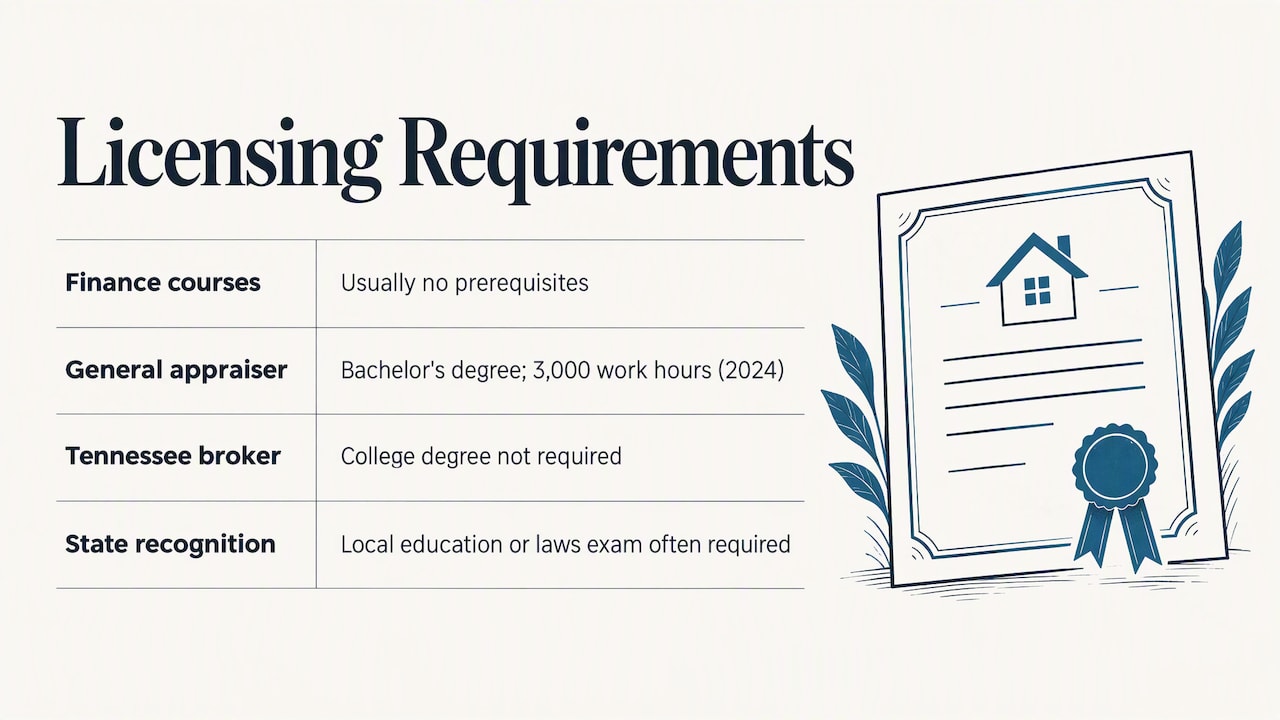
Most finance and valuation courses have no prerequisites. Appraiser licensing is the exception, and the upper levels demand a lot. A Certified General Appraiser needs a bachelor’s degree and 3,000 hours of work experience, as of February 2024. Appraisers can move up through levels of education and certification as their careers progress.
Agent licensing is more accessible. In Tennessee, for example, a college degree is not required to become a real estate affiliate broker. You complete pre-licensing education, pass the licensing exam and meet other state requirements. The same pattern applies across most states, with details that differ by jurisdiction.
That last point matters if you ever plan to move. License recognition between states often requires jurisdiction-specific education or an exam on local laws, rules and practices. Finance concepts travel. State rules do not.
Does a finance course count toward your license?
Sometimes, but only when your state regulator approves the course for that purpose. A general finance course from a university or training company does not automatically satisfy any license requirement. Check three things before you pay:
- Is the course approved by your state’s real estate regulator for pre-licensing, post-licensing or continuing education?
- Does it match the exact hours the requirement calls for?
- How are completions reported? Some providers report to the state for you. Others hand you a certificate to upload.
Finance is already built into the pre-licensing path in many states. Nevada makes it explicit: its salesperson pre-licensing education includes 12 hours of valuation and economics and 12 hours of finance, according to the state’s course form. If your goal is to get licensed, the approved pre-licensing course is the finance course you need, and a separate one can wait.
Choosing the right course for your goal
Start with what you need the course to do.
You want to become a licensed agent
Take your state’s approved pre-licensing course. It is the required path, and it covers the financing basics you will be tested on. Our real estate pre-licensing courses are state-approved and self-paced. In Florida, the Sales Associate course is 63 hours and the Broker course is 72 hours.
You already have a license and need to stay compliant
Florida sales associates complete post-licensing education after their first renewal cycle begins, then continuing education on a regular basis. These are compliance courses with fixed hour counts, so choose one approved by the state and confirm that the provider reports your completion. See our Florida post-licensing courses and the 14-hour continuing education course.
You want to sharpen your business skills
If the goal is winning listings, converting leads and marketing your properties, a short professional development course gives you more return than a long finance program. Our professional development courses include The Modern Listing Presentation, From Lead to Client and Real Estate Technology & Productivity Toolkit.
You want to analyze investments or build models
Choose a dedicated financial modeling or investment analysis program. These are optional, unlicensed and usually built around spreadsheets. They are worth taking once your licensing requirements are met.
You want to become an appraiser
Take appraiser qualifying education from a provider approved by your state appraiser board and the national criteria. This is a separate career track with its own license, experience hours and standards.
Our perspective: licensing first, specialization second
We see the same mistake often: a new agent buys an expensive finance or investing program before finishing the state-approved course that actually unlocks the license. The required course comes first, because without it nothing else can be used professionally.
At MyEdukator we build state-approved courses for each stage of an agent’s career, from pre-licensing through post-licensing and continuing education to professional development. Our courses are self-paced and offered in English, Spanish and Portuguese, because agents serve diverse clients and learn best in the language they think in. Read-along narration is designed to make the material easier to follow, and completions are reported electronically so that your compliance record does not depend on a paper trail you have to chase.
Compliance is a milestone, not a finish line. Once your hours are done, the same habits carry into business skills: how you present a listing, convert a lead, use technology and market a property. Every course also carries a 30-day money-back guarantee, so you can start without carrying the risk alone.
the author
Florida course prices at a glance
If you are in Florida, here is what our required courses cost. Prices are one-off, paid at enrollment, as published on our site.
| Course | Price |
|---|---|
| Sales Associate 63-Hour Pre-Licensing | $99 |
| Broker 72-Hour Pre-Licensing | $159 |
| Sales Associate 45-Hour Post-Licensing | $79 |
| Broker 60-Hour Post-Licensing | $149 |
| 14-Hour Real Estate Continuing Education | $23.95 |
For business skills, most of our professional development courses cost $29 each. The International Real Estate Course is $49. Those include AI for Real Estate Professionals, Social Media & Content Marketing for Real Estate and Running Better Open Houses.
Start your Florida licensing path
If you are earning, renewing or upgrading a Florida license, you can enroll in a state-approved course today and study at your own pace. Pick your course on our Florida real estate courses page, and if you are not satisfied, the 30-day money-back guarantee applies.
Spanish-speaking agents can find the same courses at cursos de bienes raíces de Florida en línea. Portuguese-speaking agents can start with the cursos de educação continuada.
A practical way to decide
Use this order of operations:
- Confirm your requirement. Find your state regulator’s current hour counts and deadlines. Check your record on the regulator’s site before buying anything.
- Finish the required course first. Pre-licensing, post-licensing or continuing education, whichever applies.
- Add one skill course. Choose the gap that costs you the most deals, whether that is lead conversion, listing presentations or financial analysis.
- Consider specialization later. Modeling, valuation or appraisal programs make sense when you have a specific career move in mind.
Plan the schedule before you enroll. A self-paced course only works if you set aside regular blocks of time for it, so decide in advance when those blocks will be.
FAQ
What does it mean to finance real estate?
It means paying for a property using a combination of your own money and borrowed funds, usually a mortgage, and managing that debt over time. A finance course teaches the loan types, the math and the risk behind those decisions. Agents use it to explain options to buyers and sellers.
Can you be a real estate agent with a finance degree?
Yes, but the degree does not replace licensing. You still complete your state’s pre-licensing education, pass the exam and meet other requirements. In Tennessee, for instance, a degree is not required at all. A finance background can help you work with lenders and appraisers.
How long are real estate classes?
It depends on the type. Introductory finance courses can run a few hours, while state licensing courses are measured in set clock hours, such as 63 for a Florida sales associate. Appraiser qualifying education runs from 75 to 300 hours depending on the license level.
Is a real estate valuation course the same as an appraisal course?
No. Appraisal courses lead to a regulated license and follow national standards such as USPAP. Valuation courses teach value estimation for investment and business use, and no license is required to apply those skills as an agent or investor.
Sources
- Courses, The Appraisal Foundation
- Real Estate Appraiser Salary, National Association of Realtors
- Nevada Form 560, Real Estate Sales Pre-Licensing Education Course
- Real Estate degree, Finance B.B.A., MTSU
- Do You Need a Degree for a Real Estate Agent Career?, Indeed
- ARELLO position statement on license portability
Recommended
- Real Estate Personal Branding Course
- International Real Estate Course
- AI for Real Estate Agents Course
- From Lead to Client: Real Estate Lead Conversion
This article is provided for general information and is not a professional advice.