


Real estate career development comes down to three stages, and each one builds on the last: earn your license, meet your state’s post-licensing and renewal rules without gaps, then add business skills that bring in repeat clients and referrals. Do the first two right and your license stays active. Do the third on purpose and your income follows. We built our state-approved, self-paced courses around exactly these stages, so you can take the next one when you are ready, in English, Spanish or Portuguese.
Key Takeaways
- A license is the entry ticket. Every path in real estate requires passing a state licensing exam, and licenses are issued by state governments, not by NAR.
- Post-licensing and continuing education (CE) rules differ sharply by state, so check your own state commission’s current rules before you buy a course.
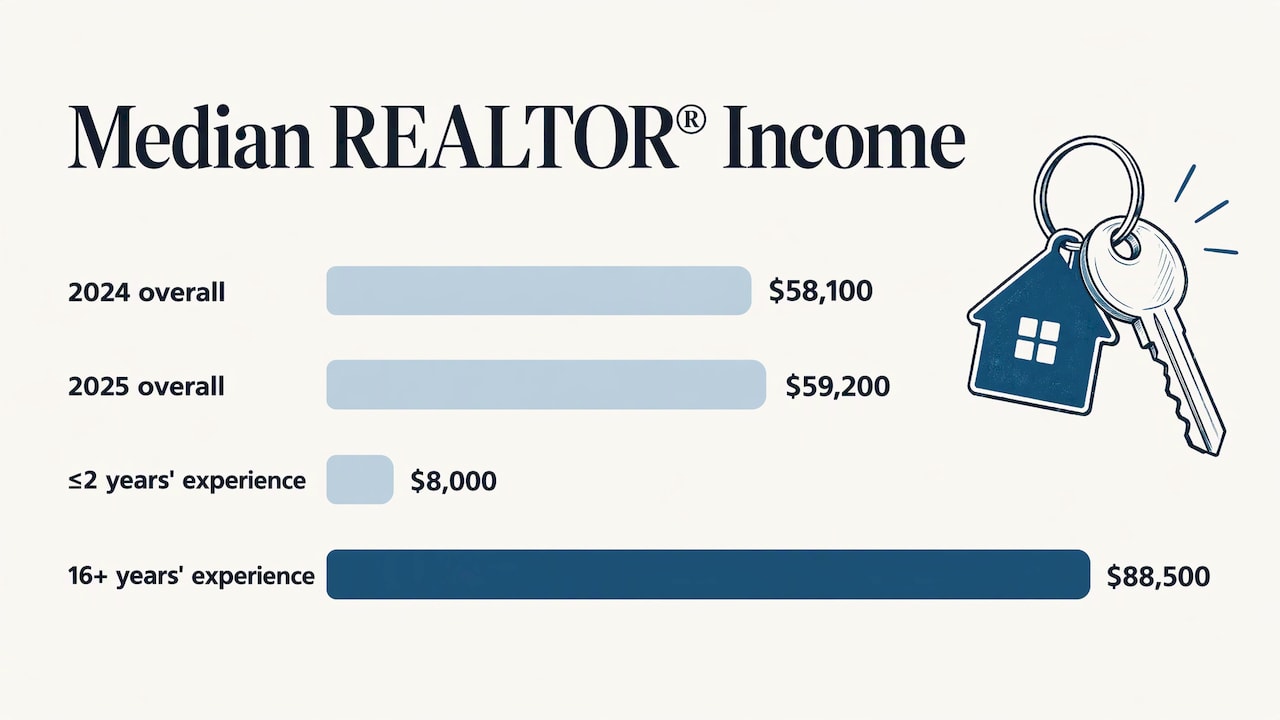
- Income grows with experience: NAR’s 2026 Member Profile puts median 2025 gross income at $8,000 for agents with two years or less and $88,500 for those with 16 or more years.
- Repeat clients and referrals produced 28% and 22% of the typical agent’s business, so client-retention and marketing skills are a career investment, not an extra.
- Choose courses that are state-approved, report your completion electronically and fit your schedule and language.
Table of Contents
- What real estate career development actually involves
- Stage 1: Get licensed
- Stage 2: Post-licensing education in your first cycle
- Stage 3: Keep your license active with continuing education
- Stage 4: Build the business skills that grow income
- How to choose a real estate course for your next stage
- Start with the course that fits your stage
- FAQ
- Sources
What real estate career development actually involves
Career development is the planned sequence of licensing, education and skill-building that moves you from a new license holder to an established professional. The field is wider than many newcomers expect. NAR describes a profession that covers residential and commercial sales, property management, land development, mortgage banking, appraisal, counseling and research. Entry usually begins as a sales trainee at a brokerage, or as an office assistant, listing or rental agent, or in a bank’s mortgage division.
Whatever route you take, the common requirement is a state written licensing exam. That is why the first stage matters: it is the gate to everything else.
Here is the roadmap in one view:
| Stage | What you are doing | What it protects or builds |
|---|---|---|
| 1. Pre-licensing | Completing the state-required course and passing the exam | Your right to practice |
| 2. Post-licensing | Finishing the first-cycle education your state requires | Your license staying active |
| 3. Continuing education | Renewing on schedule | Your license and your legal standing |
| 4. Business skills | Branding, lead conversion, marketing, technology | Your income and client base |
Stage 1: Get licensed
To list or sell property in any U.S. jurisdiction, you need a license from the state or territory where the transaction takes place. NAR’s licensing page is clear that state governments grant licenses and that your state real estate commission is the authority to contact.
The steps are similar across states, even though the numbers are not. According to Investopedia’s licensing guide, you generally need to:
- Meet the minimum age (18 in most states) and the citizenship or residency and education requirements.
- Complete a state-approved pre-licensing course covering principles, financing, ethics, contracts and property law.
- Pass a multiple-choice exam with a national section and a state section.
- Apply through your state licensing department, submit documents, complete fingerprinting if required and pay the state fee.
Hours vary by state. For example, the Illinois REALTORS® handbook describes 75 hours of pre-license study, and new Illinois licensees must work under a managing broker. Your own state sets its own number.
Pre-licensing in Florida
If you are pursuing a Florida license, our Florida pre-licensing courses are state-approved and self-paced. The Sales Associate 63 Hour Pre Licensing course costs $99, and the Broker 72 Hour Pre Licensing course costs $159. Both can be taken online in English, Spanish or Portuguese, with read-along narration if you learn better by listening while you follow the text. If you are aiming at a broker license, the 72-hour broker pre-license explainer walks through what the course covers.
Two practical habits help at this stage:
- Plan the schedule. Block weekly study time and set a target exam date before you start the course.
- Check your state record. Confirm your application and fingerprint status with your state agency so nothing delays the license after you pass.
Stage 2: Post-licensing education in your first cycle
Passing the exam is a milestone, not a finish line. Many states require newly licensed agents to complete additional education soon after the license is issued, and missing the deadline can put the license at risk.
The deadlines are strict and differ widely:
- Georgia: under Rule 520-1-.05, effective July 1, 2025, salespersons complete a post-license course of at least 25 instructional hours within one year of license issuance.
- Louisiana: the Louisiana Administrative Code requires initial licensees to complete 45 post-license hours within 180 days of the initial license date.
- Idaho: Idaho REALTORS® lists 12 post-licensing hours, made up of 8 hours of PL Fundamentals and 4 hours of a module of your choice, plus two different Idaho core courses, for salespeople who have not yet renewed once on active status.
The pattern is consistent: a fixed number of hours, a fixed window and consequences for missing it. Put the deadline in your calendar the day your license is issued, and count backward to set a weekly pace.
Post-licensing in Florida
Our Florida post-licensing courses include the Sales Associate 45 Hour Post Licensing course at $79 and the Broker 60 Hour Post Licensing course at $149. Completions are reported electronically to the state, so you are not chasing paper certificates. For a deeper look at hours, deadlines and how to choose, read our post-licensing guide or the 60-hour broker post-license requirements.
Stage 3: Keep your license active with continuing education
Once you are past the first cycle, continuing education keeps the license renewable. Again, the specifics belong to your state. NAR states plainly that it does not grant licenses, require CE or track CE courses; you must contact your state commission. Some examples show how much the rules differ:
- Tennessee: the Tennessee Real Estate Commission’s CE FAQ states 16 hours (10 elective and 6 mandatory CORE) by the expiration date, tracked in CE Broker. From January 1, 2026, all Principal Brokers overseeing at least one affiliate must take CE, including grandfathered ones.
- Georgia: the same Georgia rule requires 36 CE hours per renewal period, 3 of them on license law, and, new as of July 1, 2025, at least 18 hours of broker education for brokers and associate brokers renewing on or after that date.
- Louisiana: 12 hours before each annual renewal, at least 4 in commission-designated mandatory topics, according to the state code.
If you are a REALTOR®, there is a second layer. NAR’s education page states that members complete Code of Ethics and Fair Housing/Anti-Bias training upon joining and every three years after.
Rules change, so confirm your hours, mandatory topics and due date on your commission’s own page each cycle, then match your course to them.
Renewing in Florida
Our Florida 14-hour continuing education course costs $23.95. You can see what it covers on the 14-hour CE course page, or browse all Florida continuing education options. Because it is self-paced, you can finish it in short sessions between showings instead of giving up a weekend.
Stage 4: Build the business skills that grow income
Mandatory courses keep you legal. They do not, on their own, fill your pipeline. The income data shows why the next stage matters. NAR’s 2026 Member Profile reports a median gross income of $59,200 in 2025, up from $58,100 in 2024. The same report shows median income of $8,000 for REALTORS® with two years or less of experience and $88,500 for those with 16 or more years. Experience is the biggest lever, and what you do with those early years decides how quickly you move along that curve.
Where does the experienced agent’s business come from? The Member Profile, as reproduced by the Long Island Board of REALTORS®, says the typical REALTOR® earned 28% of business from repeat clients and 22% from referrals. Half of a typical agent’s business, in other words, comes from people who already know them. That is built through brand, follow-up, presentation and visibility.
A Redfin survey of 500 agents fielded by Ipsos found 58% earned more than $50,000 in 2024, and nearly 30% earned more than $100,000. It also found agents rate training and support (54.6%) among the top factors when choosing a brokerage. Agents who invest in their own skills carry that value with them wherever they hang their license.
Match the skill to the bottleneck
Do not try to learn everything at once. Find where your business is stuck and take the course that fixes that:
| If your problem is… | Skill to build | Our course (each $29 unless noted) |
|---|---|---|
| Nobody knows who you are | Personal brand | Building Your Real Estate Personal Brand |
| Inquiries come in but do not convert | Lead conversion | From Lead to Client: Real Estate Lead Conversion |
| You win interviews but lose listings | Listing presentation | The Modern Listing Presentation |
| Content takes too much time | Social media and AI | Social Media & Content Marketing, AI for Real Estate Professionals |
| Listings look average online | Photo, video and marketing basics | Real Estate Photography, Video & Property Marketing Basics |
| Open houses bring few leads | Open house technique | Running Better Open Houses |
| Your day is disorganized | Tools and workflow | Real Estate Technology & Productivity Toolkit |
| You serve international buyers | Cross-border transactions | International Real Estate Course ($49) |
All of these sit on our professional development page, and bundles such as the Real Estate Client & Presentation Skills Package and the Real Estate Marketing & Sales Accelerator group related skills together.
Pair skills with a system
Skills only compound if you track the people you meet. Repeat and referral business, the 50% of typical business above, depends on remembering who you spoke to and when to follow up. A CRM built for real estate teams and brokerages keeps contacts, pipeline stages and automations in one workspace, which turns a good lead-conversion habit into a repeatable routine.
How to choose a real estate course for your next stage
Use the same checklist for every course you buy, whether it is mandatory or optional:
- State approval. For licensing, post-licensing and CE, the course must be approved by the state where you hold or seek the license. Confirm with your commission, because NAR does not track CE courses.
- Hours and topics that match your cycle. Check the total hours, mandatory topics and deadline for your license type, sales associate or broker.
- Completion reporting. Find out whether the provider reports your completion to the state or whether you must upload certificates yourself. Our completions are reported electronically.
- Format and language. Self-paced study fits an irregular agent schedule. Our courses come in English, Spanish and Portuguese with read-along narration, which helps if you learn better by listening or serve clients in more than one language.
- Price and risk. Compare the total cost for the hours you need. Every one of our courses carries a 30-day money-back guarantee.
- Practical payoff. For business skills, pick the course tied to a concrete goal: more listings, more conversions, better marketing.
What we think about career development
We build courses for agents at every stage, and the pattern we see in the requirements is simple: your license is a foundation you keep rebuilding. Pre-licensing gets you in. Post-licensing and continuing education keep you in. Business skills decide how far you go.
That is why we offer all of it in one place, from state-approved licensing courses to focused professional development, in three languages, with read-along narration and electronic completion reporting. Agents serve diverse clients, and the learning should be accessible to the agent too.
Our advice: treat mandatory education as the start of your plan, not the whole plan. Finish the required hours on time, then choose one business skill at a time and put it to work in your next listing appointment or open house.
the author
Start with the course that fits your stage
If you are in Florida, pick your stage and go from there. New to the business? Start with the Sales Associate 63 Hour Pre Licensing course at $99. Licensed and facing renewal? The 14-hour CE course is $23.95. Ready to grow? Our professional development courses are $29 each, and every course comes with a 30-day money-back guarantee.
Browse the full catalog on Merecourses and enroll in the course that matches your next deadline or your next goal.
FAQ
Is real estate a good career for new agents?
It can be, and the numbers show why experience matters. NAR’s 2026 Member Profile reports a median gross income of $8,000 for agents with two years or less of experience and $88,500 for those with 16 or more years. Agents also value the independence: Redfin’s survey found 86.8% rated entrepreneurial independence and setting their own schedule as a major benefit. Plan for a ramp-up period and invest in skills early.
Do I need education after I get my license?
Usually yes. Many states require post-licensing education in your first renewal cycle, and then continuing education to renew. For instance, Georgia requires at least 25 post-license hours within one year of license issuance, and Louisiana requires 45 hours within 180 days. Check your state commission for your exact hours and deadline.
Does NAR set my continuing education requirements?
No. NAR states that it does not grant licenses, require CE or track CE courses, and directs agents to their state real estate commission. NAR does require its members to complete Code of Ethics and Fair Housing/Anti-Bias training every three years.
Which business skills should I learn first?
Start with the one that matches your biggest bottleneck. If few people know you, build your personal brand. If leads do not convert, learn lead conversion. If you lose listing interviews, work on your listing presentation. Since repeat clients and referrals make up about half of the typical agent’s business, anything that strengthens follow-up and visibility pays back.
Can I take real estate courses in Spanish or Portuguese?
Yes. Our Florida courses are offered in English, Spanish and Portuguese, with read-along narration. See our Spanish-language Florida licensing guide or the Portuguese pre-licensing page.
Sources
- Careers in Real Estate, NAR
- Licensing for Real Estate Professionals, NAR
- Education, NAR
- Step-by-Step Guide to Becoming a Real Estate Agent, Investopedia
- Illinois REALTORS® Pre-License Handbook 2025
- Georgia Rule 520-1-.05, Maintaining a License
- Louisiana Administrative Code, Section LXVII-907
- Idaho REALTORS® Education
- Tennessee Continuing Education FAQs
- NAR 2026 Member Profile
- NAR 2026 Member Profile, Long Island Board of REALTORS®
- Adapting to Change: Redfin’s 2025 Industry Survey
Recommended
- Personal Branding for Real Estate Agents: A Practical Guide
- Real Estate Social Media Marketing: A Practical Guide for Agents
- Real Estate Business Planning: A One-Page Plan for Agents
- Passing the Real Estate Exam: A Practical Plan
This article is provided for general information and is not a professional advice.