



A real estate agent (a sales agent or salesperson) must work with a broker. A real estate broker holds a higher license that allows them to run their own real estate business. According to the Bureau of Labor Statistics, the two do similar work, and the dividing line is independence and business management. Everything else, including education hours, experience and renewal, is set by your state.
This guide explains the practical differences, how an agent becomes a broker, how each earns money, and which courses you need at each stage. If you are deciding on a career, you will see the path. If you already hold a license, you will see what comes next.
Key Takeaways
- Agents work under a broker. Brokers can operate their own firm and oversee agents.
- Day-to-day sales work looks alike, but state law can reserve specific powers, such as escrow control, to brokers.
- Most states expect roughly two years of active experience before you can qualify for a broker license, and the hours of education vary widely.
- Both license types carry post-licensing and continuing education duties. Missing them can block renewal.
- Check your own state regulator first. National descriptions are a starting point, not a legal rule.
Table of Contents
- Agent vs. broker at a glance
- What each role can legally do
- How an agent becomes a broker
- Starting out: the agent route
- Post-licensing: the first renewal comes with homework
- Continuing education: keeping either license active
- How agents and brokers get paid
- Skills that matter at both levels
- Our perspective
- Take the next step with Merecourses
- FAQ
- Sources
Agent vs. broker at a glance
The fastest way to see the difference is to compare the two roles on the points that matter day to day.
| Real estate agent (sales associate or salesperson) | Real estate broker | |
|---|---|---|
| Works under | A sponsoring or employing broker | Nobody; may operate independently |
| Can open a brokerage | No | Yes |
| Supervises others | No | May oversee sales agents |
| Typical entry path | Pre-licensing course, state exam | Agent experience, more education, broker exam |
| Pay | A portion of each commission, usually split with the broker | Commissions, plus a share of what agents under them earn |
The BLS says brokers and sales agents both solicit clients, advise on prices and market conditions, show properties, present offers, mediate negotiations and prepare documents. The same page says brokers may operate an office and oversee agents. The work with clients overlaps. The responsibility does not.
What each role can legally do
In most states, the agent handles the client-facing transaction work. The broker carries the legal responsibility for the brokerage.
Texas shows how that works. Its regulator states that sales agents must be sponsored by a broker, and brokers are responsible for all brokerage activities, including acts of their sponsored agents. It also says a sponsoring broker remains responsible for an agent’s actions even when the agent works from another location.
Massachusetts draws a sharper line. Its regulator says a salesperson may perform the same general activities as a broker, except completing negotiation of an agreement or transaction, and may not control escrow funds.
That is one state’s rule, not a national one. Before you decide what an agent can or cannot do in your market, read your state commission’s rules. In Florida, that means your DBPR record and the Florida Real Estate Commission’s rules.
Supervision in practice
An agent’s license is tied to a broker. If you change brokerages, your registration must follow, and your activity in the meantime is limited by the rules of your state. Plan the move before you leave, and confirm the transfer steps with your regulator.
For brokers, supervision is a duty rather than a perk. If an agent under you makes a mistake, the responsibility reaches you. This is why brokers also spend time on compliance systems, records and agent training.
How an agent becomes a broker
Becoming a broker is a progression, not a switch. NAR describes a path from licensed agent to associate broker, to managing or principal broker, and potentially to brokerage owner. It also notes that getting a broker license does not require you to open a brokerage right away. Many brokers stay on as associate brokers and keep selling.
Experience
NAR says most states require an average of about two years with an active sales license, though the number varies. Some states ask for more:
- Pennsylvania requires three years as a licensed salesperson or equivalent qualifications.
- Michigan requires three years of full-time relevant real estate experience.
- Texas requires at least four years of active experience in the 60 months before application, and its guide also describes a transaction-based point system.
Education
Broker education is heavier than sales education, and the totals differ a great deal:
- Pennsylvania: 240 hours of professional real estate education, plus the national and state broker exams.
- Michigan: 90 hours of approved prelicensing education, including at least nine hours on civil rights and equal opportunity housing law.
- Texas: 270 classroom hours of qualifying education, including a 30-hour brokerage course, plus 630 hours of related education unless qualifying college credit applies.
The spread is the point. A reader in Michigan and a reader in Texas face very different roads, so use your state’s number, not a national average.
If you are in Florida
Florida’s broker pre-licensing course is 72 hours. Our Florida Broker 72 Hour Pre Licensing course costs $159, and the Florida 72-hour broker pre-license course page explains what it covers.
Starting out: the agent route
Every broker started as an agent, so the first license is the one that matters for most readers. Most jurisdictions ask applicants to be at least 18, hold a high school diploma or equivalent, finish prelicensing education and pass a written exam. The Connecticut Office of Legislative Research reported this as the common pattern, with requirements varying by jurisdiction. That report dates from 2014, so confirm current details with your regulator.
In Florida, you can start with our Florida Sales Associate 63 Hour Pre Licensing course at $99. See the Florida pre-licensing courses page for the options, or the 63-hour pre-license course for sales associates for details. The course is self-paced and online, with read-along narration, and is offered in English, Spanish and Portuguese. If you live elsewhere, our real estate pre-licensing courses page shows what is available.
Post-licensing: the first renewal comes with homework
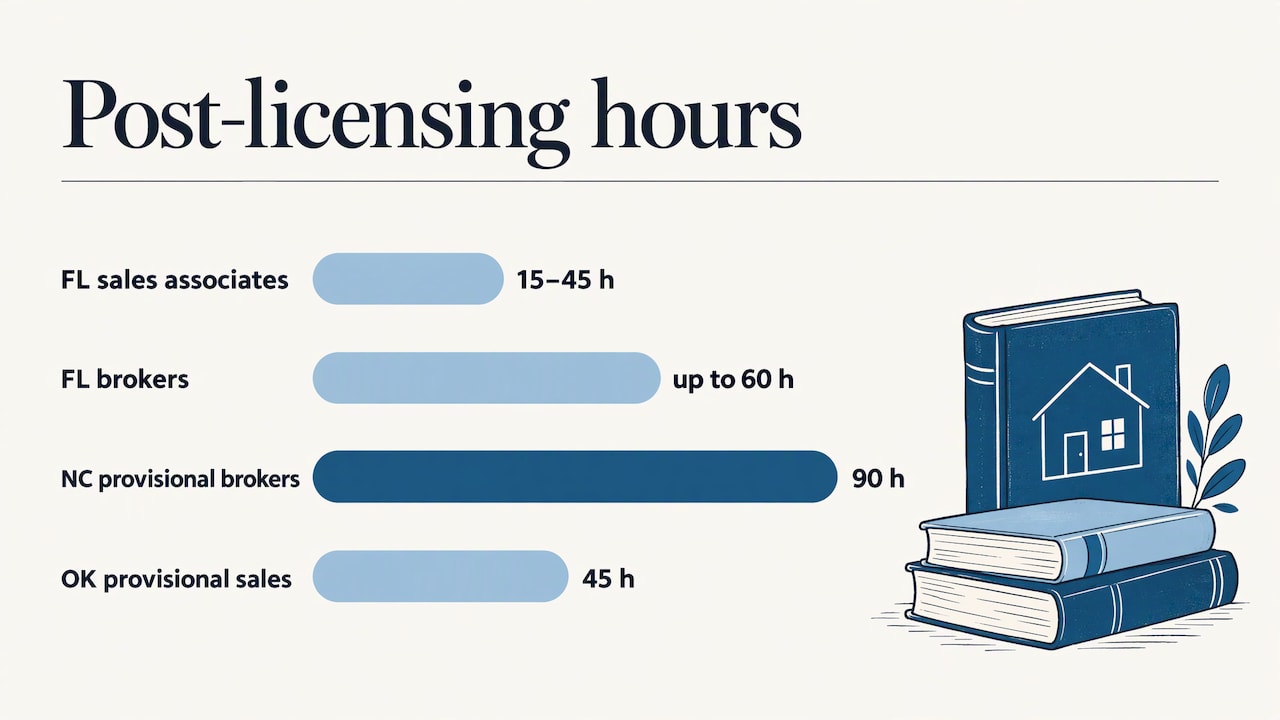
Passing the exam is a milestone, not a finish line. Many states require new licensees to complete more education before the first renewal.
The Connecticut survey found that at least 14 jurisdictions require newly licensed salespersons to complete postlicensing education during the first year. Examples of how much the rules differ:
- Florida: newly licensed sales associates and brokers must complete a commission-prescribed post-licensing course before their first renewal. Sales associates need at least 15 and no more than 45 hours, including examination; brokers no more than 60 hours.
- North Carolina: provisional brokers must complete 90 hours of postlicensing education within 18 months to remove provisional status.
- Oklahoma: a provisional sales associate needs 45 clock hours of approved postlicense education before the first license expiration, and failure prevents renewal.
For Florida licensees, our Florida Sales Associate 45 Hour Post Licensing course is $79, and the Florida Broker 60 Hour Post Licensing course is $149. Compare them on the Florida post-licensing courses page, and read the 60-hour broker post-license requirements if you are a new broker.
Continuing education: keeping either license active
Agents and brokers both renew, and renewal almost always involves continuing education. The details differ by state:
- Pennsylvania: a standard broker renewing a current license needs 14 hours of commission-approved continuing education in the preceding two-year period.
- Michigan: broker licenses renew every three years and require at least 18 clock hours per cycle, including two hours of real estate law and one hour of fair housing each year.
- Minnesota: salespersons generally need 30 hours before the June 30 renewal deadline, and unused extra hours do not carry forward.
- North Carolina: licenses expire June 30 unless renewed, and an inactive broker must stop brokerage activity until reactivated.
The lesson is to check your deadline early. Waiting until the final week leaves no room for a failed course upload or a reporting delay.
Florida licensees can complete the 14-hour requirement with our Florida 14-hour CE course for $23.95. We report completions electronically to the state, so you do not have to chase a paper certificate. For a plain-language overview of how credits work, see our guide to CE credits for realtors.
How agents and brokers get paid
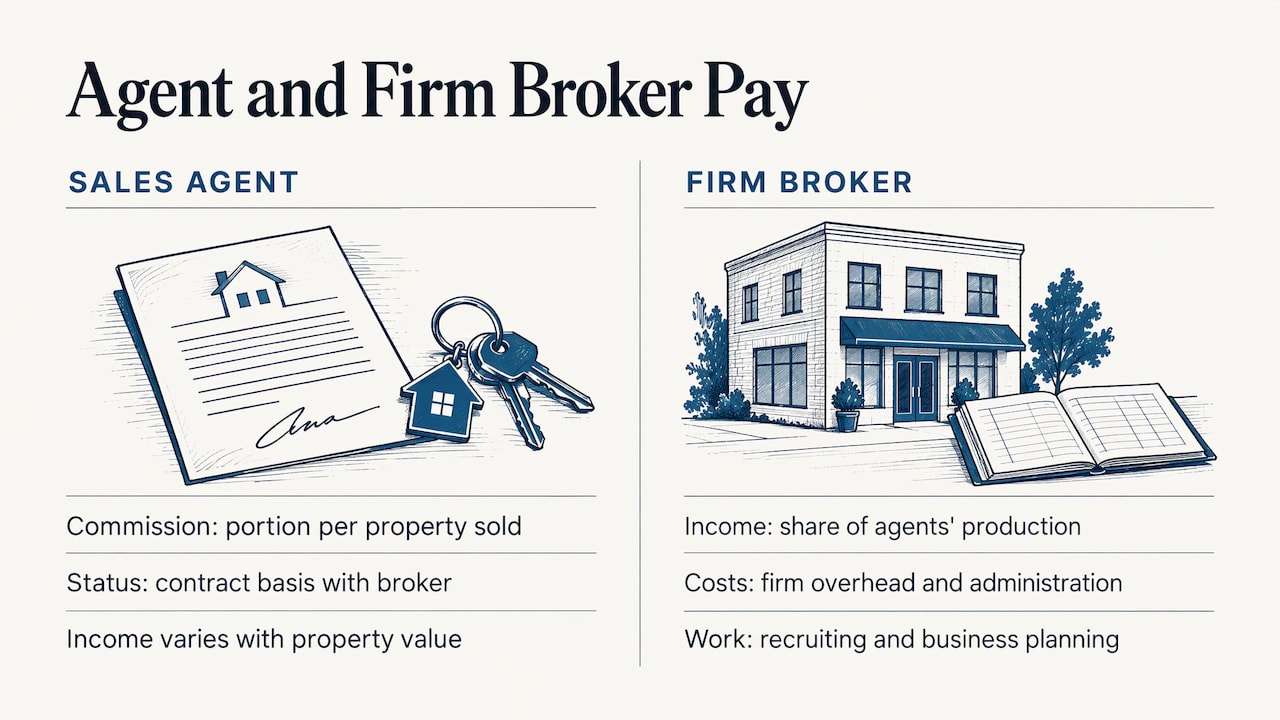
Both roles live on commissions. The BLS says brokers and sales agents earn most of their income from sales commissions, which vary by property type and value and are often divided among the buying agent, selling agent, brokers and firms. It adds that income often depends on economic conditions, individual motivation and available property, and usually rises with experience.
The same source notes that sales agents often work for brokers on a contract basis and earn a portion of the commission from each property sold. The practical result for an agent is a split with the sponsoring broker. For a broker who runs a firm, income can include a share of agents’ production, but also overhead.
That overhead is real. NAR advises prospective brokers to weigh overhead, administration, regulation, business planning, recruiting, marketing and clerical work, and whether they will keep selling personally. A broker license opens the door to ownership, and it comes with a business to manage.
Talking about your fee
Whatever your license, you will be asked what you charge and why. NAR says compensation conversations should account for experience, local knowledge, negotiation skills, time, and clear explanations of services and expectations. A clear listing presentation does a lot of that work, which is why we teach it in our professional development catalog.
Skills that matter at both levels
The BLS names business skills, including managing billing and advertising, as important, along with interpersonal skills, organization and time management, problem-solving and self-motivation. Its list of common duties starts with prospecting, then covers advising on market conditions, marketing properties, negotiating and preparing documents.
A license lets you work. Skills decide how much work you get. A personal site is a practical first step, and this overview of a realtor personal website covers what to build and how to start. Then add lead handling and presentation skills:
- From Lead to Client: Real Estate Lead Conversion ($29) for turning inquiries into signed agreements. See the lead conversion course.
- The Modern Listing Presentation ($29) for winning the listing.
- Building Your Real Estate Personal Brand ($29) and Social Media & Content Marketing for Real Estate ($29) for visibility.
- AI for Real Estate Professionals ($29) and Real Estate Technology & Productivity Toolkit ($29) for saving time.
- Running Better Open Houses ($29) for turning foot traffic into leads.
- International Real Estate Course ($49) if you serve buyers and sellers from other countries.
Brokers building a team will find the same skills useful for training agents.
Our perspective
We see agents and brokers at the same crossroads again and again: the license gets you in, and the education behind it decides how steady your career is.
Compliance courses are not a formality. Pre-licensing, post-licensing and continuing education define what you are allowed to do and for how long. That is why we designed our courses to be state-approved, self-paced and available in English, Spanish and Portuguese, with read-along narration so you can study the way you learn best.
We also report completions electronically, so the paperwork does not become your second job. And because the stakes of a lapsed license are high, every course comes with a 30-day money-back guarantee.
Finally, we believe the best agents and brokers treat the required hours as a base and add business skills on top. Our professional development courses are built for that second layer: clients, listings, marketing and technology.
the author
Take the next step with Merecourses
If you are in Florida, you can finish your required hours and build your business skills in one place. Our state-approved courses are self-paced and online. Each comes with a 30-day money-back guarantee, and completions are reported electronically.
Here is what we offer for each stage:
- Pre-licensing: Sales Associate 63 Hour at $99, Broker 72 Hour at $159.
- Post-licensing: Sales Associate 45 Hour at $79, Broker 60 Hour at $149.
- Continuing education: Florida 14-hour course at $23.95.
See all Florida options on our Florida real estate courses page, or browse the professional development courses to grow your client base.
FAQ
What is the main difference between a real estate agent and a broker?
An agent must work under a broker. A broker is licensed to operate an independent real estate business and may oversee sales agents. The BLS describes their everyday work as similar, with brokers also able to run an office.
Can an agent become a broker?
Yes. Most states ask for about two years of active experience, more education and a broker exam. The exact hours and years depend on your state, so check your regulator’s current requirements.
Do brokers have to take continuing education too?
Yes. States set continuing education for both license types. Pennsylvania, Michigan and North Carolina, for example, each publish broker renewal hours. In Florida, our 14-hour CE course covers the continuing education requirement.
Who is responsible when an agent makes a mistake?
Under Texas rules, the sponsoring broker is responsible for the acts of sponsored agents, including those working from another location. Other states have their own rules, so read your commission’s guidance.
Sources
- Real Estate Brokers and Sales Agents: Occupational Outlook Handbook (BLS)
- Real Estate Brokers and Salespersons consumer fact sheet (Massachusetts)
- Buying and Selling a Home in Texas (TREC)
- Does a broker have to supervise the daily activities of a sales agent? (TREC)
- Broker Standard Licensure Snapshot (Pennsylvania Department of State)
- Real Estate Individual Broker Licensing Guide and FAQ (Michigan LARA)
- Getting a Texas Real Estate License (Texas A&M Real Estate Research Center)
- Back to Basics: How to Become a Broker (NAR)
- Have the Conversation (NAR)
- Real Estate Salesperson and Broker Licensure Requirements (Connecticut OLR)
- Fla. Admin. Code R. 61J2-3.020, Post-licensing education
- What’s Next Once You Receive Your License? (NCREC)
- Okla. Admin. Code 605:10-3-7, Provisional sales associates
- Real Estate Licensing guide (Minnesota Commerce)
- Active versus Inactive License Status (NCREC)
Recommended
- Real Estate License Cost: What You’ll Pay in the U.S.
- Lead Generation for Realtors: What Works and What to Pay For
- Personal Branding for Real Estate Agents: A Practical Guide
- Real Estate Email Marketing: A Practical Guide for Agents
This article is provided for general information and is not a professional advice.