



A real estate business plan turns an income goal into a number of closings, then into the conversations and daily actions that produce them. You can build a working version on one page in about 30 minutes. What matters is that you use it: put it where you will see it and review it every week.
This guide walks you through each part in order, with worked numbers you can replace with your own. It is written for new agents, agents in their first years after licensing, and experienced agents who want a steadier pipeline.
Key Takeaways
- Start from your life and your expenses, not a round number. Work backward from the take-home income you need to the gross commission, closings, appointments and daily outreach.
- A short plan you review beats a long plan you file away. One page covering income goal, transactions, lead sources and weekly actions is enough to start.
- Choose two to five lead sources you can sustain, and put follow-up in the plan, because consistency converts more leads than volume.
- Budget for dues, insurance, technology, marketing, taxes and education before you decide what you can spend on growth.
- Review weekly for 15 to 30 minutes and more deeply each quarter, then adjust the numbers, not just the intentions.
Table of Contents
- What a Real Estate Business Plan Includes
- Step 1: Set an Income Goal That Starts With Your Life
- Step 2: Translate Income Into Closings and Conversations
- Step 3: Choose Lead Sources You Can Sustain
- Step 4: Turn the Plan Into Weekly Activities
- Step 5: Build a Budget and Forecast Cash Flow
- Step 6: Review the Plan on a Schedule
- Our Perspective on Business Planning
- Close the Gaps Your Plan Reveals
- A Sample One-Page Plan Layout
- FAQ
- Sources
What a Real Estate Business Plan Includes
Think of the plan as a set of answers to seven questions. Different teams and trainers label the parts differently, but a practical agent plan, such as the seven-part structure published by RealAnalytica, covers goals, your reason for doing this, your market, strengths and weaknesses, lead sources, budget, and activity with review.
Here is the same idea in plain terms:
- Goal: how much you want to take home this year, and the gross commission that requires.
- Why: one or two sentences on what the money is for.
- Market: the area, price range and client type you will focus on.
- Strengths and gaps: what you do well, what costs you deals, and what skill to build next.
- Lead sources: where your next clients will come from.
- Budget: what the business costs to run.
- Activities and review: the weekly actions and the schedule on which you check them.
Some agents use a more structured framework. The Millionaire Real Estate Agent model, for example, organizes planning around an economic model, a lead generation model, a budget model and an organizational model. You do not need all of that on day one. A new agent can start with the seven questions above and add structure as the business grows.
One warning from experience: a plan that runs to dozens of pages tends to be written once and never opened. Keep the most important elements on a single page and make the activities clear rather than long.
Step 1: Set an Income Goal That Starts With Your Life
Begin with what your household actually needs. Write down what you need each month, what you want to save and what you want to pay off. Then add one or two sentences about why that money matters. That sentence will help you more in a slow month than a vague wish to make more money.
Next, calculate your costs. Inman’s agent planning guide suggests adding up two lists, then annualizing them:
- Personal monthly expenses: mortgage or rent, car, insurance, food, utilities, childcare and health insurance.
- Business monthly expenses: MLS dues, board dues, CRM, marketing, signage, errors and omissions coverage, lead generation platforms and transaction fees.
The total is your baseline. From there, work out the true income goal: the take-home amount you want, plus taxes, broker splits and fees, which gives the gross income you must earn. Ask your CPA about the tax piece. Self-employed agents are generally responsible for their own estimated taxes, and the right set-aside depends on your situation.
Finally, set the goal in a form you can track. SMART goals (specific, measurable, achievable, relevant, time-bound) help you see progress and follow through.
Step 2: Translate Income Into Closings and Conversations
This is the step that makes the plan real. You convert a dollar goal into a count of transactions, and a count of transactions into a count of conversations.
Start with how a commission actually reaches you. RealAnalytica’s example uses a $400,000 average price at a 2.5% commission, which is $10,000 gross commission income (GCI) per side. On an 80/20 split with the broker, the agent keeps $8,000, and after a $500 per-closing fee takes home $7,500.
Now run your own version of that math. Suppose, for illustration only, that you want to take home $75,000 before personal taxes and your net per closing is $7,500:
| Step | Calculation | Result |
|---|---|---|
| Take-home per closing | $10,000 GCI, 80/20 split, $500 fee | $7,500 |
| Closings needed | $75,000 ÷ $7,500 | 10 closings |
| Closings per month | 10 ÷ 12 | About 1 every 5 weeks |
| Leads needed | 10 closings at a 1-in-10 lead conversion (your own rate may differ) | 100 leads |
The conversion rate in the last row is a placeholder. Use your own numbers once you have a few months of tracking, and update the table. The same chain continues downward: average professional fee, transactions needed, appointments required, conversations needed, and daily reach-outs required.
If you are new and have no history, use conservative estimates and treat your first quarter as data collection. Your plan is a forecast, and it improves each time you replace a guess with a real number.
Step 3: Choose Lead Sources You Can Sustain
Most agents lose momentum from trying to be everywhere. Pick two or three marketing channels you are good at using and commit to a simple schedule for them. Choosing three to five reliable lead sources is a reasonable range. Typical sources include your sphere of influence, past clients, referrals, open houses, social media and online lead platforms. For each one, estimate how many leads it should produce and assign yourself (or a teammate) as the owner.
Where the leads come from matters. According to a summary of NAR’s 2026 Member Profile, the typical member attributed 28% of 2025 business to repeat clients and 22% to past-client referrals, and 69% received no business from paid third-party lead generation. That points to relationships as the foundation of a plan, with paid sources as an add-on.
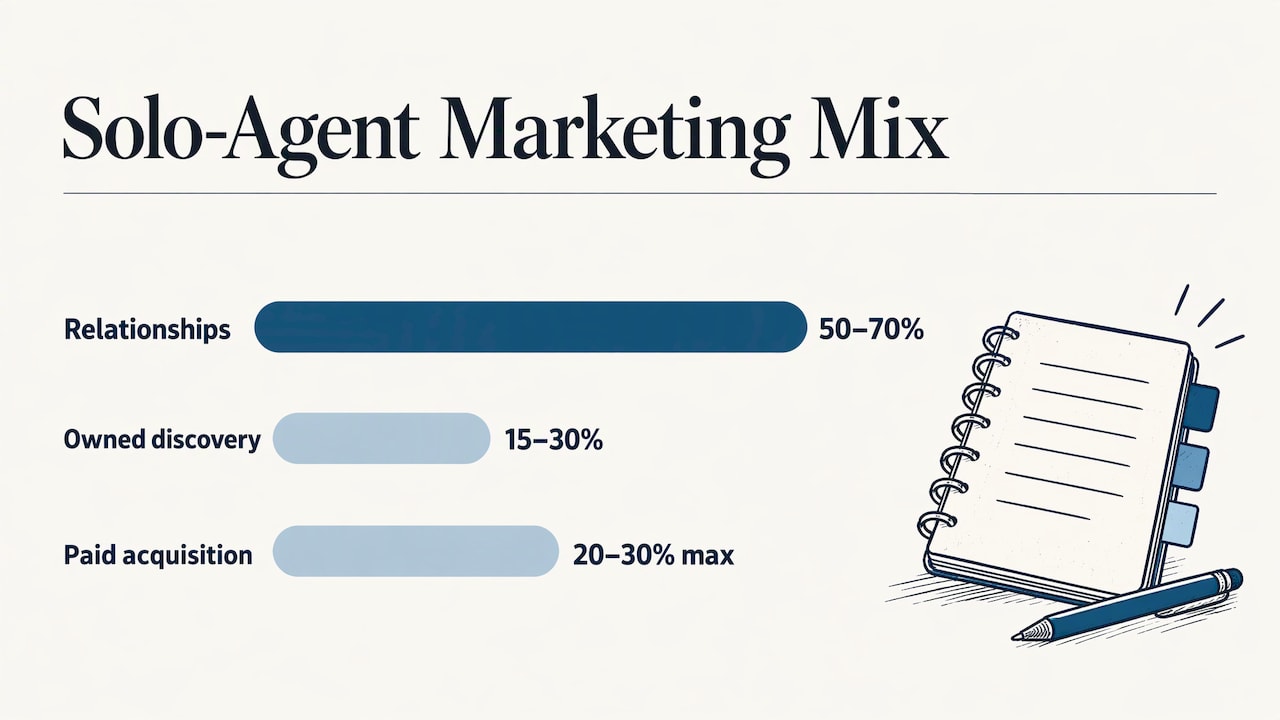
The same source suggests a rough portfolio for a solo agent: 50 to 70% relationship and community activity, 15 to 30% owned discovery such as a Google Business Profile, website and video, and no more than 20 to 30% on experimental paid acquisition until you can show what it produces. Treat that as a starting allocation and adjust it to your results.
If you want a deeper look at which sources deserve money, read our guide on lead generation for realtors. If email is one of your channels, our practical guide to real estate email marketing covers how to set it up.
Build a Referral and Past-Client System
Because past clients and referrals carry so much business, give them a place in the plan. Two structures from agent coaching are worth borrowing:
- A Top 50 list. Inman describes listing clients, referral partners and friends, grading them from top advocates to fading connections, updating the list monthly, and planning specific contact throughout the year.
- Three lanes. A database system separates people ready to transact now, people six to twelve months out, and past clients and long-term prospects. Each lane gets a different rhythm of contact.
Pick one, write the rhythm into your plan, and keep it simple enough that you will really do it.
Step 4: Turn the Plan Into Weekly Activities
A goal without activities is a wish. Define three to five daily and weekly activities that directly drive lead generation, follow-up and conversion. Examples include a set number of prospecting calls, following up with every lead within 24 hours, one open house a week, regular social content and a weekly team huddle if you work with others.
Follow-up deserves its own line in the plan. According to HousingWire, the agents who convert the most leads are the ones who follow up on the leads they have, not the ones who receive the most.
If you want a daily structure, one option is a 5×5 momentum routine: five conversations, five personal texts, five direct messages, five personal emails and five thoughtful social comments, with a 30-minute Sunday review of what produced conversations. That is 25 touches a day, which may be too much for a part-time agent. Scale it to your hours, and keep the review.
Two skills sit behind these activities. The first is turning a lead into a client; our lead conversion course is built around that step. The second is time management; see our guide to agent productivity.
Step 5: Build a Budget and Forecast Cash Flow
Commission income arrives in lumps, and expenses arrive on schedule. Your plan should show both. Start with the annual income goal, then work backward to the closings, the average commission and the amounts to set aside for expenses, taxes and savings.
List your recurring costs. The Close lists typical categories: marketing and advertising, lead generation, office supplies and equipment, transportation, professional development, dues and memberships such as MLS fees and association dues, insurance such as errors and omissions and general liability, and taxes and licenses.
Two practical habits help:
- Separate the money by purpose. When a commission check arrives, move a set share to taxes and a set share to savings before you spend any of it.
- Build a cushion for slow months. If your plan assumes one closing every five weeks, some months will have none. Know how many months of expenses you can cover.
Do not forget education. License renewal and skill-building are line items too. In Florida, our course prices are published openly: the 14-hour continuing education course is $23.95, and our professional development courses start at $29 each. Put those costs in the budget so they are never a surprise. For your current requirements, confirm them with your state regulator.
Before you commit money to an investment or a new market, run the numbers first. Some agents use real estate deal analysis tools to compare opportunities against the goals in their plan.
Step 6: Review the Plan on a Schedule
A plan that is not reviewed turns into a document. Build the review into your calendar:
- Weekly, 15 to 30 minutes. Check your numbers: conversations held, follow-ups completed, appointments set. One recommended routine is a 15-minute Friday check-in. A fuller version covers schedule, lead-generation activity, conversations, follow-up, tracking and life priorities.
- Quarterly, one to two hours. Compare closings and income against the plan. Decide which lead sources to expand and which to drop, and update your conversion numbers.
- Annually. Reset your goal, revisit your budget and choose the skill you will build next year.
Keep the plan visible. A common mistake is leaving the plan in a drawer. Post the one-page version at your desk, use visual cues and celebrate milestones. A milestone is not a finish line, and it is worth marking.
Our Perspective on Business Planning
We see the same pattern with agents who enroll with us. They finish licensing, and the plan they need next is not a bigger document. It is a clearer one.
The courses that satisfy state requirements keep you compliant, and compliance is the first piece of any plan. Your license is the asset the rest of your business stands on. That is why we put licensing, post-licensing and continuing education costs into the budget from the start, and why we report completions electronically, so one more thing is off your weekly list.
The second piece is skill. If your plan shows that leads are not turning into clients, or that your marketing does not reflect who you are, that points to a specific course, not more hours of busywork. Our professional development courses are built around exactly those gaps: lead conversion, personal branding, listing presentations, technology and marketing.
We also built our courses to be self-paced, in English, Spanish and Portuguese, with read-along narration, because agents serve diverse clients and have unpredictable schedules. We designed it so you can study between showings and keep the plan moving.
the author
Close the Gaps Your Plan Reveals
A good plan shows you what to learn next. If your numbers show weak conversion, a thin brand or a listing presentation that does not win, you can fix those with focused training. Our Real Estate Business Builder Package bundles business skills courses for agents who want to build the business side. For a single skill, our personal branding course is $29.

If you are a Florida agent, you can handle licensing and growth in one place. Pre-licensing starts at $99 for the Sales Associate 63-hour course, and post-licensing for sales associates is $79 for the 45-hour course. Every course carries a 30-day money-back guarantee. See Florida courses and pricing or browse professional development courses.
A Sample One-Page Plan Layout
If you want a starting layout, copy this outline and fill it in:
- Income goal: take-home amount, gross commission required, and one sentence on why.
- Transactions: closings per year, per quarter and per month, with your average net per closing.
- Market and niche: area, price range, client type.
- Lead sources: three to five, with expected leads and an owner for each.
- Weekly activities: three to five actions with numbers (calls, follow-ups, open houses, posts).
- Budget: monthly and annual costs, tax set-aside, education.
- Skill to build: the one gap your numbers revealed.
- Review dates: your weekly slot and your next quarterly review.
Fill in the parts you know today. A rough plan used for three months is worth more than a polished plan you never open.
FAQ
How long should a real estate business plan be?
One page is enough to start. Cover your income goal, closings needed, lead sources and weekly actions. Add detail only if you will use it, because a short plan is far more likely to be reviewed.
How do I make a business plan if I have no clients yet?
Start with your expenses and income goal, then use conservative conversion estimates. Build your sphere of influence list first, since past clients and referrals are a major source of business for the typical agent. Treat the first quarter as a test and replace estimates with real numbers.
How often should I review my plan?
Review it weekly for 15 to 30 minutes to check your activity and numbers, and more deeply each quarter. The weekly review keeps small problems from becoming missed quarters.
Should I spend money on paid leads?
Only after you have a relationship-based foundation. NAR’s 2026 member data, as summarized by one lead generation resource, shows most members got no business from paid third-party leads. If you try paid sources, cap the share of your budget and track results.
Sources
- Free template and step-by-step real estate business plan, RealAnalytica
- Setting up for success: real estate business planning, KW Outfront Magazine
- Texas real estate agent business planning and goal setting, Omnia Elevate
- The ultimate real estate agent business plan for 2026, Inman
- 8 steps to creating a real estate business plan, HousingWire
- 7 steps to writing a real estate business plan, The Close
- The 60-deal-a-year referral-based blueprint, Inman
- How to get off the feast-or-famine roller coaster, Inman
- How Realtors generate leads in 2025 to 2026, SixPL
- 30-minute real estate business plan template, realtor.com PRO
- Reidy.ai
Recommended
- Agent Productivity: How Real Estate Agents Get More Done
- Lead Generation for Realtors: What Works and What to Pay For
- Real Estate Email Marketing: A Practical Guide for Agents
- Real Estate Personal Branding Course
This article is provided for general information and is not a professional advice.